Dazed and confused? Not me. I’m just Lost in the Cheese Aisle.

Wednesday, August 24, 2016

ON THE HALF-SOUR PICKLE AS A SOURCE OF CREATIVE INSPIRATION


Half-sour pickles. Image: Pickle Licious.

Today I was breakfasting at the Local Bagel and Smoked Fish Emporium (as is my occasional practice) with Dee and the Mistress of Sarcasm (a less occasional practice, but much more delightful).

As the servitor took our order, I asked her, “Does that come with a pickle?” She assured me that it did, and I asked her, in turn, to deliver unto me a nice, crisp, bright green half-sour pickle.

For I am a fan of the half-sour pickle. If you are fortunate, you may live in an area where this style of pickle is available - sometimes in jars, sometimes in vats, always refrigerated. The ideal half-sour pickle is bright green, with a pronounced crunch. As half-sours age, their green becomes dull as they soften into the garlicky kosher sour pickles many folks love. But I likes ’em young and crisp.

But this post was not intended to be a disquisition on the half-sour pickle. It’s more an observation on my twisted mind...

...because no sooner had the servitor walked away than I suddenly had an image in my head, a picture of Ebenezer Scrooge from the conclusion of A Christmas Carol, the scene where our repentant and newly Christmas-observant protagonist looks out the window and, seeing a boy on the street below, promptly sends him on an errand to procure an enormous prize-winning turkey, the which to send to miserable, humble Bob Cratchit as an unexpected Christmas gift. Only in my head, it was no turkey. It was an enormous half-sour pickle.

I related this vision to Dee and my daughter, who - almost simultaneously - began to hum the familiar strains to “Entrance of the Gladiators,” a bit of music that you may know as “that dopey circus music you usually hear played on a steam calliope when the clowns rush in.”

Yeah, I know. I’m more than just a little nutty sometimes. (OK, most times.) The Mistress said it best several months ago. During an earlier visit this year, as the three of us were taking a lengthy walk along one of the thoroughfares near the neighborhood, I asked Dee to pose in front of the T-Mobile store.

“Why do you want a picture of me in front of the T-Mobile store?” she asked... a perfectly reasonable question.

“Because I want to caption it “La Donna è T-Mobile.”

Of course Dee refused, but when the Mistress overheard this little exchange, her comment was, “What’s it like in there?” She was referring, of course, to my noggin.

Well, now we know what it looks like in there... but it’s still a bit hard to explain what’s going on in there.

As for that Christmas Carol story - the very thought of which so bemused my wife and daughter - I am happy to present it below. I call it...

A Shabbes Carol

“What’s to-day?” cried Scrooge, calling downward to a boy in school clothes, who perhaps had loitered in to look about him.

“Eh?” returned the boy, with all his might of wonder.

“What’s to-day, my fine fellow?” said Scrooge.

“To-day?” replied the boy. “Why, Friday.”

“It’s Friday - Erev Shabbes!” said Scrooge to himself. “I haven’t missed it. The Dybbuks have done it all in one night. They can do anything they like. Of course they can. Of course they can. Hallo, my fine fellow!”

“Hallo!” returned the boy.

“Do you know the Delicatessen, in the next street but one, at the corner?” Scrooge inquired.

“I should hope I did,” replied the lad.

“An intelligent boy!” said Scrooge. “A remarkable boy! Do you know whether they’ve sold the huge half-sour pickle that was in the barrel there - Not those little dill pickles: the big crisp green half-sour?”

“What, the one as big as a certain part of Ron Jeremy?” returned the boy.

“What a delightful boy!” said Scrooge. “It’s a pleasure to talk to him. Yes, my buck.”

“It’s floating there now,” replied the boy.

“Is it?” said Scrooge. “Go and buy it.”

“Gevalt!” exclaimed the boy.

“No, no,” said Scrooge, “I am in earnest. Go and buy it, and tell them to bring it here, that I may give them the direction where to take it. Come back with that great green warty bastard, and I’ll give you a shilling. Come back with it in less than five minutes and I’ll give you half-a-crown.”

The boy was off like a shot. He must have had a steady hand at a trigger who could have got a shot off half so fast.

“I’ll send it to Bob Cratchit’s!” whispered Scrooge, rubbing his hands, and splitting with a laugh. “He shan’t know who sends it. It’s twice the size of Tiny Tim...”

Monday, August 22, 2016

A PECUNIARY NIGHTMARE

Nowadays, as chip cards become more commonplace, we find ourselves having to shove our money cards into the readers rather than performing the more familiar swiping of the magnetic strip. To help keep things straight, I propose the two alternatives be labeled “stick it” (for the chip cards) or “flick it” for non-chip-enabled cards and/or readers. Stick it or flick it!

And because I am a helpful soul, I have composed this catchy little piece of doggerel to help you remember... 

In stores, when you pay with your Credit Card,
How do you do it? It’s not too hard –
If you have a chip, then you must stick it
If you don’t have a chip, then you must flick it
Stick it or flick it – the choice ain’t hard
That’s how you handle your Credit Card!

CHORUS
Stick it or flick it – the choice ain’t hard
That’s how you handle your Credit Card!

[Apologies to Isaac Bromley, Noah Brooks, W. C. Wyckoff, Moses W. Handy, and (more familiarly) Mark Twain (“A Literary Nightmare,” q.v.), and the Punch Brothers.]

YOGI BARE-CHINMOY: A 100-WORD MEDITATION

Practitioners of yoga are familiar with shavasana, also known as the corpse pose. It is a posture that involves 20-30 minutes of relaxation in supine position, arms splayed at a 45° angle.

Guru Yogi Bare-Chinmoy takes it one step further with his unique burmashavasana, a pose in which the practitioner lies supine and gets a nice smooth shave while releasing all muscular tension. His school has become extremely popular in part due to word-of-mouth publicity, but also because of his unique advertisements posted on local highways:

The Downward Dog
Is one cool move
But yogis like
Their faces smooth
Burma-Shavasana

[inspired by a comment on Facebook]

ANOTHER McSWEENEY’S REJECTION, ALAS

Just because McSweeney’s didn’t go for it doesn’t mean I can’t make you suffer, Esteemed Readers. And thus, herewith I present my latest Lists Column rejection...

WORDS THAT GO TOGETHER WELL, IN APPROXIMATE SERIATIM RANKING.

1. Horse. Feathers.
2. Cannon. Ball.
3. Peanut. Butter.
4. Buffalo. Wings.
5. Bubble. Bath.
6. Ma. Michelle.
7. Bung. Hole.
8. Scary. Clown.
9. Elmer. Fudd.

Wednesday, August 17, 2016

THE SCHOLARLY SWINE: A 100-WORD ABSTRACT


[Photo courtesy of Jerry Wiley.]

Back when I was a student at a certain university in central New Jersey, one of my colleagues in the Chemical Engineering department kept a pet pig.

We had known that pigs had a reputation for being smart beasts, but this one was exceptional. His owner Neil taught him to use a specially modified keyboard, and after only one semester he was actually able to ace problem sets in thermo and quantum mechanics. I thought it was funny… until the damned pig got better grades in high-energy physics than me. Asshole.

What did we call him? Neil’s Boar, of course.

Saturday, August 13, 2016

DAY OF MOURNING

Happy Tisha b’Av!
A completely inappropriate holiday greeting. [Of course this is not a real sign - it was made with the help of the infamous Church Sign Generator.]

O day of mourning, Tisha b’Av
It’s not a holiday we love

For nine days we’ve refrained from meat
Today, no leather on our feet
We do not drink; we do not eat
(A beefsteak would be indiscreet)

O day of mourning, Tisha b’Av
It’s not a holiday we love

We think of death and of the grave
We do not wash ourselves or shave
If one is a religious Jew
One will not try to cop a screw

We sit upon the floor at night
Chant elegies by candlelight
Recalling tragedies of yore
(That’s why we’re sitting on the floor)

A grunt or nod, but no “Good Day”
When next we trudge to shul to pray
That mankind’s hatred disappear
(A prayer that falls upon deaf ear)

O day of mourning, Tisha b’Av
It’s not a holiday we love

[Reposted from Tisha b’Av 2014. This most solemn day of Jewish observance marks the destruction of the Second Temple in Jerusalem in 70 C.E. It begins at sundown August 13 and is marked by the reading of the Book of Lamentations and with a 25-hour fast.] 

Tuesday, August 9, 2016

BINGO NIGHT

Be pleasant to the Elderly
And do not call them names,
Like “Silverback,“ or “Stinky Pee,”
Or, likewise, “Grandpa James,”
Or “Toothless Grin,” or “Q-Tip Dude,”
Or, “Old Replacèd Knees”:
The Elderly are sensitive to epithets like these.

There’s nobody will more repay
A treatment kind and fair:
At least, so lonely people say
Who know Old Folks, and, by the way
They are extremely rare.

[apologies to Hilaire Belloc]

Yesterday evening Dee and I repaired to one of the local Independent Living places to help one of our friends run the Monday Evening Bingo game.

“Friend” is really too mild a word for Chelo, who is the mother of a dear friend of ours. She’s more like an adoptive Mom, for which reason we call her “Mamacita.” A sweeter lady is hard to find, and her disposition, general attitude, and earthy sense of humor are not necessarily what you’d expect from someone who has made Piano Keys.

Going to the Independent Living environment is entertaining in and of itself. This is a self-contained place with nowhere near the immensity and geographical footprint of, say, The Villages, but it is nevertheless possible to venture a few social observations. For example: There are two types of people that predominate in any large gathering of Senior Citizens - the sweet and the cranky. It tends, always, toward a bimodal distribution with nobody in between. You’re either one or the other.

Another observation: People retain their ability to surprise. Octogenarians - like the lady with whom we shared our dinner table - will do things like jump out of airplanes. Nonagenarians will kick your ass at Scrabble.

Bingo never fails to please. The last time Dee and I helped run a Bingo game was over twenty-five years ago at our synagogue in Connecticut, where people took the game extremely seriously. I’m talking about people who would come decked out with an array of stamps, lucky tokens, statuettes, you name it. This place was sedate by comparison.

We would pull the numbers out of an air-stirred tank of ping-pong balls and Chelo would announce them, one by one, until someone hit their BINGO! Then we would check off the card and pay the winner(s). Not exactly World Series of Poker-levels of suspense, but it was a room full of people enjoying the evening together... and we were glad to be a part of it.

And especially with Chelo... our Mamacita, mi quérida.

OASIS: A 100-WORD STORY


Abdullah was parched.

Hardly surprising, that. The endless dunes of the Hizaj were among the most arid places on Earth. Careful rationing had stretched Abdullah’s thin supplies... but his camels were a considerable additional water burden.

“In the name of Allah, most merciful!” he intoned thankfully when he saw the oasis in the far distance. But his joy turned to horror on arriving: Not one drop of water was to be found there.

“We got Coke, Dr Pepper, Seven-Up, Cheerwine, Moxie, and Doctor Brown’s Celray Tonic!” advised the counterman.

“What hellish place is this?” croaked Abdullah.

“Welcome to Sody Arabia.”

Saturday, August 6, 2016

NIETZSCHE? PEACHY

A bit of sage philosophy
That, like as not, is true:
When you stare into the dark abyss
It stares right back at you

And if you piss in that abyss
You'd better watch out, Mac
’Cause sure as death and taxes
It’ll piss on you right back

S’CHUG, or
PUTTING THE “SHOCK” IN SHAKSHUKA

Many of my Esteemed Readers will be unfamiliar with shakshuka, a Middle Eastern egg dish that is nevertheless growing in popularity here in the States. It’s a staple in Israel, where it has become a ubiquitous offering at hotel breakfasts (because eggs!) as well as a beloved evening meal.

Relatively easy to make, shakshuka consists simply of eggs poached in a simmering sauce of tomatoes, chili peppers, and onion. There are variations aplenty, depending on what else you might throw into the pan: cheese, beans, you name it. The dish is usually served right out of the deep skillet in which it is prepared.

My experience with shakshuka is mostly limited to the visit we made to Israel four years ago... and that’s strange, because it’s really damned tasty. I may have to whip up a batch at home...

...especially because I just made a pile of the perfect condiment to accompany it: s’chug.

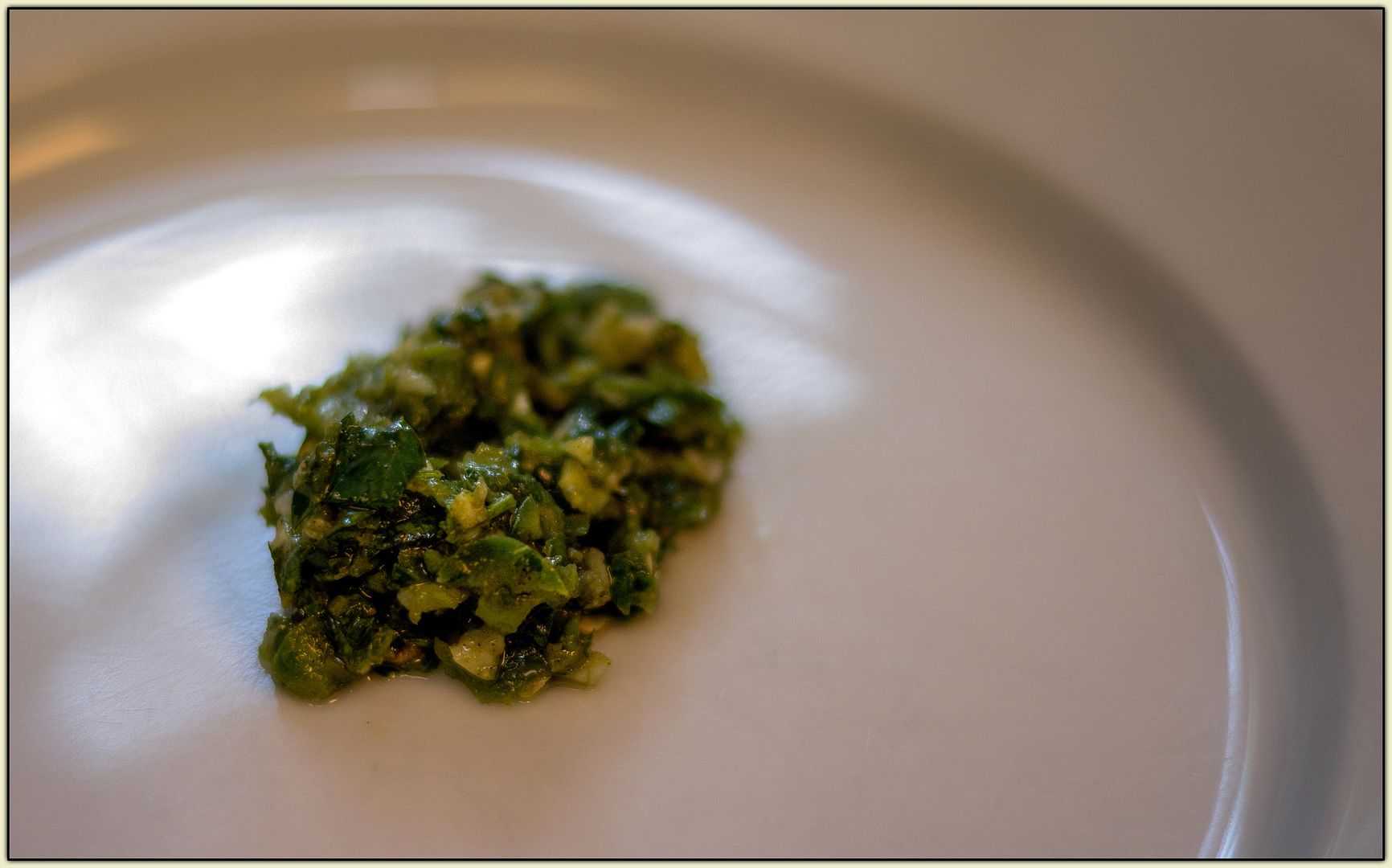
WTF is s’chug? you ask. Variously spelled סחוג, schüg, skhug, shoug, or zhug, it’s a Yemenite concoction of chili peppers, parsley, cilantro, garlic, and spices that goes really well with shakshuka and other Middle Eastern goodies like hummus. You can find it in some Middle Eastern groceries - Sabra (the hummus guys) make a really good one that is available in both both red and green versions. Think of it as the Yemenite version of Morocco’s harissa.

I’ve had a little trouble sourcing my s’chug lately, since the nearby Persian grocery that used to stock it no longer carries it. But that’s no problem, since it’s easy and economical to make my own... especially since one of the Minyan Ladies gifted me with a whole sackful of fresh home-grown jalapeños from her garden. (Fresno or Serrano peppers would also work just fine.)


Homemade s’chug: the perfect way to use a whole lotta jalapeños. This stuff will grow hair on your chest... and possibly your tongue.

Here’s the recipe I used - it’s from Michael Solomonov’s brilliant cookbook Zahav: A World of Israeli Cooking.

20 Serrano (or Fresno or jalapeño) peppers, stems removed
1 cup fresh parsley leaves
1 cup fresh cilantro leaves
4 garlic cloves, peeled
Juice of one lemon
1 Tbsp ground coriander
1 Tbsp ground cardamom
1 cup vegetable oil (I used about half that amount)

Take the peppers, parsley, cilantro, garlic, lemon juice, coriander, and cardamom and pulse in a food processor until you get a coarse paste. Scrape into a bowl and drizzle in the oil. Keeps for up to one month tightly sealed and refrigerated.

[Another recipe - from Saveur magazine - is here. ]

Is this stuff piquant?

Aw, hells, yes. It’s ridiculously spicy, and yet it doesn’t overwhelm. Packed with flavor, s’chug will put the shock in your shakshuka.

I’m going to try it out with an omelet. Pray for me, dear readers... and for my kishkes.

Postscriptum: Hot as a bastard, but delicious with that omelet. Next up: hummus!

Tuesday, August 2, 2016

ROAD GAMES


Rhymes with Orange, July 24, 2016. ©2016 King Features Syndicate.

The above cartoon by Hilary B. Price reminded me of the numerous times Dee and I - and the girls, back when we were younger - would play the License Plate Game whenever we went on long road trips.

It’s pretty simple, really. All you do is keep track of the various license plates you see during your journey. The only rule is that the vehicle must be a passenger vehicle: plates spotted on trucks are not eligible. Once you complete your trip, you can start all over again. My only gripe? Getting that Hawaii plate is a solid-gold bitch.

There are other Vehicular Amusements too. Another favorite is the Alphabet Game, which is nothing more than spotting signs that contain words beginning with the letters of the alphabet - in sequence. Once you get to the end of the alphabet, you simply start over.

The rules are uncomplicated for this game, too. Signs cannot be affixed to a vehicle, and the words cannot be acronyms or abbreviations. Good eyesight is a sine qua non for playing this game well.

Just as Hawaii license plates are thin on the ground here in the continental United States, so are signs bearing words beginning with the letter “X.” When we lived in Connecticut, we could always rely on a prominent sign in Bridgeport that identified one of the Xerox Corporation’s major outposts, but most places, you’re pretty much out of luck finding that X. You therefore must be willing to put up with a modest degree of frustration when you are a serious Alphabet Game player.

Another Roady Amusement is Green Room, a game that has the distinct disadvantage that it can only be played when there are people present who have never played Green Room before. This is because the sole point is to figure out how to get into the Green Room: Once you do, the game is over - for you, anyway. And despite its not being complicated, even adults can take a maddeningly long time to get it, depending on how their brains are wired. (You want to know how to play? Drop me a comment or an e-mail and I’ll give you a few clues.)

What dopey Road Games do you like? And do you still play ’em? We do!

Monday, August 1, 2016

A FAMILY HEIRLOOM GETS A NEW LIFE

Once upon a time, Dee had a widowed grandmother who lived in a modest little house in Foat Wuth, Texas. It was a house built by the work of her hands, paid for with the income from her lifelong work as a seamstress. What it may have lacked in size it made up for in years of family memories.

Nanny lived in that house until a dramatic decline in her health around Thanksgiving of 1987, when she was rendered insensate by the double whammy of a simultaneous heart attack and stroke. We wouldn’t have given odds on her surviving the week, but Nanny was a tough old bird who managed to hang on for over four years, even outliving my own mother.

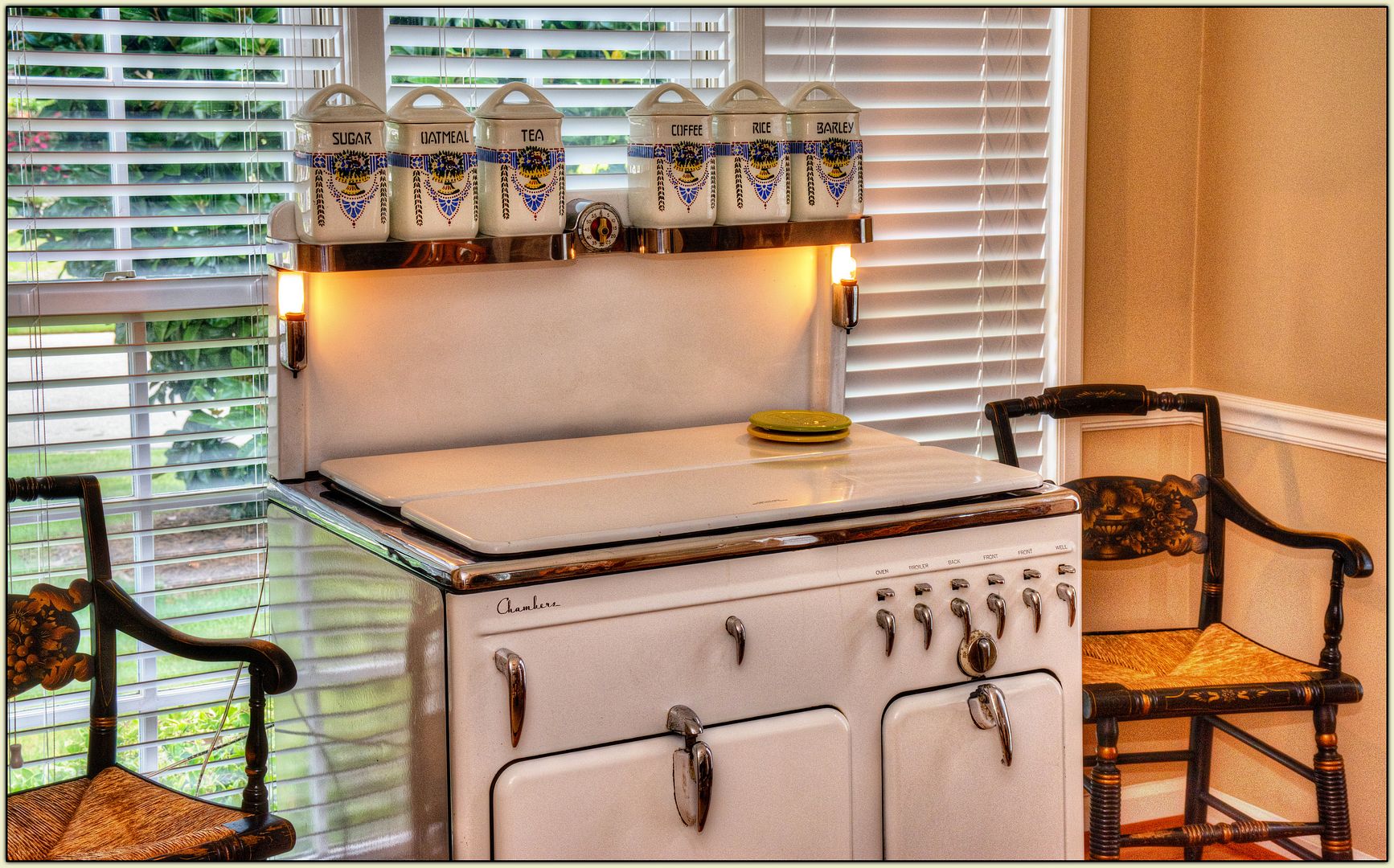
Among the furnishings she left behind was a 1946 Chambers B-Model gas stove. We arranged to have it shipped to our home in Houston, and eventually it found its way to Atlanta with us, where it has resided ingloriously in our basement for the past eighteen years.

A few days ago, Dee had a decorating brainstorm. We had just converted our sunroom into a casual dining room, and there was an empty space near the eastern windows that cried out to be filled. What about the old Chambers stove? she suggested.

Her idea put me in a bit of a quandary. On the one hand, the old stove would be perfect for the place she had in mind for it, and with a little elbow grease and cleanser it would look good as (almost) new. Not bad for a seventy-year-old appliance. But on the other hand, I knew that it would be a serious job of work to schlep that massive stove up from the basement. We were talking about a massive chunk of cast iron and porcelain weighing something on the order of four hundred pounds.

And we did it.

Aside from Dee, credit goes to Gym Jim, my personal trainer, and to Home Depot - the former for extra muscles to supplement mine, the latter for the strap dolly we used to horse the damned thing up our front steps. (We dodged the need to go up the basement stairs by rolling it outside at ground level, across the side yard and out to the street.)

Once we got that big boy settled in its spot, we had to partially dismantle it to replace the old wiring for the lamps on either side of the backsplash: The old wiring’s insulation had literally crumbled with age. As soon as the everything was reassembled and new bulbs installed, we plugged it in. Success!


The Family Heirloom: a 1946 Chambers B-Model gas stove. The canisters were handed down from Dee’s great-grandmother and sat atop that selfsame stove back when it belonged to her Nanny.

No, we have no plans to hook this baby up to the gas supply. But it would be a formidable appliance were we to do so. It has three surface burners plus a deep well burner for slow-cooking soups, sauces, and stews; it also has a built-in griddle. And man, is it solid. They really don’t make household appliances this substantial any more.

I’m not entirely sure that this was a coincidence, but the day after we put the Chambers stove in its new upstairs home was the forty-first Yahrzeit of Dee’s sister. After remembering Polly at morning Minyan, we and a group of good friends came back to our house for a special breakfast - a breakfast in the presence of Nanny’s old stove. Polly had known that stove well - it was the source of so many of Nanny’s family dinners all those decades ago. I like to think that she was looking down upon us from her residence in the World to Come and getting a little bit of nostalgic joy from seeing it again - a Family Heirloom sculpted in cast iron and porcelain.

Sunday, July 31, 2016

CLAPPTRAPP

D’oh - a word that Homer says
Ray - a blind musician guy
Me - A T and you’ve got meat
Fa - some European soap
So - another word for “thus”
La - a part of “tra-la-la”
Tee - a little wooden peg
That will bring us back to D’oh...

[apologies, albeit insincere, to Rodgers and Hammerstein]

Monday, July 25, 2016

A PEEK UNDER THE HOOD

A few weeks ago, I made note of my having had my head examined - specifically, an MRI imaging of the Elissonian Noggin, in order to uncover the source of certain mysterious, ahh, discomfort that I call The Bear. (Discomfort being a nice way of describing the sensation of suddenly having a hot ice pick shoved into your jaw.)

Well, there’s always a Good News/Bad News aspect of this sort of Voyage of Discovery. The good news is that my problem is not structural - no weird malformations, no tumors, nothing that isn’t where it’s supposed to be. The bad news is, it’s almost certainly a condition that I will have to live with, since it’s One Of Those Things That Never Fucking Goes Away Permanently. But there is more good news, and that is that there are medications to treat it that usually work. Hooray for me!

Looking at your Skull-Innards, though... that’s an experience that encapsulates both good news and bad news all within itself. On the one hand, it’s nice to know that there actually is a brain stuffed into my often seemingly empty noggin: I always envision the neurologist shining a penlight into one ear and having the beam pass right through to the other. On the other hand, there’s something weirdly recursive about looking at your own Thinky-Meat. It’s like seeing your True Essence in a mirror, a view most of us are not quite prepared for.

An MRI, for those who haven’t had the pleasure, is an imaging technology that allows you to look at thin sections of your body without the inconvenience and discomfort of strapping you to a deli meat slicer. As we looked at the computer screen in the neurologist’s office - look, there’s the base of your spinal cord! - there’s your cerebellum! - I wondered whether I had lived down South long enough to have grown an antebellum. And I was pleased to hear the doctor say, “Your brain looks really good for someone your age.” That is, of course, a left-handed compliment, yet I was happy to hear it despite thinking, “It may look good, but it works like a chunk of Emmenthal’s finest.” Her comment reminded me of an old cartoon I had seen years ago, from the Princeton Tiger, our campus humor magazine:

So for those who can stand to look, I present below the Brainpan d’Elisson for your delectation... a peek under the hood, if you will.

Why, it’s either Elisson’s brain or a Rorschach ink-blot card!
The resemblance between this image and a slice of headcheese is more than just a little disconcerting, innit?

Friday, July 8, 2016

THE ENEMY


Pogo. ©1971 Walt Kelly.

This strip was Walt Kelly’s famous salute to Earth Day on its first anniversary. It seems to be more appropriate than ever in these fractious times.

Monday, July 4, 2016

BARREL O’ CRACKERS

I speak, of course, of Cracker Barrel Restaurant, a chain that has grown into a roadside standby from its humble origins in Lebanon, Tennessee back in 1969. There are over six hundred of them now, scattered across forty-two states; but in our little corner of the world they are especially thick on the ground.

I always call it “Crapper Barrel.” Or sometimes “Cracker Beebish,” for no discernible reason except to amuse myself. Fact is, we will inevitably stop there at least once on any given Road Trip... for while we never eat at any of its numerous local outlets, we find it to be a pleasant enough alternative to the typical roadside fast-food selections. 

Several weeks ago, as we worked our way northward to visit the Mistress of Sarcasm in her new digs, we stopped for lunch at a Cracker Barrel near Roanoke, Virginia. 

A quick inspection of the dining room revealed why “Cracker Barrel” is such a well selected name for the place: The clientele could very well be described as a Barrel o’ Crackers. Elderly white folks were thick on the ground... many of them thick in the middle as well. It put me in mind of a cafeteria dining room at The Villages, packed with hungry Q-Tips.

As with all CB’s the walls were festooned with miscellaneous memorabilia. Old Timey Shit. Cracked, stained photographs of people long dead, washboards, superannuated advertising posters shilling for defunct products. I had a passing vision of the Cracker Barrel of the Future, decorated with old X-Boxes, iPad cases, framed photos of Steve Jobs and Bono, and microwave oven doors. Hello Kitty could even make an appearance, right alongside Darth Vader. 

With difficulty, I resisted the temptation to play with the dopey Golf Tee game while we waited for our luncheon selection to arrive. You know the one I’m talking about: you start out with fourteen golf tees arranged in a triangular pattern in a block with fifteen holes. By jumping one tee over the other (it must have an empty hole to land in) and removing the tee you jumped over, the skilled player (“Sweet Genius”) can finish with but a single tee remaining. I usually end up with a forest of tees still standing, which puts me somewhere between “Shit-for-Brains” and “Spent Too Much Time Chewing on the Stupid Loaf.”


Chicken fried chicken, a somewhat redundantly named menu offering.

Our entrées arrived, and I salted mine with a flourish. Mmmmm... chicken livers, dipped in batter and fried until they are the consistency of bluestone gravel. Dee, meanwhile, had ordered the pepper trout - always a good choice - and she munched merrily away.

On the way out, we ignored the massive display of knick-knacks and Semi-Obsolete Confections as I paid. The tariff was reasonable as usual, a little north of what you’d pay at a fast-food outlet but not excessive given the table service. Appetites comfortably sated, we eased ourselves into the car to continue our trek.

Tuesday, June 28, 2016

FUN WITH THE BUN


The diminutive Man-Bun Fedora, latest fashion trend. [Image credit: Capitol Hill Seattle Blog.]

I’ve been around the block a few times... if by “been around the block” you mean “taken a ride around the Sun.” More than a few times, in fact. Which means I’ve seen fashion trends come and go, come and go.

In the fullness of time, I have seen tie widths go from narrow to ridiculously wide, back to narrow again. Now that I rarely wear ties, they seem to have settled at a reasonable width somewhere between the extremes.

Trousers, AKA pantaloons, AKA pants, have had pleats sometimes, sometimes not. Their legs have flared anywhere from not at all to the ridiculous bell-bottoms of the early 1970’s; their waists have done everything from hugging the hips to threatening an assault on the Adam’s apple.

Having survived the 1970’s, a decade that fairly bristled with fashion faux pas - leisure suits, platform shoes, Qiana shirts open to the navel - there are no horrors at the haberdasher’s that I cannot handle. (No, I never owned a leisure suit, thanks Gawd.)

This, though - this might just send me over the edge. Yes, the tiny-ass fedora - just big enough to perch atop a Man-Bun - is now, apparently, a Thing.

I have not seen one of these out in the Real World yet, but it’s just a matter of time. It is, I suppose, the natural progression of things. Just as a few experimental tokes of weed after the high school prom inevitably lead down the slippery slope to jamming a spike full of China White into the veins between your toes (all the other blood vessels having already been rendered nonfunctional by overuse), so does wearing a beard and a wooden bow tie lead one to wearing a miniature Panama hat atop one’s Bro-Pony.

Happily, despite my love of headgear, I am safe from this newest Fashion Fad. Even were I interested in cultivating a Man-Bun, my headly foliage is so diminishèd from its former luxuriant state that there is no point to it. Why, even were a miniaturized colander available, I could not provide a topknot worth perching it upon.

Of course, guys, if you just gotta have one of these ridiculous little hats, there’s another head upon which you could wear it. I leave that to my Esteemed Readers’ perfervid imaginations.

Wednesday, June 22, 2016

THE ATHLETIC APHORIST: A 100-WORD GROANER

With a running start, she jumped onto the slender handrail and slid twenty feet, then vaulted over a low stone wall, landing on her hands. Maintaining a perfect handstand all the way, she made it down two flights of concrete steps.

“You can lead a horticulture, but you can’t make her think!” she exclaimed.

Reaching the bottom, she dismounted by cartwheeling her way to a ten-foot drop onto an eight inch wide wall. Sticking the landing, she quipped, “I’d rather have a bottle in front of me than a frontal lobotomy.”

Nobody combined movement and wit quite like Dorothy Parkour.

Monday, June 20, 2016

YOU OUGHTA GO HAVE YOUR HEAD EXAMINED

People have been telling me that for years, but I finally did.

Ever wonder what the inside of your head looks like? Sure you have. And now, thanks to the miracle of Magnetic Resonance Imaging, I’ll get to do just that.

Having an MRI scan of your head is a fascinating process. If you are of a meditative turn of mind, it can be quite pleasant, lying motionless for about an hour (give or take) with your head in a confined space and with a dissonant orchestra of metallic hammering, zizzing, humming, and thumping assaulting your ears. It’s like listening to Eric Satie performing a concert on acid, with a guest appearance by Kraftwerk.

If you have any amount of claustrophobia, the experience is probably something like the seventh circle of Hell... but thankfully, I don’t suffer from that particular problem. What I do suffer from is The Bear - inexplicable, lancinating pain in my jaw - that is apparently not caused by dental issues or (as far as I know) TMJ. I’m hoping that a peek at the insides of my skull will provide a clue as to what is causing those mysterious jolts.


The only thing missing in this vintage 1960’s Anacin ad is a hot icepick to the jaw.

Thursday, June 16, 2016

IN A BROWN STUDY

I walked into a Hershey bar
And ordered up a shot
I thought they’d serve me whiskey, but
Hot chocolate’s what I got

The first thing you notice is the color scheme. It’s brown, of course... and it is everywhere.

It is as though a rabid UPS-crazed mob of painters had run amok through the town, shambling and gibbering, slopping paint over each stick of wood, every speck of masonry while the incessant chant of “What can brown do for yoooouuuu?” echoed in the streets.

The town, of course, is Hershey, Pennsylvania.

Hershey was named (in a fit of unwarranted modesty, no doubt) for its founder, one Milton S. Hershey, who built a world-spanning chocolate business beginning in the waning years of the nineteenth century. Milton was a visionary who believed in exploiting a happy, well educated, conveniently located workforce, an unusually progressive attitude for the time. He built a school for orphans that continues to operate unto this very day, funded by a stream of profits from the chocolate company.

In turn, research conducted at the Milton Hershey School has been a boon to the Hershey Company. The skilled genetic engineers that first honed their talents on enhancements to the notoriously finicky cacao tree eventually directed their efforts towards subtle modifications to the human genome, with the infamous Oompa-Loompa labor force being the result. The orange-skinned gnomes who toil in the chocolate works are not, as popular opinion holds, slaves: Technically, they are indentured servants to the corporation, working off the price of their “genetic enhancements.” Their coloration makes them easy to spot should any attempt an escape.


“Sepia... wouldn’t want to be ya.”

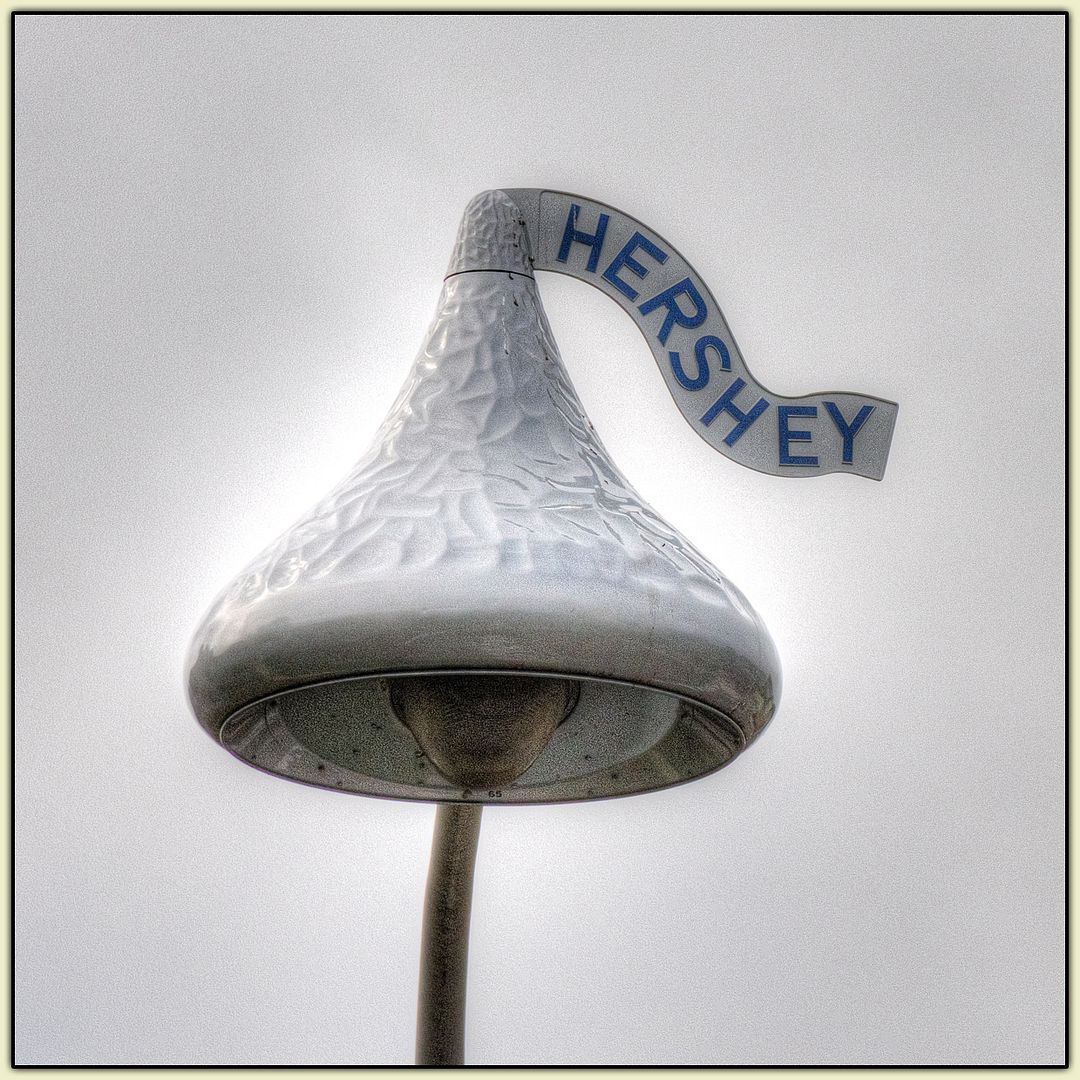
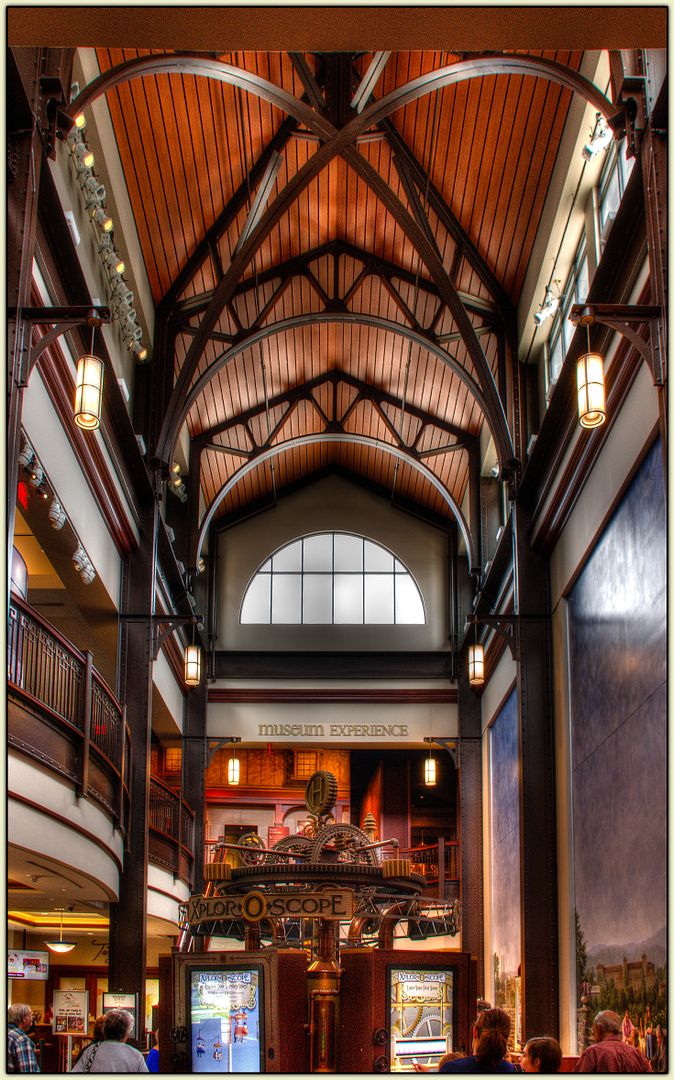
Hershey has plenty of activities and amusements for vacationing families. There’s the Hershey World of Chocolate, a hands-on experience that offers nothing less than a total immersion in the world of chocolate manufacturing, where (for a modest fee) visitors are able to work alongside a team of Oompa-Loompas as they crank out the day’s quota of Hershey products. There’s The Hershey Story (pictured above), a museum featuring an Olympic-sized swimming pool of tepid semisweet chocolate. There is Hersheypark, a chocolatized version of Six Flags featuring thrill rides and similar attractions. There are also world-class restaurants and golf courses available, for those who have had their fill of Brown Goods.

And it’s easy enough to get there. Just fly or drive to Harrisburg, Pennsylvania and head east for thirteen miles on the Hershey Highway.

*N. B. - The above post is mostly bullshit, but the bit about Milton Hershey creating a school for orphans is no joke. The Milton Hershey School is funded with 30% of the Company’s annual profits and thus has a sizeable trust fund with which to educate its population of some ~2,000 students. Admission is no longer restricted to orphans, but the school’s mission is to serve lower-income families: It is cost-free. As the School puts it, “We believe all children deserve the very best education regardless of their financial circumstances. A family’s income should not determine a child’s outcome.” Amen to that.

CHOPPED: A 100-WORD STORY


Chef “Not Ready for Food Network.”

The Chef was sweating bullets.

It was his debut appearance on “Chopped.” He had barely squeaked through the appetizer round and was now in the midst of preparing an entrée that had to include lima beans, prune juice, capuchin meat, and duck schmaltz. The meat, he knew, would make a good fritter, but how could he make it memorable? Only seven minutes remained...

Aha! Inspiration!

He dashed to the pantry for one critical ingredient, then set to work.

Later, the judges would credit his victory to his bold choice of breading for the capuchin fritters: He had pankoed the monkey.

Tuesday, June 7, 2016

YIDDISH OR ELVISH? (A QUIZ)

This is yanked from the pages of McSweeney’s Internet Tendency, where it was first published. For some inexplicable reason, you won’t find it there any more, given that it was taken down sometime after its original posting in or around early April, 2004. (I figure it’s OK to republish it here, since I’m the guy who wrote it.)

Thanks to my old friend Karen Wise, who rescued it from oblivion.

Elvish or Yiddish?

1. A Elbereth Gilthoniel
2. Lorelindorenan
3. Geyin D'rerd Dort'n
4. Mellon
5. Parma Eldalamberon
6. Quenya
7. Keyneyin Hara
8. Malach Hamavis
9. Glorfindel
10. Osmon Hatgelt Furtmon
11. Arwen Undomiel
12. Chaim Schmiel
13. Elavil

Answers:
Elvish: 1, 2, 4, 5, 6, 9, 11
Yiddish: 3, 7, 8, 10, 12
Mood-Altering Prescription Medication: 13

Saturday, May 28, 2016

HAPPY BIRTHDAY, DADDY

Ivories
Eli plays the piano in this photo taken in 2009.

Today is Dad’s ninety-first birthday. Alas, he is no longer here to celebrate it with us... and yet he will always be with me.

I cannot play the trumpet or piano like he did. But I can still tell some of his jokes, almost (but not quite) as well as he did.

In our tradition, birthdays - especially those of departed family and friends - are not nearly as important as their Yahrzeits, the anniversaries of their departures. Perhaps that is because a person is a blank slate at birth, and the full measure of their accomplishments is only known after they pass.

And yet we still like birthdays, don’t we? It’s got to be for more than just the cake.

Happy birthday, Daddy. I miss you.

Thursday, May 26, 2016

THESE ARE WORDS THAT GO TOGETHER WELL. WAIT, NO.

Said words being “Toilet Python.” 

Every once in a while, you see a news story that goes beyond the normal definition of “cringeworthy”: something so horrific that it is the stuff of future nightmares.

That aptly describes a recent (and apparently all-too-true) incident in which a Thai fellow was attacked by a python while copping a squat. It’s bad enough to be attacked by a python under any circumstances, although I suspect that the likelihood of such an attack taking place is higher within a 90 km radius of Bangkok than it is, say, here in east Cobb County, Georgia... but what makes this attack especially horrendous is that the snake slithered up through the plumbing and attached itself to the fellow’s John Thomas.

Reflect on that, Esteemed Readers. You’re minding your own business, squatting over the Thai version of a Porcelain Throne, preparing to crimp off a length. Drop the kids off at the pool. Lay a bit of cable. (You get the idea.) Perhaps you’re reading the sports section of the Krungthep Daily Post... or maybe the business section. Hmmm. The baht is up 3%, King Bhumibol seems to be recovering from a mysterious infection...

And all of a sudden there’s a fucking 13-foot-long Burmese python clamped onto your Membrum Virile with the same jaws, presumably, that he uses to swallow entire goats. Even worse, he is not in any hurry to let go.

I am happy to report that both man and snake survived the ordeal - at least, according to the news reports - although it’s very likely that the gentleman will have an entirely justifiable paranoia regarding ever going to the bathroom again. And so, also, will pretty much anyone who hears about this story.

Oops.

A story this strange and perverse deserves a sonnet. Here you go:

One day a Man was squatting on the Loo
A Day like any Other, in swelt’ring Heat
He’d tried and tried to drop a Number Two
And so he strained, Hand clasped upon his Meat.

Just then, a Serpent slithered through the Pipes:
A mighty Python, huge of Girth and Length;
Seeing there a Sausage, with snakely Jaws it bites,
Bearing down with all its vaunted Strength!


O Agony! Excruciating Pain!
A massive Serpent chomping on his Member.
A Scene so fright’ning, once seared upon my Brain,
Alas, I would forget - yet must remember.


Forevermore, lest Snakes should bite my Dick,
I pee whilst standing up, and that right quick!


Tuesday, May 24, 2016

ON HUMOR AND HUMOR MAGAZINES

Mad #1
Mad #1, October 1952. Is it a coincidence that Mad and I arrived on the planet bearing the same birthdate?

My formative years included a regular dose of Mad Magazine’s inspired foolishness. After having seen a few copies in the hands of some of my more disreputable classmates, I bought my first Mad in April of 1962 at the ripe old age of nine. It provided hours of entertainment as my mother, brother, and I took the 25-hour train ride on the Atlantic Coast Line’s Miami Special from Penn Station (the old Penn Station) to south Florida.

I didn’t miss a single issue until it was almost time to receive my college degree. I still have ’em: All those old copies of Mad - along with many others - reside in the bowels of Chez Elisson.

The first issue of Mad I ever
bought: June 1962.
It was not obvious to me at first, but Mad was a kind of distillate of Jewish humor and thinking. It was humor that, while itself not of the Borscht Belt (the resorts in the Catskill Mountains that catered to a Jewish clientele and where many famous comedians cut their humor-teeth), understood the Borscht Belt. Nietszche observed that when you stare into the abyss, the abyss stares back at you: so the comic sensibilities of a whole generation of tummlers were reflected in Mad’s pages. Not all of its writers and artists were Jewish, but it seemed like even the non-Jews had absorbed a certain degree of Yiddishkeit. There were so many Yiddish words and phrases sprinkled in - like poppyseeds on a challah - that sometimes I would be mystified even as my parents would crack up. (A fake travelogue about the fictional town of Gournish, Illinois, for example, is funnier when you know that goornisht means “absolutely nothing” in Yiddish.)

Halvah. Farshimmelt. Furshlugginer.

As I got older, I continued to buy my monthly copies of Mad, but by the time I got to college there was a new kid in Humortown: the National Lampoon.

This infamous January 1973 NatLamp
resides in the Elisson archives.
The Lampoon was a completely different animal. Spun off from the Harvard Lampoon in 1970 by several of that school’s alumni, its humorous sensibility was entirely different. It was WASP Ivy League humor. Its parodies had layers of chucklestuff that could only be teased out with difficulty... unless you were widely read. And it was seasoned with a liberal application of tasty, tasty ribaldry - something that Mad entirely lacked.

It was just the thing to appeal to a young man coming of age in the early 1970’s. The National Lampoon was like a college humor rag gone mainstream - because that is, in fact, exactly what it was.

I myself was involved in that world for a time, gradually getting involved with the Princeton Tiger - our own attempt to bring Teh Funny to a semi-sophisticated college audience. Starting as a contributing artist, I managed to work my way up to chairman of the magazine.

The two disparate worlds of Mad - old-school Jewish humor - and my newer Ivy League college humor sensibilities collided one evening as I traipsed from dormitory to dormitory, hawking copies of the latest Tiger Mag. One of my customers (to my delighted surprise) turned out to be one George Woodbridge, Jr., whose father had been one of “the usual gang of idiots” illustrating Mad magazine since the early 1950’s.

Princeton Tiger, September 1972.
Art by Yours Truly.

The Tiger - at least, in the early 1970’s - was not in the league of either the NatLamp or Mad, although it could boast of having had numerous well-known alumni in its ranks over the years: Booth Tarkington, F. Scott Fitzgerald, John McPhee, Michael Witte, Henry Martin, Henry Payne, and Chip Deffaa among them. And here’s a little-known factoid for you: the first published appearance of the limerick that begins “There once was a man from Nantucket...” was in a 1902 copy of the Tiger.

It is, alas, the clean version, the one that goes as follows...

There once was a man from Nantucket
Who kept all his cash in a bucket.   
But his daughter, named Nan,
Ran away with a man

And as for the bucket, Nantucket.

[The ribald version with which most of us are familiar may predate this, but its earliest publishing date was in 1927.]

A couple of years ago, Dee and I were strolling around the Princeton campus during my 40th Reunion weekend, and we managed to get to the Tiger offices just in time to catch the very tail end of an open house. I may have been among the older alumni stopping by that day (who knows?), but I was pleased to see that, among the numerous old magazine covers festooning the walls of the offices, several of my creations were included. That seemed to impress the staffers.

“Wow, you did some of those covers? You must be really fucking old!
They asked me if I had any advice for them, and indeed I had.

“You probably feel sometimes that you are nought but a collection of geeks and nerds. Highly intelligent geeks and nerds, but here you are, working on the Tiger. Am I right?

“But here’s the thing. Yesterday evening at our Class Dinner, I saw a lot of people that hadn’t seen me in years... and plenty of people who didn’t know me very well when we were students here. But the funny thing is, almost everyone who knew me - even marginally - remembered that I had been involved with the Tiger. ‘Oh, yeah, I know you - you were with the Tiger Mag!’

“Here it is, forty years down the road, and the majority of people in our class who remember my name don’t remember what my major was, or whether I was graduated with honors, or how I did on that problem set that kept me up two nights in a row, or what grade I got on my Orgo midterm, my Thermo final, or my thesis... but, by Gawd, they remember that I worked on the Tiger Mag. So think about that the next time you’re busting your asses to meet a deadline. This - this stuff right here - is how you will be remembered.”

I tried to ignore that the floor of the office was covered with hundreds of unopened condom packages as we beat (you should excuse the expression) a moderately hasty retreat.

Sunday, May 22, 2016

HUNGARY? NO, I JUST ATE (AGAIN)

The trip that folks consider best
Is when they visit Budapest.
I find that I have often wished
One day to have been Budapished.

Saturday, May 21, 2016

FOREVER YOUNG


Alan Young (1919-2016). Requiescat in pace.

I was saddened to hear that Alan Young, who will be remembered by many for his turn as straight man to a talking horse on Mr. Ed, the iconic early 1960’s sitcom, has passed away at the age of 96.

A prolific actor, Alan Young first came to my attention in The Time Machine, in which he played the inventor’s steadfast friend David Filby... as well as Filby’s son adult James in scenes taking place 17 and 66 years after the inventor embarks on his journey into the future. Young, whose role in George Pal’s 1960 film was expanded considerably from a brief appearance in H G. Wells’s novel, would play Filby again in 1993 in a mini-sequel entitled Time Machine: The Journey Back in which both he and Rod Taylor reprised their roles from thirty-three years prior. And Young even scored a cameo appearance as a flower shop owner in the 2002 remake of The Time Machine, a film mainly noteworthy for having been directed by Simon Wells, the great-grandson of the original novel’s author. (In a bizarre coincidence, when Young reported for costume fitting, he was given the same shirt collar he had worn in the 1960 film(!))

Despite having had a lengthy and productive career, the role that comes to mind when people mention Alan Young is (of course, or course) that of Wilbur Post, the owner of the uniquely verbose horse Mr. Ed. At least, it comes to mind for people of a certain age, the series having been aired from 1961-66. It is a testament to Young’s considerable self-confidence as an actor that he was willing to play second banana to the ’ponymously titular Mr. Ed. Whether Wilbur Post owned Ed or vice-versa is a bit of an unresolved matter, however, because the horse often seemed to have more intellectual wattage than his bemused owner - the only one who ever heard Ed speak. It is worth examining whether Wilbur was the victim of an unusually vivid type of hallucination, but that would consume far too much of my time.

And yet... although my time is so eminently valuable, it is nevertheless true that I had, at one point long ago, taken it upon myself to translate the Mr. Ed theme song into several foreign languages. I am here to report that it seems to work best in English... unless one takes the lyrical rather than the (semi) literal route.

Thus, by way of an elegy, I shall take the liberty of reprinting here (below the fold) my work of some twenty-five years past, the Ed Variations. May they serve to sing the late, lamented Mr. Young to his eternal rest, where he will be Forever Young. Ave atque vale!

Monday, May 16, 2016

A COMPLETELY USELESS FACT


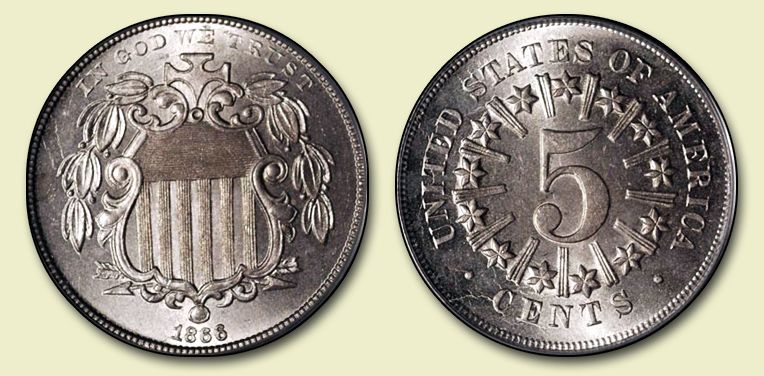
1866 Shield nickel... the first US five-cent coin struck from base metal. [Photo: PCGS.]

Here’s a completely useless fact that was brought to my attention today: The United States cupronickel five-cent piece - the coin we all know and love as the “nickel” - is 150 years old today, having first been produced May 16, 1866.

The five-cent nickel wasn’t the first coin that bore that sobriquet, however. That would have been the three-cent cupronickel coin, first issued in 1865 as an alternative to the silver three-cent pieces that had virtually disappeared thanks to hoarding during the Civil War (variously known here as “the War of Northern Aggression” or “The Late Unpleasantness.” Those silver 3¢ pieces were tiny-ass coins, popularly called “fishscales” for obvious reasons. The three-cent nickel was more manageable, although the denomination had more to do with postage rates and was not a good fit with the country’s decimal coinage system.

The five-cent nickel was also not our country’s first five-cent coin. The Mint had been producing silver half-dimes for circulation since 1794, but like their (even more) diminutive three-cent cousins, the little silver coins were thin on the ground during and after the war. The half-dime would stick around until 1873, by which time the nickel version of that denomination had caught on solidly.

The original design for the nickel five-cent coin was rather boring, featuring a shield on the obverse and a numeral 5 on the reverse. It also bore the legend “In God We Trust” - the second US issue to do so - a consequence of the national religious fervor that had accompanied the war.

In 1883, the Shield was replaced by Charles Barber’s Liberty Head design, which featured a dowdy Lady Liberty on the obverse and a large V on the reverse to indicate the denomination. Unfortunately, Barber had not included the word “cents” anywhere on the coin, and what with the nickel being about the size of a five-dollar gold coin, it was not long before enterprising criminals took to gold-plating the new nickels and passing them off on unsuspecting rubes as five-dollar coins. By mid-year, the Mint had had Barber redesign the coin to add the denomination.

1913 Type 1 Indian Head nickel
Proof 1913 Type 1 Indian Head nickel... one of the most beautiful examples of US coinage. [Photo: PCGS.]

Fast forward thirty years to 1913, when the Indian Head nickel (AKA the “buffalo nickel” on account of the bison on the coin’s reverse) replaced the Liberty Head design. It, in turn, was replaced in 1938 by the Jefferson nickel.

Our five-cent nickel has been made of an alloy of 75% copper and 25% nickel since its inception, the sole exception being during World War II, when an alternative alloy of 56% copper, 35% silver and 9% manganese was substituted due to nickel having been a critical material. These “war nickels” circulated until 1965, when the elimination of silver coinage created an incentive for people to hoard any money that had actual precious metal in it.

If you want a real nickel nickel, though, you have to go to Canada, where for many years five-cent coins were produced with a composition of 99.9% nickel. American-style cupronickel was only used from 1982 until 2001: Since then, the Canadian nickel has been made of steel with a thin copper-nickel plating. And that brings us to another (almost) useless fact... most (but not all) Canadian nickels will stick to a magnet. Aren’t you glad you asked?

Wednesday, May 11, 2016

THIRTY


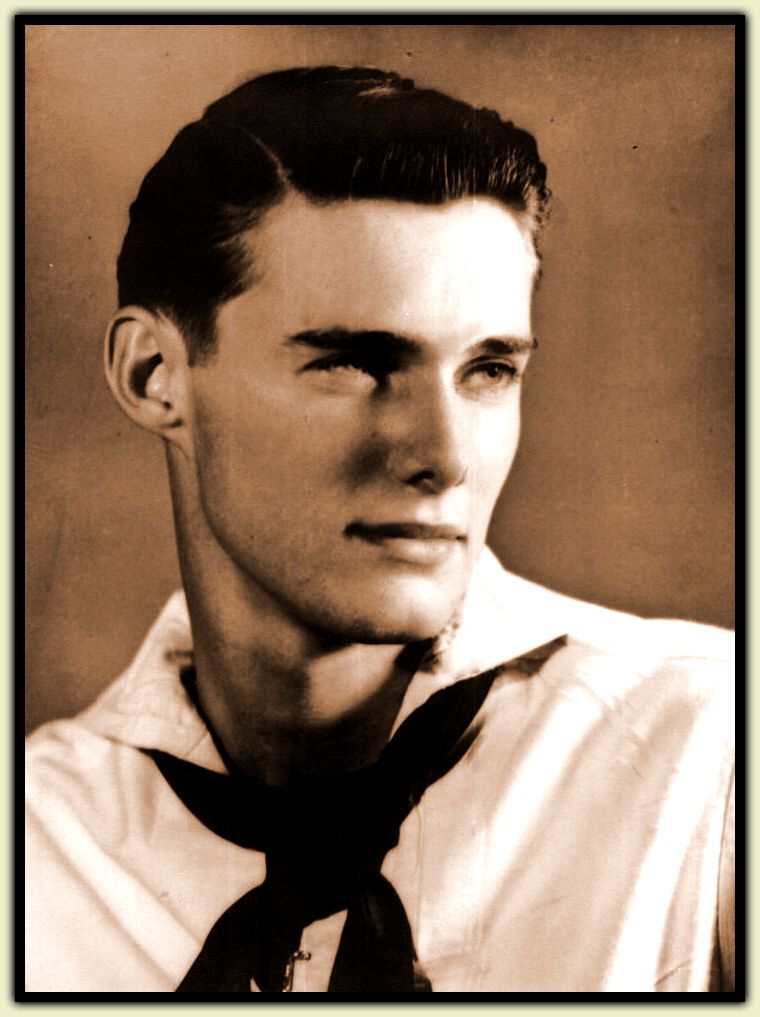
Bill, in his Navy days - ~1946.

“My daddy’s been gone 30 years. Not a day goes by that I don’t miss him.”

Today is Bill’s thirtieth Yahrzeit - the anniversary of his passing according to the Hebrew calendar. (On the Gregorian calendar, purely by coincidence, that anniversary is tomorrow.)

I cannot add or change a single word that would make Dee’s words any more eloquent.

We miss you, Bill. Every day.


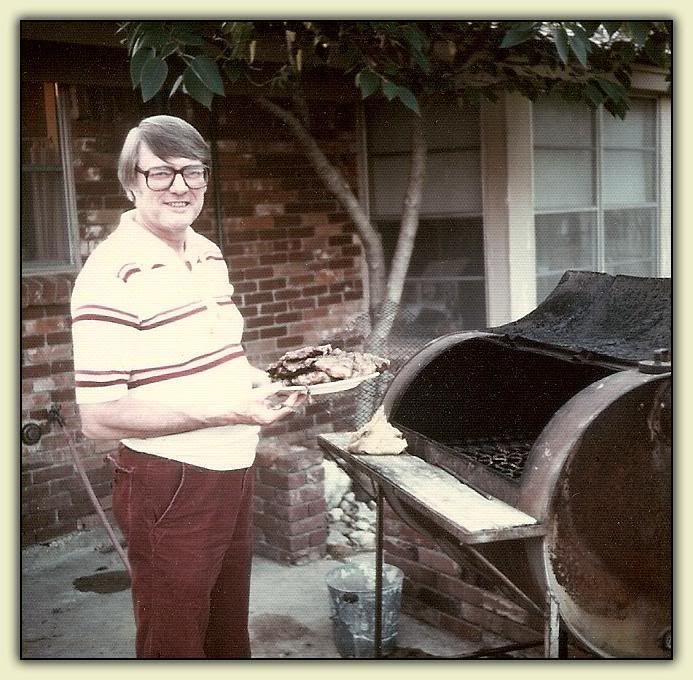
Bill, the barbecue maven, as photographed in the late 1970’s.

Sunday, May 8, 2016

ADRIAN’S LIVER HEAVEN


Chicken liver paté with pickled shallots.

Our friend Sue recently told me about a prank she and her kids would play upon the unsuspecting. It involved a fictional restaurant - Adrian’s Liver Heaven - where all the dishes would incorporate some form of liver.

The idea of a fictional restaurant is right up my alley. Well over a decade ago, I created the House of Meat, a no-nonsense restaurant offering titanic slabs of red meat, a monument to Wretched Excess. (Interested in investing? Feel free to leave a comment.)

But Adrian’s Liver Heaven takes it to another level, with a menu based on an organ meat that, while beloved by many, is the stuff of horror movies to others. It’s one of those proteins that you either love or hate: There is no middle ground on the liver lover’s scale.

Think of Bubba Gump’s Shrimp Company, only with liver...

Calf’s liver and onions.
Calf’s liver and bacon.
Calf’s liver with onions and bacon.
Rumaki (chicken livers and water chestnuts wrapped with bacon).
Chopped chicken liver.
Paté de foie gras.
Char-grilled foie gras skewers.
Chicken livers en brochette.
Southern fried chicken livers and gizzards.
Liver with fava beans (a good Chianti optional).
Strasburg Pie.

People would listen to Sue’s kids rattle off all of these bizarre dishes without batting an eye, but at some point they would get suspicious. “This isn’t a real place, is it?”

That would usually be right after the question, “Would you care to try the cream of liver soup?”

Hell, I’d eat at Adrian’s Liver Heaven if it were a real place. What liver-based dishes would you put on the menu?

Saturday, May 7, 2016

MOTHER’S DAY MEMORIES


Dee and her mom, 2012.

Mother’s Day is one of those rare Greeting Card Holidays with a respectable pedigree. Its originator, one Anne Jarvis of Grafton, West Virginia, had initiated its observance 1908 as a way to memorialize her own mother... and in later years she was horrified at how commercialized the day had become, thanks to the incessant blandishments of the greeting card, florist, and restaurant industries.

But most of us walk this planet by the grace of being of mother born, and so it’s entirely appropriate to set aside one day of the year to glorify and honor All Things Maternal.

I’ve got three mothers that are the primary focus of my thoughts on this occasion: my own mother, now departed over twenty-eight years; Dee, the mother of our two daughterly children; and Dee’s mother.

Dee’s mom lives in Foat Wuth, where she still puts in a day a week working retail. She has had a lot on her plate this year, what with one son having undergone heart valve surgery and the other dealing with deep vein thrombosis... and her daughter still recovering from a broken hip and wrist. But she’s a tough bird, determined to do things her own way (even if it drives her children nuts).


 Bernice, the Momma d’Elisson (z''l) in her 1949 college graduation photo.

My mom lives in Olam ha-Ba - the World to Come, where she has been resident for close to three decades, as well as in the memories of those who knew and loved her. I think of her whenever I eat duck, whenever I drink Scotch or Campari (she was not much of a cocktail hound, but she did love an occasional Rob Roy or Campari and soda), whenever I play golf or tennis, whenever I read a science fiction novel, and whenever I do the Sunday New York Times crossword puzzle. In the best of all possible worlds, she would have had a few more decades to enjoy her sons, her daughter-in-law, and her granddaughters... but, alas, it was not to be.

And then there’s Dee, who became a mother almost thirty-seven years ago when Elder Daughter (then Only Daughter) appeared on the scene. Dee was, and continues to be, a wonderful mom to our girls... certainly not her only skill-set, and by no means her defining role, but the one that is relevant to the occasion being celebrated. Navigating the waters of motherhood as your children grow into fully-fledged adults isn’t the easiest task, but we have been blessed with sweet, bright daughters who love their Mom without reservations, qualifications, or limits... and I know that it’s mutual.

I’ll raise a glass to these three Moms. Now: what should be in the glass?

ADVENTURES IN ASTRONOMY


When he’s in a self-deprecating mood, Houston Steve likes to tell this story of his days in the United States Naval Academy, back when he was a naïve young middie.

It is a USNA tradition that upon returning from their summer cruise and sighting the Academy chapel dome, third-class midshipmen are elevated to the exalted status of “youngster,” with the various privileges pertaining thereto. Our story takes place during Houston Steve’s youngster cruise... on a dark, clear, moonless night somewhere in the Atlantic Ocean.

Picture, if you can, Midshipman 3c Houston Steve, who is standing on the signal bridge with a fellow whom we shall refer to here as Signalman 2c Smith. Smith is a grizzled veteran, someone who probably has been plugging away in the E-5 grade for at least ten and more likely twenty years. And yet Houston Steve, despite his being a mere snot-nosed middie, outranks Smith.

As noted above, it is a dark, clear, moonless night... and way out in the middle of the ocean, it is really dark. No cities are near enough to spoil the night sky with visual and atmospheric pollution, which means there is a spectacular view of the entire dome of the heavens from horizon to horizon.

This is when Houston Steve attempts to make conversation with his companion on the signal bridge.

Houston Steve: “You know, Smith - it’s pretty amazing. There’s no moon, but you can still see the clouds.”

Smith: “Jesus Christ, Sir - that’s the fucking Milky Way!”

Note that Smith’s riposte, despite conveying a heavy freight of amused contempt towards his youthful superior, is perfectly and appropriately polite.

It has been some forty-five years since this little adventure took place, and Houston Steve still takes pleasure in telling about it. He also acknowledges that Signalman Smith - assuming he is still walking the planet - probably enjoys telling the story as well. We both wonder how different it sounds from his vantage point.

Friday, May 6, 2016

THE YEAR THE MUSIC DIED


Ask not for whom the cowbell tolls
It tolls for music artists
Who shaped our culture and our lives
But now they must depart us

O, farewell Bowie, farewell Prince
Adieu, our sweet Merle Haggard
And yet, Keith Richards walks the Earth
That everlasting blackguard!

[2016 has been a rough year thus far for musical celebrities, with the Grim Reaper harvesting (among many others) David Bowie; Paul Kantner; Glenn Frey; Merle Haggard; Frank Sinatra, Jr.; and Prince.]

Wednesday, May 4, 2016

STAR WARS DAY


It’s Star Wars Day. May the Fourth be with you!

(An appropriately stupid occasion to immediately precede Drinko de Mayo.)

Monday, April 25, 2016

PESAHDIK POTABLES

One of the challenges even a moderately observant Jew must deal with during the eight-day Passover festival is that of What To Drink.

Soft drink fanciers will generally look for beverages that are sweetened with something other than the ubiquitous high-fructose corn syrup, corn being a product that most Ashkenazic Jews traditionally avoid during the holiday. But those of us who favor higher-octane tipples face a more difficult quandary.

Most spirituous liquors, you see, are made from grain - and most are produced from one or more of the five grains that are verboten during Passover: wheat, spelt, rye, oats, and barley.

Single malt Scotch? No can do. Irish? Uh-uh. Bourbon? That’d be disturbin’. Gin? A sin.

That leaves us with a limited palette of brandies (which must be produced under strictly controlled conditions); eaux-de-vie; rums, and vodkas (which are OK if made from potatoes).

My traditional Pesach Potable is the dastardly Central European plum brandy known as slivovitz. It is not a drink for the faint of heart: Strong men have been known to become violently ill after ingesting a single shot. Lower quality versions have a bouquet that reminds one of Ronsonol... and yet a good slivovitz, while powerfully alcoholic, has the unmistakable fragrance and subtle sweetness of sunny, ripe plums.

It’ll just have to do until sundown Saturday.

Tuesday, April 19, 2016

THOUGHTS ON THE TWELFTH OF NISAN


Our mom Bernice, z''l (1927-1988).

It’s been twenty-eight years since she has shared this world with us, and there isn’t a day that goes by that I don’t think of her.

The photograph above is one of my favorites, having captured just the smallest whiff of her vivaciousness. If you knew her, you’d know what I mean... and if you didn’t get to know her, alas for you.

Sometimes I wonder how much of my personality came from her and how much from Dad. My sense of humor is probably 99.8% Eli. The other day, Dee saw me react to something or other and immediately said, “What you just did? That’s Eli.”

But when I pick up a book? That’s Mom. I like to think that she’s there, invisible, looking over my shoulder whenever I read.

Tuesday, April 12, 2016

FIFTY WAYS

“The problem is all inside your head” she said one night
“The menu’s simple if just look at it right
I’d like to help you in your struggle for a bite
There must be fifty ways to love your liver”

She said “I really don’t want to get up into your grill
Furthermore, I hope you won’t think I’m an asshole or a pill
But I’ll repeat myself: If you wish to eat your fill
There must be fifty ways to love your liver
Fifty ways to love your liver”

You can have it sautéed, Sinéad
Throw it on the grill, Phil
Don’t drown it in soy, Roy
Just cook it gently
Serve it on toasted bread, Fred
Sear it ’til you don’t see red
Some fried onions are key, Lee
Please listen to me

Oooh, you can have it sautéed, Sinéad
Throw it on the grill, Phil
Don’t drown it in soy, Roy
Just cook it gently
Serve it on toasted bread, Fred
Sear it ’til you don’t see red
Some fried onions are key, Lee
Please listen to me

She said “It saddens me to see you in such grief
I wish there was something I could cook – perhaps roast beef”
I said “I appreciate that – now please tell me your belief
About the fifty ways”

She said “Why don’t we sleep on it tonight – I really care
And I believe a love like yours is more than very rare”
And then she smelled the pong of onions in my hair
There must be fifty ways to love your liver
Fifty ways to love your liver

You can have it sautéed, Sinéad
Throw it on the grill, Phil
Don’t drown it in soy, Roy
Just cook it gently
Serve it on toasted bread, Fred
Sear it ’til you don’t see red
Some fried onions are key, Lee
Please listen to me

You can have it sautéed, Sinéad
Throw it on the grill, Phil
Don’t drown it in soy, Roy
Just cook it gently
Serve it on toasted bread, Fred
Sear it ’til you don’t see red
Some fried onions are key, Lee
Please listen to me

[Apologies to Paul Simon]

Sunday, April 10, 2016

THE CHEESE AISLE DICTIONARY, Vol. 23

I could not help but be intrigued by my friend Eric’s recent Facebook post:

“...you know that you need your reading glasses when you click on a link to “Paleo Sandwich” on the internet and it turns out to be an article on a baseball player named Pablo Sandoval...”

Hmmm. Paleo Sandwich, Pablo Sandoval.

That post elicited a comment that went as follows:

“This made me laugh out loud. Beeecause... the other day, I saw an ad that I could’ve SWORE said something about a sphincter. I looked again and it said “specialized.”
I’ve experienced similar misreads... and as I get older, I find that this phenomenon occurs more frequently. One example: as we were stopped at a red light yesterday evening, I saw a license tag that said (I thought) “Okeechobeee” below the tag number. But when I realized that it was a Georgia plate, I also realized that Okeechobee - which may refer to either a lake or a county in Florida - made no sense. Closer examination showed the word to be “Oglethorpe.” Aha.

That, Esteemed Readers, is a mondeseen - the newest coinage in the Cheese-Aisle Dictionary.

mondeseen [mon-de-sin] (n): a word or phrase that is initially misread due to faulty eyesight, glitchy brain function, or a combination of both.

Mondeseen is a spin on the term “mondegreen,” meaning a mishearing of song lyrics or spoken words. The difference is that the focus is visual, not aural: misreading rather than mishearing.

Another example: While in the pet store a few days ago, Dee saw a sign that she initially read as “Cow List.” After the inevitable double-take, she realized that it said “Low Cost.”

I experience mondeseens frequently, and the number seems to be accelerating. I attribute this to my declining distance vision, coupled with changes in my mental acuity that I hope are the result of normal aging processes and not a rapid freefall into drooling senescence.

Time will tool, I suffuse.

[Other entries in the Cheese Aisle Dictionary may be found here.]

Monday, April 4, 2016

A CENTURY-OLD TURNING POINT

Calendar Year 2016 is already one-fourth over, and it took this long for me to realize how significant a year it is... at least for those of us who collect coins.

Yes, Esteemed Readers - Elisson is a coin collector. It’s hard to imagine a more nerdly hobby aside from stamp collecting, a pastime that makes the Dork-O-Meter go all the way to 11. My saving grace is that I’ve never gotten into it too seriously, owing to the fact that I usually spend my money on more mundane things like food, clothing, liquor, and The Interminable Mortgage. For that, I am thankful... though not as thankful as Dee, who cringes whenever I start talking about coinstuff.

Nothing, save music, can roll the years back like looking at the coins you used to see when you were young. And we had some real beauties when I was a young Snot-Nose. 

This year is not such a big deal per se, but it’s important because it is the 100th anniversary of one of the great turning points in American numismatics: when American coinage finished crossing the great artistic divide into the twentieth century.

Up until then, the dime, the quarter, and the half-dollar all had sported similar Liberty Head designs by Chief Engraver Charles Barber (the quarter and half were almost identical in appearance). Barber’s coins were boring and stodgy, generating negative reviews almost from the first day they were produced in 1892. Without an act of Congress, however, his designs could not be replaced until 1916... by which time everything else coming out of the Mint had been modernized.

It was worth the wait.

The new designs were dramatically different from Barber’s simple Roman-style profiles of Lady Liberty. The dime, by Adolph Weinman, featured Liberty wearing a winged cap, symbolizing freedom of thought - and on the reverse, the fasces - the bundle of sticks that has represented strength in unity since Roman days.
Adolph Weinman’s Liberty Head dime, popularly (but incorrectly) called the Mercury dime. [Image: Coin Community]
Weinman’s half-dollar showed Liberty in full stride towards the sun, an American flag behind her and branches of laurel and oak in her arms. The reverse featured a mighty eagle, wings partially unfolded, perched atop a mountain crag.
Weinman’s Walking Liberty half-dollar. [Image: USA Coin Book]
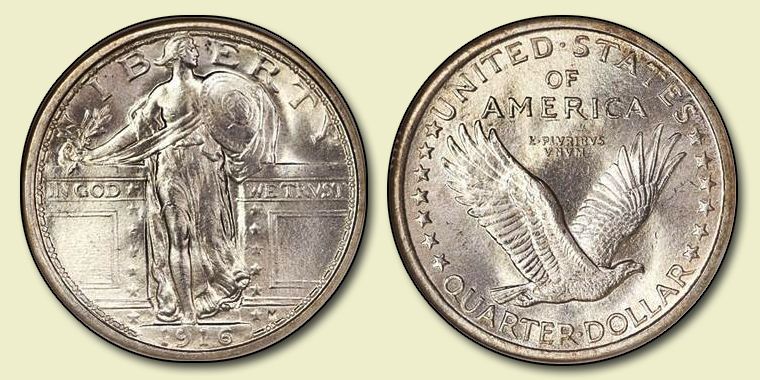
For the quarter, Hermon MacNeil created an image of a standing Liberty in flowing robes, holding a shield in one hand and an olive branch in the other.
Hermon MacNeil’s Standing Liberty Quarter. This version, produced in 1916, was subsequently modified to conform more closely to MacNeil’s original design. Only 52,000 of the 1916 specimens were struck, making it a rarity. [Image: CoinHELP!]
All of these coins were (you should excuse the pun) strikingly different from their predecessors. More than just utilitarian factory output, they were works of art in miniature, products of the sculptor’s imagination rather than the engraver’s. You would look at them and see America’s growing self-confidence and presence practically leaping from their shiny faces. They were not without their flaws - the quarter was difficult to strike properly and its date was notoriously prone to wear, for example - but they were beautiful.

In my Snot-Nose Days, all three of these coins were easily found in pocket change, despite the fact that they were all obsolete by then. The Standing Liberty quarter had only lasted until 1930 - an exceptionally short-lived series - yet well-worn specimens, often without readable dates, would show up daily. The so-called Mercury dimes and “Walker” halves were by no means uncommon. But when the Coinage Act of 1965 introduced dimes, quarters, and halves with a copper-nickel clad composition, silver coins vanished from circulation almost overnight.

Today, the beloved Walking Liberty design has been resurrected for use in silver bullion coins... but somehow, those lack the charm - the everyday beauty - of actual circulating coinage. As for today’s (faux) silver, the Roosevelt dime has been unchanged for seventy - count ’em! - years; the Washington quarter has essentially the same ugly obverse it has had since 1932, despite having five new (mostly forgettable) reverse designs every year since 1999; and the iconic Kennedy half, now fifty-two years old, no longer circulates at all. Où sont les dessins d’antan?

Once in a while, I’ll take some of those old coins out and look at them, rolling back the years. Damn, those were beautiful times. At least, that’s what the coins tell me.

Sunday, April 3, 2016

REMEMBERING ELI


The irrepressible Eli (1925-2014), photographed in 1990.

As the sun sets this evening, I will light a candle in my father’s memory to mark the second year since he passed on to the Undiscovered Country... that great and foreboding land to which we all must eventually journey.

Two years - at least, by the arcane reckonings of the Hebrew calendar.

They say Time heals all wounds. (They also say Time wounds all heels.) And it’s true. The ache of loss diminishes as the days and years pass - else how could we go on with the business of living, weighted down by accumulated grief? And yet there is an empty space that never goes away.

In the photograph above, Dad was sixty-five - only two years older than I am now.  But my deepest memories were of Eli as a young man, spreading out newspaper on the floor to catch the drippings from his trumpet’s spit valve... sitting down to play the piano... taking me and my brother to Coney Island Steeplechase amusement park... navigating from Bensonhurst to our home in suburban Massapequa after a day with his parents, my sleepy head resting on his leg as he drove.

Those, ahh, those were sweet days.


Friday, April 1, 2016

VILLAGE OF FOOLS


Memorial marker at Beth David Cemetery, Elmont, NY. [Photograph by The Other Elisson.]

Chelm is a small city - with about 67,000 inhabitants, you could really call it a good-sized village - in eastern Poland. Back in the early 1920’s it really was more of a village, its population at the time not much more than 23,000... more than half of them Jews, the remainder Christians consisting of Roman Catholics, Eastern Orthodox, and a sprinkling of Lutherans.

Occupying a unique place in Jewish folklore, this small, otherwise unremarkable city is the legendary home of the Wise Men of Chelm, an ironic compliment typical of Yiddish. You could say that Chelm was celebrated for being an entire village of Village Idiots... the kind of people that, when asked why the sea was salty, attributed its salinity to the large number of herring living in it. You’d have to go to Washington, D.C. to find a more concentrated source of High Doltage.

Isaac Bashevis Singer, the noted Yiddish author, wrote about the well-meaning fools of Chelm (The Fools of Chelm and Their History), and it’s easy enough to find similar collections of tales by others. A quick search on Amazon.com will suffice.

Were the Jewish residents of Chelm really fools? It’s hard to say, because they’ve vanished. Most were exterminated by the Nazis in a single, brutal operation in early December, 1939, and the remaining stragglers were picked off as the war ground on.

But at least one escaped, back in 1922 when escape was possible. That would be my grandfather Jacob of blessèd memory, father of Eli (hizzownself)... a Chelmite who was smart enough to get out while the getting was good.

What better day to remember the Wise Men of Chelm - and the real-life victims of the Holocaust who lived there - than on April Fools’ Day?