I have a friend - a member of our Morning Minyan crowd - who grew up in the sunny little burg of Vidalia, Georgia.
Vidalia, as any food aficionado will tell you, is the home of the eponymous Vidalia onion, the sweetest, mildest allium cepa that you will ever put teeth to. And Richard, well, he knows his onions.
When Richard sits down to breakfast, he will occasionally get a wistful look in his eyes... especially if someone else at the table has ordered a LEO (lox, eggs, and onions, cooked up omelette style). With the slightest prodding, he’ll embark on a reverie, a recounting of the onion-based dishes with which he grew up. It almost puts one in mind of Bubba, Forrest Gump’s shrimp-obsessed Army buddy.
“Anyway, like I was sayin’, onions are the fruit of the earth. You can barbecue ’em, boil ’em, broil ’em, bake ’em, sauté ’em, grill ’em. You can slice ’em and dice ’em. Pan fried, deep fried, stir-fried. There’s your straight-up onions - yellow, red, white, Spanish, pearl. There’s your scallions, your green onions. You got your leeks, shallots, and garlic. There’s onion pie, onion and cabbage pie, onion tarts, onion soup; crispy onions, onion rings, caramelized onions...”
It’s enough to make your eyes glaze over. But one thing they won’t do is water. Vidalias are too mild to make you cry.
You’d think that Richard, coming from a small town as he does, would be a simple man. One-dimensional. But he is actually quite complicated. Got a lot of layers, he does...
Wednesday, June 21, 2017

Sunday, June 18, 2017
MIRACLES
This is a story about miracles.
When some people think of miracles, they think of dramatic events. They think of Moses standing at the edge of the Sea of Reeds as God splits the waters. They think of Jesus turning water into wine at a wedding in Cana or feeding the multitudes with a handful of loaves and fishes. They think of Muhammad ascending to Heaven from the Rock in Jerusalem where Ibrahim was restrained by Allah from sacrificing Ishmael. Whether these events really happened matters not. These are our foundational fables. These are the Great Miracles, articles of faith.
As for me, I am a skeptic when it comes to big miracles, the wonderful stories beloved of those who share our Abrahamic faiths: I tend to view them as myth rather than historical truth. Nevertheless, I see the miracles of our daily lives all around me. The impossibly complex machines - our bodies - that allow our brains to function. The myriad pipes and tubes, the strands of nerves that allow us to awaken every morning. These are the everyday miracles, and they are numberless.
This is a story about miracles.
This is the story of Houston Steve, who - along with his wife Debby - purchased a house in southwest Houston in early 1979. Unbeknownst to any of us at the time, the house they bought had been ours - in fact, our very first house, the house we had purchased as soon as we had gotten engaged. But Dee and I had never sat at a closing table with them, it having been a corporate transfer... and so we had no idea who the purchasers were, nor did we care. It was sheer coincidence on an astronomic scale when Steve and I sat next to each other at post-Minyan breakfast one morning in 2002 and discovered the connection between us. After all, what were the odds?
We became good friends with Steve and Debby after that. Our friendship was, we felt, predestined... and yet it grew naturally out of our common values and interests. Besides, how many couples can claim that they each have children conceived in the same bedroom?
This is a story about miracles.
This is the story of Bonnie and Harris, with whom we became close friends in late 1987. Soon after we became acquainted with the couple, we moved to another town in Connecticut... and then, two years after that, to Houston. Dee and I were the godparents of their only son, and we were devastated a few years later when they announced - seemingly out of the blue - their intention to divorce.
The divorce created an unfortunate estrangement between us and Bonnie. We were no longer close when she remarried, and so we were not there to comfort her when Bruce, her second husband, passed away after only a few short years. It’s a regret that we always will carry within us.
But during Bonnie and Bruce’s unfortunately short-lived marriage, they moved to a different house on the other side of town. As Bonnie described it to a friend one day, the friend gave her a funny look. “You know you bought Elisson and Dee’s house, don’t you?” She had not known. What were the odds?
This is a story about miracles.
In 2010, Houston Steve’s beloved Debby got a bad diagnosis. She soldiered on, allowing the doctors to take out pieces of her, one at a time. What she never allowed them to take was the quality of her life.
Meanwhile, in late 2013, Dee had reestablished contact with Bonnie, who was still living in Connecticut, albeit in a different town now. They wept over all the time lost together, and their friendship was rekindled. After a visit with us in early 2014, Bonnie made plans to move to Atlanta. By that Thanksgiving, she was settling in. It did not take long before she was solidly ensconced in our circle of friends and had gotten to know Houston Steve and Debby.
These are the miracles of our technological age, the Ars Electronica that facilitate reconnections and allow unlikely new friendships to blossom. (Ask any blogger... or ask The Younger Elisson.)
This is a story about miracles.
Debby passed away in August of 2015. During her five-year-long struggle with the Emperor of Maladies - throughout all the surgeries, years of chemotherapy, and, as the end neared, the Gamma Knife - she had never allowed herself to be ill. Two weeks before her demise, Debby and I had been at Party City, buying supplies for a Shabbat dinner she knew would be the last she would host. When things suddenly became dire, she retired to a room on the ground floor of her home and passed within thirty-six hours... and as was her wish, she left her house feet first.
Houston Steve and his children grieved for Debby. Our faith prescribes a seven-day period of deep mourning (shiva) followed by a thirty-day time of partial grieving (sh’loshim) during which certain normal activities are resumed, and Steve followed these prescriptions carefully and lovingly in the arms of a supportive community. But in his heart Steve had been grieving for years... ever since the day Debby received the Bad Diagnosis.
As Steve resumed social activities - some within our circle of friends, some not - we knew that there would inevitably be situations in which Steve and Bonnie would be together. We made sure that other friends would be around at such times. We were not going to be playing Yenta the Matchmaker.
And yet... this is a story about miracles.
One day last fall, Steve and Bonnie informed us that they were going to start seeing each other. And, some months afterwards, they announced their engagement. We were ecstatic.
This past Thursday, they were married in the little chapel in which we conduct our daily morning services. It was an intimate affair, with just a handful of Houston Steve’s relatives and a small group of friends. Despite my being a skeptic in matters having to do with the Afterlife, I could almost swear that Bruce and Debby were both looking on, smiling approvingly.

One of the Great Miracles? No, this one was not quite Scripture-worthy. No seas were split; there were no heaven-ascendant chariots; no transmutation of beverages.
An everyday miracle? Absolutely not: what were the odds?
But that this was a miracle, I did not doubt for one second. And we were there from the beginning.
When some people think of miracles, they think of dramatic events. They think of Moses standing at the edge of the Sea of Reeds as God splits the waters. They think of Jesus turning water into wine at a wedding in Cana or feeding the multitudes with a handful of loaves and fishes. They think of Muhammad ascending to Heaven from the Rock in Jerusalem where Ibrahim was restrained by Allah from sacrificing Ishmael. Whether these events really happened matters not. These are our foundational fables. These are the Great Miracles, articles of faith.
As for me, I am a skeptic when it comes to big miracles, the wonderful stories beloved of those who share our Abrahamic faiths: I tend to view them as myth rather than historical truth. Nevertheless, I see the miracles of our daily lives all around me. The impossibly complex machines - our bodies - that allow our brains to function. The myriad pipes and tubes, the strands of nerves that allow us to awaken every morning. These are the everyday miracles, and they are numberless.
This is a story about miracles.
This is the story of Houston Steve, who - along with his wife Debby - purchased a house in southwest Houston in early 1979. Unbeknownst to any of us at the time, the house they bought had been ours - in fact, our very first house, the house we had purchased as soon as we had gotten engaged. But Dee and I had never sat at a closing table with them, it having been a corporate transfer... and so we had no idea who the purchasers were, nor did we care. It was sheer coincidence on an astronomic scale when Steve and I sat next to each other at post-Minyan breakfast one morning in 2002 and discovered the connection between us. After all, what were the odds?
We became good friends with Steve and Debby after that. Our friendship was, we felt, predestined... and yet it grew naturally out of our common values and interests. Besides, how many couples can claim that they each have children conceived in the same bedroom?
This is a story about miracles.
This is the story of Bonnie and Harris, with whom we became close friends in late 1987. Soon after we became acquainted with the couple, we moved to another town in Connecticut... and then, two years after that, to Houston. Dee and I were the godparents of their only son, and we were devastated a few years later when they announced - seemingly out of the blue - their intention to divorce.
The divorce created an unfortunate estrangement between us and Bonnie. We were no longer close when she remarried, and so we were not there to comfort her when Bruce, her second husband, passed away after only a few short years. It’s a regret that we always will carry within us.
But during Bonnie and Bruce’s unfortunately short-lived marriage, they moved to a different house on the other side of town. As Bonnie described it to a friend one day, the friend gave her a funny look. “You know you bought Elisson and Dee’s house, don’t you?” She had not known. What were the odds?
This is a story about miracles.
In 2010, Houston Steve’s beloved Debby got a bad diagnosis. She soldiered on, allowing the doctors to take out pieces of her, one at a time. What she never allowed them to take was the quality of her life.
Meanwhile, in late 2013, Dee had reestablished contact with Bonnie, who was still living in Connecticut, albeit in a different town now. They wept over all the time lost together, and their friendship was rekindled. After a visit with us in early 2014, Bonnie made plans to move to Atlanta. By that Thanksgiving, she was settling in. It did not take long before she was solidly ensconced in our circle of friends and had gotten to know Houston Steve and Debby.
These are the miracles of our technological age, the Ars Electronica that facilitate reconnections and allow unlikely new friendships to blossom. (Ask any blogger... or ask The Younger Elisson.)
This is a story about miracles.
Debby passed away in August of 2015. During her five-year-long struggle with the Emperor of Maladies - throughout all the surgeries, years of chemotherapy, and, as the end neared, the Gamma Knife - she had never allowed herself to be ill. Two weeks before her demise, Debby and I had been at Party City, buying supplies for a Shabbat dinner she knew would be the last she would host. When things suddenly became dire, she retired to a room on the ground floor of her home and passed within thirty-six hours... and as was her wish, she left her house feet first.
Houston Steve and his children grieved for Debby. Our faith prescribes a seven-day period of deep mourning (shiva) followed by a thirty-day time of partial grieving (sh’loshim) during which certain normal activities are resumed, and Steve followed these prescriptions carefully and lovingly in the arms of a supportive community. But in his heart Steve had been grieving for years... ever since the day Debby received the Bad Diagnosis.
As Steve resumed social activities - some within our circle of friends, some not - we knew that there would inevitably be situations in which Steve and Bonnie would be together. We made sure that other friends would be around at such times. We were not going to be playing Yenta the Matchmaker.
And yet... this is a story about miracles.
One day last fall, Steve and Bonnie informed us that they were going to start seeing each other. And, some months afterwards, they announced their engagement. We were ecstatic.
This past Thursday, they were married in the little chapel in which we conduct our daily morning services. It was an intimate affair, with just a handful of Houston Steve’s relatives and a small group of friends. Despite my being a skeptic in matters having to do with the Afterlife, I could almost swear that Bruce and Debby were both looking on, smiling approvingly.

One of the Great Miracles? No, this one was not quite Scripture-worthy. No seas were split; there were no heaven-ascendant chariots; no transmutation of beverages.
An everyday miracle? Absolutely not: what were the odds?
But that this was a miracle, I did not doubt for one second. And we were there from the beginning.
Tuesday, June 6, 2017
SMOKIN’: A 100-WORD STORY

The Steampunk E-Cigarette Emporium was failing. Built with a massive amount of Charlie’s personal capital, the Emporium was a financial disaster, and Charlie could not understand why.
Having procured the finest supplies, he offered an extensive selection of aromatic vapors. Madagascar vanilla, Vietnamese cinnamon, pure menthol, even good old-fashioned Virginny terbacky... all awaited his customers, who could inhale their selections while seated on plush banquettes. He had spent a fortune on rich Corinthian leather. And the steampunk theme was a natural.
Was it the sign above the entrance? “Welcome, Vapists!”
Perhaps it needed to be bigger, he thought.
Saturday, June 3, 2017
WONDER WOMAN: A 100-WORD ORIGIN STORY
According to one version of Wonder Woman’s origin story, Queen Hippolyta desperately wanted a child... so much so that she resorted to sculpting one from clay. Given the religious proclivities of the Greeks of the time, one can assume that prayers and sacrifices to the Olympian gods were employed as well.
Hippolyta’s prayers were answered. With uncharacteristic compassion, the goddesses living atop Mount Olympus brought the clay child to life.
The child, who would be known as Diana, was subsequently raised to adulthood by the Amazons on the mysterious isle of Themyscira.
Thus was born the Legend of the Girlem.
Hippolyta’s prayers were answered. With uncharacteristic compassion, the goddesses living atop Mount Olympus brought the clay child to life.
The child, who would be known as Diana, was subsequently raised to adulthood by the Amazons on the mysterious isle of Themyscira.
Thus was born the Legend of the Girlem.
Saturday, May 27, 2017
WHAT WAS THAT, AGAIN?
In my memory, there’s something missing;
I’m not too good at reminiscing.
Pulling random factoids out of my brain
Used to be easy. Now it’s a strain.
Just like an old man is slow taking piscences,
I must remonstrate with my reminiscences.
I’m not too good at reminiscing.
Pulling random factoids out of my brain
Used to be easy. Now it’s a strain.
Just like an old man is slow taking piscences,
I must remonstrate with my reminiscences.
Sunday, May 14, 2017
MOTHER’S DAY
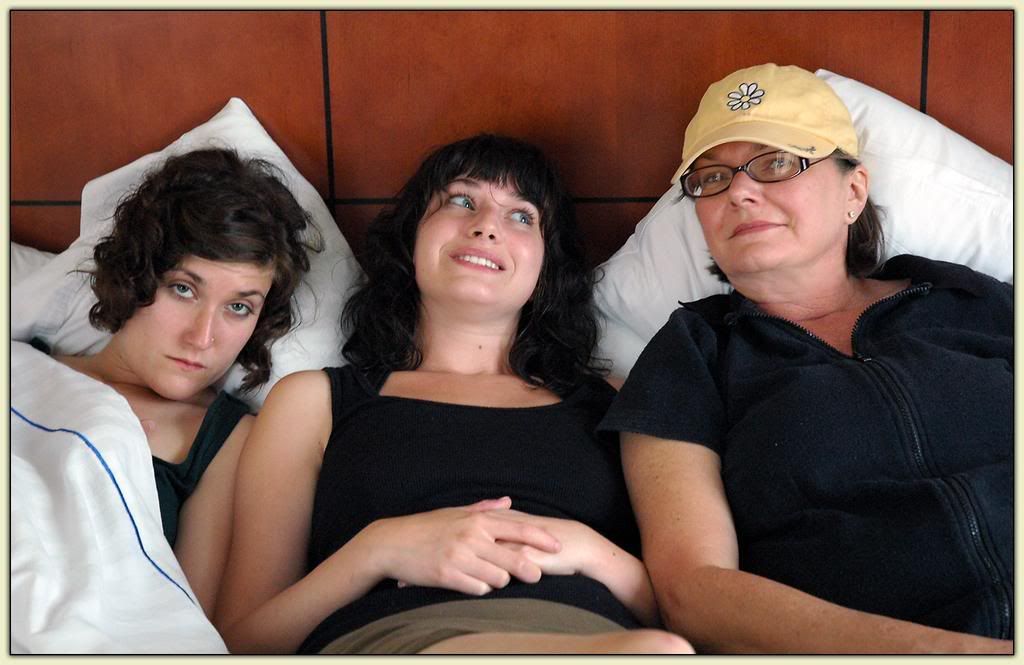
In a 2007-vintage photo, Dee and our daughters relax on a rainy afternoon in Washington, D.C.
Today is when we remember our mothers, without whom we would have a devilishly difficult time existing on Planet Earth. They are the ones who not only contributed half of our genetic material - the stuff that makes us us - but they’re the ones who had to schlep us around for something on the order of nine months, enduring (in some cases) nausea; bloat; enlarged abdomens (coupled with bladders squished down to the size of raisins); sleepless nights, and swollen extremities. They are the ones who cleaned us up after we crapped our diapers; the ones who wiped our noses, applied bandages to our scraped knees and - later - our scraped egos. They were the first ones we would run to for help when help was needed... because Mom!
We are fortunate to still have Dee’s Mom walking the planet with us. Mine is long gone - twenty-nine years - but she remains in my heart, always.
We have our precious Mamacita, our adoptive 89-year-old mommy, who loves her brood of “framily” children as her own.
And then there’s Dee, herself, who was, is, and continues to be a role model in the mothering business. She has many talents and capabilities, and she has given me many gifts over the years, but the gift of our daughters is one that daily brings a smile to my face and warmth to my heart.
Happy Mother’s Day, sweetheart! And happy Mother’s Day to all moms - family, friends, and members of the great human family... because Mom!
Friday, May 12, 2017
THE WISDOM OF RAV KATSCHKE: A 100-WORD MIDRASH

“They’re gonna do what?!”
The little village of Katzenellenbogen-affen-Yam was barely more than a speck on the map, but its minuscule size belied the extreme piety of its inhabitants. Yet now, as the Day of Atonement approached, they were faced with a most serious religious problem.
For reasons known only unto the Eternal One, a plague had descended upon the shtetl’s chickens, wiping them all out. Not a single pullet was left with which the villagers could purge their sins by performing the ancient ritual of sh’logn kapoyres.
The village rabbi consulted his dusty tomes and found a solution. “Use a duck,” he announced.
Saturday, May 6, 2017
ON NEIGHBORS
A couple of Words to Live By from today’s Torah reading:
“...you shall love your neighbor as yourself: I am the Lord.” - Leviticus 19:18
“The stranger that sojourns among you shall be to you as the home-born among you, and you shall love him as yourself; for you were strangers in the land of Egypt: I am the Lord your God.” - Leviticus 19:34
[For those of my Esteemed Readers of the Christian persuasion, I will note that in Mark 12:30-31, Jesus refers to Leviticus 19:18 as the second most important commandment, the first being the words familiar at all Jews as the Sh’ma (“Love the Lord your God with all your heart and with all your soul and with all your mind and with all your strength.”)]
I conclude from all this that any serious Christian or Jew who gets his or her bowels in a twist about immigrants... or about people different from them in their own communities... maybe needs to go back to religious school.
Dee and I are especially sensitive to these matters: My grandparents - and most of hers - were immigrants who came to this country in the early years of the twentieth century. Had they stayed in Europe, they would almost certainly have perished at the hands of the Nazis or their co-conspirators.
Moreover, thanks to my employment at the Great Corporate Salt Mine, we were frequent relocators. There were numerous times that we were the strangers that sojourned in strange lands, and it is owing to the communities that welcomed us and treated us as the home-born among them, and who loved us as themselves, that our family was able to thrive throughout the years.
“...you shall love your neighbor as yourself: I am the Lord.” - Leviticus 19:18
“The stranger that sojourns among you shall be to you as the home-born among you, and you shall love him as yourself; for you were strangers in the land of Egypt: I am the Lord your God.” - Leviticus 19:34
[For those of my Esteemed Readers of the Christian persuasion, I will note that in Mark 12:30-31, Jesus refers to Leviticus 19:18 as the second most important commandment, the first being the words familiar at all Jews as the Sh’ma (“Love the Lord your God with all your heart and with all your soul and with all your mind and with all your strength.”)]
I conclude from all this that any serious Christian or Jew who gets his or her bowels in a twist about immigrants... or about people different from them in their own communities... maybe needs to go back to religious school.
Dee and I are especially sensitive to these matters: My grandparents - and most of hers - were immigrants who came to this country in the early years of the twentieth century. Had they stayed in Europe, they would almost certainly have perished at the hands of the Nazis or their co-conspirators.
Moreover, thanks to my employment at the Great Corporate Salt Mine, we were frequent relocators. There were numerous times that we were the strangers that sojourned in strange lands, and it is owing to the communities that welcomed us and treated us as the home-born among them, and who loved us as themselves, that our family was able to thrive throughout the years.
Thursday, May 4, 2017
SUPPER AT STARBUCKS

Let’s have supper at Starbucks
We’ll stay awake all night
We can drink caffeine
’Til our teeth are green
O, won’t it be a delight
Let’s have supper at Starbucks
Bring your laptop along
The WiFi is free
And there’s a place you can pee
’Cause, man, that coffee’s strong
There are muffins and cakes and protein bars
But there’s no valet to park your cars
Let’s have supper at Starbucks
We’ll be up the whole damn night
And when we get to our house
My beloved spouse
You know I’ll treat you right
You know I’ll treat you right
ADVENTURES IN DEMENTIA
Dee and I were driving around, running a few errands, when she turned to me and asked, “Where were we coming back from Monday night when they had Johnson Ferry Road blocked off?”
My Ivy League-educated brain shifted immediately into overdrive. I knew this. I had this.
We had been out to dinner with friends at a popular Italian place... one with which we had been very familiar when we lived in Sweat City. It had gotten its start there, beginning with a single restaurant downtown and later adding a second location outside the I-610 loop on the west side. And then came the deluge: a deal with Outback that resulted in massive expansion across the country.
Now, what the fuck was the name?
Me: “Carraboogio’s?” (Ohhh, so close!)
Dee: “Carrababba’s.”
We looked at each other. Of course, it was Carrabba’s.
Derp!
My Ivy League-educated brain shifted immediately into overdrive. I knew this. I had this.
We had been out to dinner with friends at a popular Italian place... one with which we had been very familiar when we lived in Sweat City. It had gotten its start there, beginning with a single restaurant downtown and later adding a second location outside the I-610 loop on the west side. And then came the deluge: a deal with Outback that resulted in massive expansion across the country.
Now, what the fuck was the name?
Me: “Carraboogio’s?” (Ohhh, so close!)
Dee: “Carrababba’s.”
We looked at each other. Of course, it was Carrabba’s.
Derp!

Wednesday, May 3, 2017
CARS ON THE FENCE: A MEDITATION ON HUMAN BEHAVIOR
Albert Einstein once famously said that doing the same thing over and over again and expecting different results is the definition of insanity.
It could also be said that it is the definition of how a four-year-old plays with toys. Call it discovery rather than insanity, the latter of which is a condition more descriptive of full-grown adults.
Consider the case of a small child playing with toy cars. “If I put these toys on the top of the fence where they often fall on the other side and become unreachable, should I (1) continue putting the toys on top of the fence, or (2) stop putting the toys on top of the fence?”
Ahhh, the tenuous connection between action and consequence: That connection is the great undiscovered country for a four-year-old, and learning how it operates is a Critical Life Skill. Some little ones figure it out pretty quickly, while others take a bit longer.
And some of us adults never quite get it. Being human dooms many of us to living on the slack side of the learning curve.
It could also be said that it is the definition of how a four-year-old plays with toys. Call it discovery rather than insanity, the latter of which is a condition more descriptive of full-grown adults.
Consider the case of a small child playing with toy cars. “If I put these toys on the top of the fence where they often fall on the other side and become unreachable, should I (1) continue putting the toys on top of the fence, or (2) stop putting the toys on top of the fence?”
Ahhh, the tenuous connection between action and consequence: That connection is the great undiscovered country for a four-year-old, and learning how it operates is a Critical Life Skill. Some little ones figure it out pretty quickly, while others take a bit longer.
And some of us adults never quite get it. Being human dooms many of us to living on the slack side of the learning curve.
Tuesday, April 25, 2017
BLACK BEAR

“Did someone just try to poke me? I hate it when someone pokes me.”
Black bear growling in the dead of night
Eat a moose in one big honkin’ bite
O, the fright
You are always prowling in the middle of the night
Black bear growling in the dead of night
Take my pen, but you can’t learn to write
Yeah, that’s right
Stick to what you know and take a great big honkin’ bite
Black bear bite
Black bear bite
Eatin’ that moose in the cold dark night
Black bear growling in the dead of night
Eat a moose in one big honkin’ bite
O, the fright
You are always prowling in the middle of the night
You are always prowling in the middle of the night
You are always prowling in the middle of the night
[Semi-sincere apologies to John Lennon and Paul McCartney]
Friday, April 14, 2017
from BREI

Houston Steve prepares a whole mess of matzoh brei on the flat top.
But hark! A sound is stealing on my ear—
A soft and silvery sound—I know it well
Its tinkling tells me that a time is near
Precious to me—It is the Breakfast Bell.
O, blessèd Bell! Thou bringest Matzoh Brei,
Thou bringest good things more than tongue can tell:
Seared is, of course, my heart—but unsubdued
Is, and shall be, my appetite for food.
I go. Untaught and feeble is my pen:
But on one statement I may safely venture:
That few of our most highly gifted men
Have more appreciation for the trencher.
I go. One plate of Matzoh Brei and then
A recitation from my food-stained bentcher;
That, shulward-going, I may safely say,
“Kein ayin hora, I have dined today.”
(Apologies to C. S. Calverley)
Thursday, April 13, 2017
MATZOH BREI MORNING
We’re three days into Passover, a festival that runs for eight days here in the Diaspora. (It’s only seven days long in Israel, for reasons that I will not waste your time explaining right now. If you’re that curious, drop me a comment.)
The salient feature of Passover is its especially stringent dietary laws. Jews are forbidden to eat anything containing leaven - fermented or fermentable products of wheat, spelt, rye, oats, or barley. Those grains may only be consumed in the form of matzoh, a cracker-like concoction made with the addition of water only, and which must be baked within eighteen minutes of being moistened lest the tiniest trace of fermentation occur.
It is not a bread-lover’s holiday. Nor is it a whisky- or beer-lover’s holiday.
One is only obligated to eat matzoh twice: during the Passover Seder meals on the first two evenings of the holiday. The rest of the time it is optional. Actually, though, matzoh isn’t too bad. It is crisp and tasty in its own way, and it’s an excellent butter conveyance device. I don’t go out of my way to consume it during the rest of the year, but I enjoy it for the duration of the Festival of Unleavened Bread despite its legendary constipating effects. (Pro tip: eat plenty of fruit compote or prunes.)
A popular breakfast dish that makes excellent use of matzoh is matzoh brei. (That’s “brei,” which rhymes with “fry.” People who spell it “matzoh brie” have forgotten their English phonics lessons.) Think of it as French toast with matzoh in lieu of bread... or, as the French might say, pain perdu dans le désert pendant quarante ans. It’s versatile, as it can be served up sweet or savory as one wishes.
This morning I cooked up some MB, a dish for which there are as many recipes as there are Jewish grandmothers... and this is how I did it:
Take a couple of boards of matzoh, Over a bowl, crumble those bad boys up into nice little shards. Big chunks, little bits, your choice. Feeling lazy? Use matzoh farfel, which has already been crumbled for you. Pour over it a little boiling water and let it sit for a few minutes to soften up. Let cool. If you’ve overdone it with the hot water, squeeze the excess out.
Drop in a couple of eggs. I used one egg per matzoh-board, but you can adjust this based on how eggy you like your matzoh brei. Mix well, add salt and pepper, and then drop it into a preheated skillet that has been greased up with a little butter, ghee, olive oil, whatever. Scramble it or cook it pancake-style - however you like it. (This ain’t Julia Child, you know.) When it starts to get nice and brown, you are good to go. Serve it forth.
I like my brei savory, so I jack up the salt and pepper content. You can add a dollop of sour cream, or you can take the sweet route with sugar, jam, or syrup.
Now eat, bubeleh!
The salient feature of Passover is its especially stringent dietary laws. Jews are forbidden to eat anything containing leaven - fermented or fermentable products of wheat, spelt, rye, oats, or barley. Those grains may only be consumed in the form of matzoh, a cracker-like concoction made with the addition of water only, and which must be baked within eighteen minutes of being moistened lest the tiniest trace of fermentation occur.
It is not a bread-lover’s holiday. Nor is it a whisky- or beer-lover’s holiday.
One is only obligated to eat matzoh twice: during the Passover Seder meals on the first two evenings of the holiday. The rest of the time it is optional. Actually, though, matzoh isn’t too bad. It is crisp and tasty in its own way, and it’s an excellent butter conveyance device. I don’t go out of my way to consume it during the rest of the year, but I enjoy it for the duration of the Festival of Unleavened Bread despite its legendary constipating effects. (Pro tip: eat plenty of fruit compote or prunes.)
A popular breakfast dish that makes excellent use of matzoh is matzoh brei. (That’s “brei,” which rhymes with “fry.” People who spell it “matzoh brie” have forgotten their English phonics lessons.) Think of it as French toast with matzoh in lieu of bread... or, as the French might say, pain perdu dans le désert pendant quarante ans. It’s versatile, as it can be served up sweet or savory as one wishes.
This morning I cooked up some MB, a dish for which there are as many recipes as there are Jewish grandmothers... and this is how I did it:
Take a couple of boards of matzoh, Over a bowl, crumble those bad boys up into nice little shards. Big chunks, little bits, your choice. Feeling lazy? Use matzoh farfel, which has already been crumbled for you. Pour over it a little boiling water and let it sit for a few minutes to soften up. Let cool. If you’ve overdone it with the hot water, squeeze the excess out.
Drop in a couple of eggs. I used one egg per matzoh-board, but you can adjust this based on how eggy you like your matzoh brei. Mix well, add salt and pepper, and then drop it into a preheated skillet that has been greased up with a little butter, ghee, olive oil, whatever. Scramble it or cook it pancake-style - however you like it. (This ain’t Julia Child, you know.) When it starts to get nice and brown, you are good to go. Serve it forth.
I like my brei savory, so I jack up the salt and pepper content. You can add a dollop of sour cream, or you can take the sweet route with sugar, jam, or syrup.
Now eat, bubeleh!
Monday, April 10, 2017
THE RITE OF SPRING
When Igor Stravinsky wrote The Rite of Spring, he was doubtless not thinking about the Passover festival, but our seasonal holiday - our Rite of Spring - creates its own musical masterpiece every year, in smell instead of sound.
I’m upstairs while Dee is beginning the lengthy labor of preparing for our Passover Seder tomorrow. There’s a humongous slab of beef brisket in the oven braising merrily away, while a massive skillet of matzoh farfel with onions and mushrooms adds to the symphony of cooking aromas.
They’re the aromas of the season... the distinctive (and beloved) Pongs o’Pesach.
Soon we will introduce other aromatic grace notes. The sweet medley of fruit compote as it simmers. The apple, cinnamon, and wine of the charoset. The sprightly fragrance of asparagus, the vegetable that - more than almost any other - connotes springtime.
The lower register of our symphony will be composed of the deep, mellow aroma of onions caramelizing in goose schmaltz, a key ingredient in the chopped liver I’ll be making later this evening.
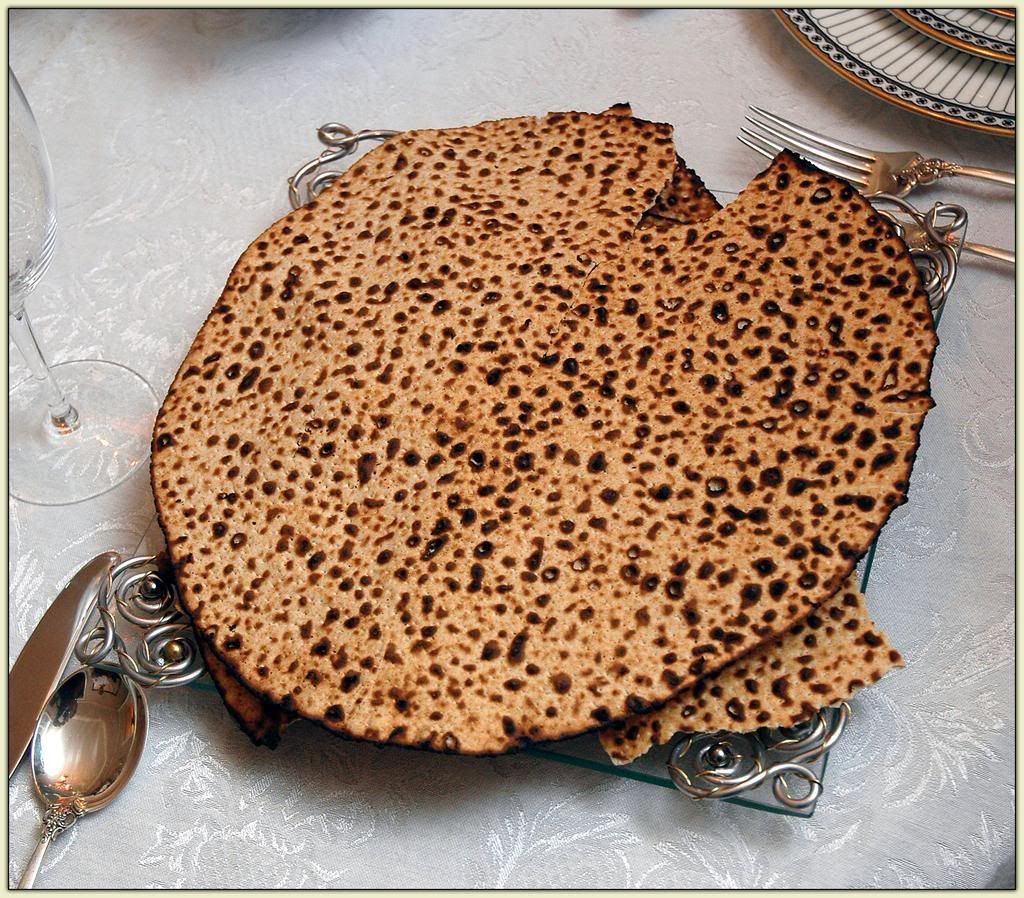
Handmade shmura matzoh. The snap of breaking matzoh provides a crisp percussion element.
There’ll be other additions to the program. Dee has already prepared the gefilte fish, which will (when served) provide the overture to the festive meal, with its sting of horseradish. Houston Steve has a vat of chicken soup (with caramelized onion matzoh balls) that will likely require a tanker truck to transport it here. And there will be a mountain of sweet stuff as well, provided by our friend Debbie.
I’ve heard variations of this symphony all my life... and I look forward to it every year.
Regardless of your religious or family traditions, this time of year is one that is filled with taste memories. Why not share yours in the Comments?
I’m upstairs while Dee is beginning the lengthy labor of preparing for our Passover Seder tomorrow. There’s a humongous slab of beef brisket in the oven braising merrily away, while a massive skillet of matzoh farfel with onions and mushrooms adds to the symphony of cooking aromas.
They’re the aromas of the season... the distinctive (and beloved) Pongs o’Pesach.
Soon we will introduce other aromatic grace notes. The sweet medley of fruit compote as it simmers. The apple, cinnamon, and wine of the charoset. The sprightly fragrance of asparagus, the vegetable that - more than almost any other - connotes springtime.
The lower register of our symphony will be composed of the deep, mellow aroma of onions caramelizing in goose schmaltz, a key ingredient in the chopped liver I’ll be making later this evening.
Handmade shmura matzoh. The snap of breaking matzoh provides a crisp percussion element.
There’ll be other additions to the program. Dee has already prepared the gefilte fish, which will (when served) provide the overture to the festive meal, with its sting of horseradish. Houston Steve has a vat of chicken soup (with caramelized onion matzoh balls) that will likely require a tanker truck to transport it here. And there will be a mountain of sweet stuff as well, provided by our friend Debbie.
I’ve heard variations of this symphony all my life... and I look forward to it every year.
Regardless of your religious or family traditions, this time of year is one that is filled with taste memories. Why not share yours in the Comments?
Friday, April 7, 2017
GOLF SEASON... AGAIN

The Momma d’Elisson of blessèd memory, in her college yearbook photo.
We Red Sea Pedestrians are a strange lot.
Birthdays don’t matter all that much to us. Sure, we celebrate ’em... but that’s a secular activity that is driven mainly by our participation in the American popular culture. There’s no religious observance that attaches to birthdays, save for the recognition of a child as a Bar or Bat Mitzvah at the age of thirteen (for boys, and as early as twelve for girls).
We pay more attention to the date on which a person moves on to Olam ha-Ba, the World to Come.
The anniversary of a person’s death - the Yahrzeit - is observed by the people who mourned that person in life, a permanent ritual of remembrance. Traditionally, one lights a candle that burns for a full twenty-four hours. It is also customary to attend services so that one may, in the presence of the required quorum of ten worshipers, recite the Mourner’s Kaddish, a prayer which, despite its name, is not an expression of grief but rather a call-and-response expression of praise.
It was explained to me once that birthdays are less meaningful than Yahrzeits because a person is, at birth, a mass of unrealized potential. Upon his or her passing, however, that person has (it is to be hoped) affected other lives and brought some measurable change to the world. He or she is, at least to the extent possible, has become a sort of Known Quantity. You can take that explanation or leave it, but it does - at least, to me - make some sense.
If you translated Yahrzeit literally, you’d get “year-time” - anniversary. But the term has a further implication, that of “season,” rendered Jahreszeit in German. It’s not just that a year has passed; it’s that a particular time of year connects us to our long-gone loved ones in a unique, powerful way.
With my mother, that season is the springtime, the days leading up to the Passover holiday. It’s a time when the days get longer and warmer, when trees are in bloom, when the yellow blossoms of forsythia (one of her favorites) paint the neighborhood. (Yes, I know we throw a memorial dinner for her every year on the first night of Chanukah, but there’s another story behind that peculiar observance.)
I suspect that this time of year, she would have mostly been thinking, “Golf Season is here!” She was, after all, an inveterate golfer, playing two or more times a week at a time when most of the neighborhood’s housewives were deciding whether to fix a meatloaf or hot dogs for the family supper, or what kind of pie to bring to the school’s bake sale. Always athletic, she also played tennis and bowled, covering both the white-collar and blue-collar sides of the sports spectrum.
We can only speculate upon what she would have been like in her Golden Years, had she lived to enjoy them. Would she have slowly grown cranky and obstreperous like her own mother had done, or would she have continued to be the fun-loving Doting Grandma to her beloved granddaughters? We can only wonder... but I like to think that she would have avoided the trap of Excessive Cantakerousness.
Tomorrow is Mom’s twenty-ninth Yahrzeit. For almost three decades now, she has been playing her heavenly Golf Game from the side of the fairway where the pointy part of the tee goes, and we who have been left behind to mourn her have had to do without her warmth, humor, and common sense.
This evening I’ll light that candle, and I’ll be at shul tomorrow to say Kaddish. Perhaps I will toast her memory with a perfect Rob Roy - her favorite cocktail - and ponder the bittersweet realization that I have even now walked the Earth over four years longer than she had the opportunity to do. Alas.
[Adapted from my original post dated March 22, 2013.]
Tuesday, March 28, 2017
ECCLESIASTICAL EMPLOYMENT
Every religious institution has a cadre of employees and functionaries without whom it could not function. For example, a Roman Catholic church would be in big trouble without its priest, its altar boys, and whoever gets to swing that incense censer.
The synagogue, of course, is no exception.
Most people, when asked to name the essential personnel at the Jew-Church, will put the rabbi at the top of the list. Not so! It’s nice to have a rabbi, of course - having someone who holds ordination papers lends a certain amount of gravitas to the proceedings and is also handy if you want to conduct a wedding - but he or she is not necessary. Same goes for the chazzan (cantor), whose voice is as superfluous as it is mellifluous. Lay people can perform these roles.
The real essential personnel are the ones who work behind the scenes: the custodial staff. These are the folks that see to all the daily operations of the building without which there would be disorder, filth, and discomfort. These functions overlap to an extent with those of the “Shabbes goy,” a function that really deserves its own category.
“Shabbes goy” is a term that literally means Sabbath Gentile: a non-Jew who performs functions on the Sabbath that are not permitted to the observant Red Sea Pedestrian. It is, of course, not that simple: anything having to do with Jewish law never is. A Jew cannot simply hire a non-Jew to stoke the fireplace on the Sabbath in his stead, for that is equally forbidden. But he might say, “Gee, it’s awfully cold in here (wink wink, nudge nudge),” and the implicit assumption is that the non-Jew, unconstrained by the rules of Sabbath observance, might take it upon himself to throw a log on the fire. The same rationale allows lights to be switched on or off, thermostats to be adjusted, and so on.
Being a Shabbes goy is a respectable profession is its own way, and there are several people who served in that role before achieving fame and fortune in other fields. Perhaps you’ve heard of them: Elvis Presley, Harry Truman, Al Gore, Barack Obama, Colin Powell, Thurgood Marshall, and Mario Cuomo.

“I wanna hunka hunka hunka burnin’ chopped liver.”
There are other jobs as well. The shammes (AKA beadle or sexton) may perform minor functions such as ushering and assisting with religious functions. In our congregation, we call these folks the “go-getters,” and their job is to ensure that religious honors are distributed properly and that the service flows smoothly. You would be surprised how much subtle choreography is involved in a religious service.
The gabbaim (singular: gabbai) officiate during the ceremonial reading from the Torah scroll, ensuring that any errors in the reading or cantillation are corrected, and announcing page and verse numbers so that the congregation can follow along in their printed books. Because the scroll contains nothing but consonants - no vowels or musical notes, which must be memorized by the reader - the function of the gabbaim is essential.
And yet perhaps the most unsung (and critical) role in the synagogue is that of the Haisse Dondeh. It’s hard to imagine any Jewish house of worship functioning without at least one Haisse Dondeh, and I suspect that many of our Christian friends may have a person (or persons) with a similar job in their congregations as well. What does he do? When someone is standing at an inappropriate moment, he shouts, “Hey! Siddown there!”
[H/T: Joe Saruk z''l]
The synagogue, of course, is no exception.
Most people, when asked to name the essential personnel at the Jew-Church, will put the rabbi at the top of the list. Not so! It’s nice to have a rabbi, of course - having someone who holds ordination papers lends a certain amount of gravitas to the proceedings and is also handy if you want to conduct a wedding - but he or she is not necessary. Same goes for the chazzan (cantor), whose voice is as superfluous as it is mellifluous. Lay people can perform these roles.
The real essential personnel are the ones who work behind the scenes: the custodial staff. These are the folks that see to all the daily operations of the building without which there would be disorder, filth, and discomfort. These functions overlap to an extent with those of the “Shabbes goy,” a function that really deserves its own category.
“Shabbes goy” is a term that literally means Sabbath Gentile: a non-Jew who performs functions on the Sabbath that are not permitted to the observant Red Sea Pedestrian. It is, of course, not that simple: anything having to do with Jewish law never is. A Jew cannot simply hire a non-Jew to stoke the fireplace on the Sabbath in his stead, for that is equally forbidden. But he might say, “Gee, it’s awfully cold in here (wink wink, nudge nudge),” and the implicit assumption is that the non-Jew, unconstrained by the rules of Sabbath observance, might take it upon himself to throw a log on the fire. The same rationale allows lights to be switched on or off, thermostats to be adjusted, and so on.
Being a Shabbes goy is a respectable profession is its own way, and there are several people who served in that role before achieving fame and fortune in other fields. Perhaps you’ve heard of them: Elvis Presley, Harry Truman, Al Gore, Barack Obama, Colin Powell, Thurgood Marshall, and Mario Cuomo.

“I wanna hunka hunka hunka burnin’ chopped liver.”
There are other jobs as well. The shammes (AKA beadle or sexton) may perform minor functions such as ushering and assisting with religious functions. In our congregation, we call these folks the “go-getters,” and their job is to ensure that religious honors are distributed properly and that the service flows smoothly. You would be surprised how much subtle choreography is involved in a religious service.
The gabbaim (singular: gabbai) officiate during the ceremonial reading from the Torah scroll, ensuring that any errors in the reading or cantillation are corrected, and announcing page and verse numbers so that the congregation can follow along in their printed books. Because the scroll contains nothing but consonants - no vowels or musical notes, which must be memorized by the reader - the function of the gabbaim is essential.
And yet perhaps the most unsung (and critical) role in the synagogue is that of the Haisse Dondeh. It’s hard to imagine any Jewish house of worship functioning without at least one Haisse Dondeh, and I suspect that many of our Christian friends may have a person (or persons) with a similar job in their congregations as well. What does he do? When someone is standing at an inappropriate moment, he shouts, “Hey! Siddown there!”
[H/T: Joe Saruk z''l]
THE PERIPATETIC SOCK
Waldo and Carmen Sandiego have nothing on Edith’s big blue stocking.
Waldo. Remember him? He was that douchenozzle in the round spectacles, wearing a stripèd shirt and matching stocking cap, always lurking in the midst of a crowd in various bizarre places. The kind of guy who gets around despite having no visible means of support. These days, he’d probably be on the terrorist watch lists of twelve different countries just for showing up.
And then there’s Carmen, a five-year-old kid with the travel budget of the entire Belgian parliament and the kind of precocious geographical knowledge that only an autistic savant - or a highly educated dwarf - could muster.
What they have in common is their seemingly miraculous abilities to move from one place to another... like Sean Spicer sensing a truth-molecule in an enclosed space and frantically attempting to dodge it.
Which brings us to Edith’s sock. Stocking. Whatever.
The stocking itself was a long-ago gift from our friends Laura Belle and Donnie Joe. They had gotten our girls a matched set of fuzzy blue Christmas stockings for the express purpose of packing them full of holiday tchotchkes. Blue, of course, because of Chanukah. Both stockings are still in use for their original purpose, but Edith has apparently discovered the one that the Mistress of Sarcasm had buried deep in her bedroom closet.
Stella has never been a cat that evinced any interest in schlepping stuff around. She’s more involved in typical Ragdoll behavior: grooming herself, leaving steamers atop the litter in her box while making no attempt to bury them, looking gorgeous, harfing up the occasional hairball, and napping frequently. For that matter, none of our Kitty-Companions have been schleppers. Stripes, Hakuna, Matata, and Levon were all content to leave stuff where it lay.
Edith is different. Edith moves things around. Edith modifies her world to suit her own desires.
Yesterday evening, for example, the Blue Sock had been downstairs. But as I arose this morning, Edith greeted me with an unusually loud series of miaows. Was she alerting me to Stella’s presence? No, she was informing me that she had delivered unto me a gift: the Blue Sock, which now lay atop our bed, placed neatly in Edith’s sleeping-pad.
By mid-day, it had worked its way to the Mistress of Sarcasm’s room on the other side of the house’s upper level. It’s anyone’s guess how long it will stay there before migrating back downstairs.
We’ve caught her in transporte delicto, so to speak... with the sock hanging from her mouth as she trots from room to room. It’s hysterical.

I suppose I can’t complain. Outdoor kitties bring all sorts of presents to their human parents, some not particularly welcome. And as Kitty-Gifts go, I’ll gladly take a migrating sock over the occasional eviscerated mouse or decapitated bird.
Postscriptum: The sock continues its journeys. Bedroom, breakfast room, entry hall... who knows where it will appear next?
Waldo. Remember him? He was that douchenozzle in the round spectacles, wearing a stripèd shirt and matching stocking cap, always lurking in the midst of a crowd in various bizarre places. The kind of guy who gets around despite having no visible means of support. These days, he’d probably be on the terrorist watch lists of twelve different countries just for showing up.
And then there’s Carmen, a five-year-old kid with the travel budget of the entire Belgian parliament and the kind of precocious geographical knowledge that only an autistic savant - or a highly educated dwarf - could muster.
What they have in common is their seemingly miraculous abilities to move from one place to another... like Sean Spicer sensing a truth-molecule in an enclosed space and frantically attempting to dodge it.
Which brings us to Edith’s sock. Stocking. Whatever.
The stocking itself was a long-ago gift from our friends Laura Belle and Donnie Joe. They had gotten our girls a matched set of fuzzy blue Christmas stockings for the express purpose of packing them full of holiday tchotchkes. Blue, of course, because of Chanukah. Both stockings are still in use for their original purpose, but Edith has apparently discovered the one that the Mistress of Sarcasm had buried deep in her bedroom closet.
Stella has never been a cat that evinced any interest in schlepping stuff around. She’s more involved in typical Ragdoll behavior: grooming herself, leaving steamers atop the litter in her box while making no attempt to bury them, looking gorgeous, harfing up the occasional hairball, and napping frequently. For that matter, none of our Kitty-Companions have been schleppers. Stripes, Hakuna, Matata, and Levon were all content to leave stuff where it lay.
Edith is different. Edith moves things around. Edith modifies her world to suit her own desires.
Yesterday evening, for example, the Blue Sock had been downstairs. But as I arose this morning, Edith greeted me with an unusually loud series of miaows. Was she alerting me to Stella’s presence? No, she was informing me that she had delivered unto me a gift: the Blue Sock, which now lay atop our bed, placed neatly in Edith’s sleeping-pad.
By mid-day, it had worked its way to the Mistress of Sarcasm’s room on the other side of the house’s upper level. It’s anyone’s guess how long it will stay there before migrating back downstairs.
We’ve caught her in transporte delicto, so to speak... with the sock hanging from her mouth as she trots from room to room. It’s hysterical.

I suppose I can’t complain. Outdoor kitties bring all sorts of presents to their human parents, some not particularly welcome. And as Kitty-Gifts go, I’ll gladly take a migrating sock over the occasional eviscerated mouse or decapitated bird.
Postscriptum: The sock continues its journeys. Bedroom, breakfast room, entry hall... who knows where it will appear next?
Monday, March 27, 2017
DOMESTIC TRANQUILITY

Edith and the Mistress of Sarcasm enjoy a Tranquil Moment together. It’s the picture of poifect contentment, I tells ya!
Subscribe to:
Posts (Atom)


 Posts
Posts