Dazed and confused? Not me. I’m just Lost in the Cheese Aisle.
Showing posts with label Great Literature. Show all posts

Tuesday, May 24, 2016

ON HUMOR AND HUMOR MAGAZINES

Mad #1
Mad #1, October 1952. Is it a coincidence that Mad and I arrived on the planet bearing the same birthdate?

My formative years included a regular dose of Mad Magazine’s inspired foolishness. After having seen a few copies in the hands of some of my more disreputable classmates, I bought my first Mad in April of 1962 at the ripe old age of nine. It provided hours of entertainment as my mother, brother, and I took the 25-hour train ride on the Atlantic Coast Line’s Miami Special from Penn Station (the old Penn Station) to south Florida.

I didn’t miss a single issue until it was almost time to receive my college degree. I still have ’em: All those old copies of Mad - along with many others - reside in the bowels of Chez Elisson.

The first issue of Mad I ever
bought: June 1962.
It was not obvious to me at first, but Mad was a kind of distillate of Jewish humor and thinking. It was humor that, while itself not of the Borscht Belt (the resorts in the Catskill Mountains that catered to a Jewish clientele and where many famous comedians cut their humor-teeth), understood the Borscht Belt. Nietszche observed that when you stare into the abyss, the abyss stares back at you: so the comic sensibilities of a whole generation of tummlers were reflected in Mad’s pages. Not all of its writers and artists were Jewish, but it seemed like even the non-Jews had absorbed a certain degree of Yiddishkeit. There were so many Yiddish words and phrases sprinkled in - like poppyseeds on a challah - that sometimes I would be mystified even as my parents would crack up. (A fake travelogue about the fictional town of Gournish, Illinois, for example, is funnier when you know that goornisht means “absolutely nothing” in Yiddish.)

Halvah. Farshimmelt. Furshlugginer.

As I got older, I continued to buy my monthly copies of Mad, but by the time I got to college there was a new kid in Humortown: the National Lampoon.

This infamous January 1973 NatLamp
resides in the Elisson archives.
The Lampoon was a completely different animal. Spun off from the Harvard Lampoon in 1970 by several of that school’s alumni, its humorous sensibility was entirely different. It was WASP Ivy League humor. Its parodies had layers of chucklestuff that could only be teased out with difficulty... unless you were widely read. And it was seasoned with a liberal application of tasty, tasty ribaldry - something that Mad entirely lacked.

It was just the thing to appeal to a young man coming of age in the early 1970’s. The National Lampoon was like a college humor rag gone mainstream - because that is, in fact, exactly what it was.

I myself was involved in that world for a time, gradually getting involved with the Princeton Tiger - our own attempt to bring Teh Funny to a semi-sophisticated college audience. Starting as a contributing artist, I managed to work my way up to chairman of the magazine.

The two disparate worlds of Mad - old-school Jewish humor - and my newer Ivy League college humor sensibilities collided one evening as I traipsed from dormitory to dormitory, hawking copies of the latest Tiger Mag. One of my customers (to my delighted surprise) turned out to be one George Woodbridge, Jr., whose father had been one of “the usual gang of idiots” illustrating Mad magazine since the early 1950’s.

Princeton Tiger, September 1972.
Art by Yours Truly.

The Tiger - at least, in the early 1970’s - was not in the league of either the NatLamp or Mad, although it could boast of having had numerous well-known alumni in its ranks over the years: Booth Tarkington, F. Scott Fitzgerald, John McPhee, Michael Witte, Henry Martin, Henry Payne, and Chip Deffaa among them. And here’s a little-known factoid for you: the first published appearance of the limerick that begins “There once was a man from Nantucket...” was in a 1902 copy of the Tiger.

It is, alas, the clean version, the one that goes as follows...

There once was a man from Nantucket
Who kept all his cash in a bucket.   
But his daughter, named Nan,
Ran away with a man

And as for the bucket, Nantucket.

[The ribald version with which most of us are familiar may predate this, but its earliest publishing date was in 1927.]

A couple of years ago, Dee and I were strolling around the Princeton campus during my 40th Reunion weekend, and we managed to get to the Tiger offices just in time to catch the very tail end of an open house. I may have been among the older alumni stopping by that day (who knows?), but I was pleased to see that, among the numerous old magazine covers festooning the walls of the offices, several of my creations were included. That seemed to impress the staffers.

“Wow, you did some of those covers? You must be really fucking old!”
They asked me if I had any advice for them, and indeed I had.

“You probably feel sometimes that you are nought but a collection of geeks and nerds. Highly intelligent geeks and nerds, but here you are, working on the Tiger. Am I right?

“But here’s the thing. Yesterday evening at our Class Dinner, I saw a lot of people that hadn’t seen me in years... and plenty of people who didn’t know me very well when we were students here. But the funny thing is, almost everyone who knew me - even marginally - remembered that I had been involved with the Tiger. ‘Oh, yeah, I know you - you were with the Tiger Mag!’

“Here it is, forty years down the road, and the majority of people in our class who remember my name don’t remember what my major was, or whether I was graduated with honors, or how I did on that problem set that kept me up two nights in a row, or what grade I got on my Orgo midterm, my Thermo final, or my thesis... but, by Gawd, they remember that I worked on the Tiger Mag. So think about that the next time you’re busting your asses to meet a deadline. This - this stuff right here - is how you will be remembered.”

I tried to ignore that the floor of the office was covered with hundreds of unopened condom packages as we beat (you should excuse the expression) a moderately hasty retreat.

Monday, August 17, 2015

ON THE FOODLY BUCKET LIST

Mimi Sheraton, celebrated food writer and former restaurant critic for the New York Times, has come out with a new book: 1000 Foods to Eat Before You Die: A Food Lover’s Life List.

Ms. Sheraton, at the age of eighty-nine, has had way more food experience than most of us. I figured I would see what I had been missing out on... or, put another way, whether I needed to reorder my Foodly Priorities in case (Gawd forbid) I should get hit by a bus or meteor tomorrow.

I’m still plowing through the first chapter, which focuses on British and Irish foods... and I have been pleasantly surprised to have enjoyed several items on her list, including roast goose (albeit not with sage-onion stuffing), roast beef with Yorkshire pudding, Gentleman’s Relish, shepherd’s pie, steak and kidney pie, fish and chips, codfish cakes, and Stilton cheese.

Cheddar cheese is also on Ms. Sheraton’s list, and here is what she has to say:

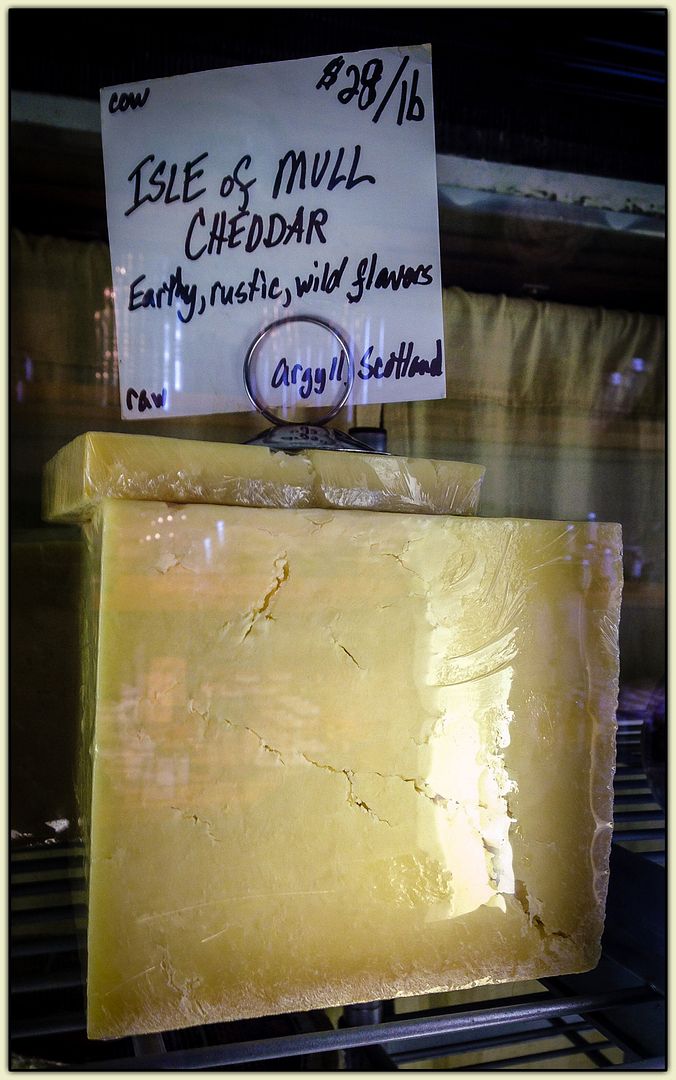
“By far the best and most complex of all, and the rarest in the U.S., is the Isle of Mull cheddar, from the Sgriob-ruadh farm (the Gaelic means ‘red furrow’ and is pronounced ‘SKEE-brooah’) on the Isle of Mull in the Inner Hebrides.”

Thanks to happy coincidence, I had only a few days prior procured a chunk of that very cheese at Star Provisions, the high-end food purveyor where I go when I need, say, a whole lobe of duck foie gras. It had gotten my attention because the Isle of Mull is the home of the Tobermory Distillery, some of whose fine products I have sampled thanks to my malt-loving buddy Eric. Apparently, the dairy lies hard by said distillery, and the cows’ diet is supplemented with spent barley mash. Lucky cows.


And, yes, that Cheddar is pretty damned good... although I also am a fan of Vermont-made Cabot Clothbound cheddar. Which one is better at any given moment depends on your mood, and what you’re having it with.

I can’t wait to see what other goodies Mimi and I agree upon. I’ll keep you posted...

Tuesday, August 11, 2015

IN WHICH I DESPOIL A SCIENCE FICTION CLASSIC

Science fiction fans will remember Frank Herbert’s 1965 novel Dune, a landmark work that eventually gave rise to a whole series of books. Herbert ended up writing six Dune novels in total, ranging in quality from “meh” to “excellent,” with none of the sequels quite measuring up to the original. (After his death, his son Brian, along with collaborator Kevin J. Anderson, would milk the property relentlessly with additional sequels and prequels.)

Dune was a rarity: a science fiction novel set in a fully realized imaginary universe, one that had a complex society, technology that was simultaneously highly advanced and yet limited in comparison with our own, and memorable characters. It cried out to be filmed, yet was so intricate as to be practically unfilmable. That did not stop people like Arthur P. Jacobs and Alejandro Jodorowsky from trying, although they never succeeded in getting a project off the ground... too damn bad, because that film would have been amazing. (Imagine Dune as envisioned by H. R. Giger. Yeah, that H. R. Giger.)

Instead, after a decade or so of Development Hell, executive producer Dino De Laurentiis hired David Lynch to write and direct his own version of Dune. At first blush, one would think that the creative mind behind films such as Eraserhead and The Elephant Man - not to mention the enigmatic television series Twin Peaks - would be just the person to bring Dune to the big screen with the appropriate creative vision. One would, alas, be wrong.

The 1984 De Laurentiis production of Dune was, to put it mildly, disappointing. The art and set design were the sole bright spots in a movie that featured weird voiceovers, huge narrative and motivational gaps, and plenty of scenery chewing. That’s too bad: the property deserved so much better.

It had its moments. Kyle MacLachlan and Sting in a knife fight! Sting wearing a glorified diaper! Mentat Piter de Vries (played by Brad Dourif with majorly bushy eyebrows, a complete 180° turn from his later, eyebrowless portrayal of Grima Wormtongue in the LOTR films) mumbling the Mentat Mantra, a glorious piece of nonsense Lynch created for the film:
“It is by will alone I set my mind in motion. It is by the juice of sapho that thoughts acquire speed, the lips acquire stains, the stains become a warning. It is by will alone I set my mind in motion.”
Baron Harkonnen in his antigravity belt, soaring around the room and laughing like a maniac! And, of course, the bizarre Guild steersmen, so mutated by constant exposure to the melange spice that they resemble giant versions of Donovan’s Brain.

Nevertheless, some people see something salvageable in this glorious mess of a film. At least, film editor Michael Warren did. He decided to patch together the original theatrical film along with numerous deleted scenes, storyboards, and extended television footage to create what he thinks is a New and Improved Dune, which he was kind enough to upload to Vimeo.

Is it any good? Well, I just started watching it, so it’s too early to say. But one thing caught my eye, and that was some of the early footage that featured illustrations of José Ferrer in his role as the Padishah Emperor Shaddam IV. Why, that face and uniform looked sorta... familiar!


General Elisson and the Padishah Emperor. Separated at birth?

Update: It appears that the video has been taken down, no doubt because of the spike in attention it received as a result of the Digg link. Perhaps the nice folks at Universal had some intellectual property concerns.

Oh, well. That’ll save me the three hours I would have pissed away watching the thing.

Monday, October 20, 2014

ANOTHER USELESS OBSERVATION


For all you LOTR nerds out there...

Is it just me, or has anyone else noticed that the inscription on the One Ring - in the language of Mordor (“Black Speech”), written in the Elvish tengwar script, and visible only when the ring is red-hot - can be sung to the tune of the Ode to Joy in the final movement of Beethoven’s Ninth Symphony?

Ash nazg durbatulûk,
Ash nazg gimbatul,
Ash nazg thrakatulûk
Agh burzum-ishi krimpatul

Try it... it works!

Sunday, June 22, 2014

FLOWERS FOR DANIEL

...P.P.S. please if you get a chanse put some flowrs on Algernons grave in the bak yard...

- from Flowers for Algernon, by Daniel Keyes

Daniel Keyes, author of the tragically brilliant short story Flowers for Algernon, died last week at the age of eighty-six.

The story concerns Charly, an intellectually challenged man - in older, less politically correct days, he would have been called “retarded” - who is given an experimental treatment that raises his IQ to genius level. The story’s first tragedy is that his increased intelligence allows him to see that many of the people he regarded as his friends had, instead, been cruel and abusive. The second tragedy is far worse, however: The treatment is a failure because it is not permanent. With enhanced brainpower, Charly sees his future decline, his return to the world of slow-wittedness. It’s heartwrenching.

Keyes expanded his 1959 short story into a novel - not entirely successfully, in my opinion. But Flowers for Algernon has also seen several screen adaptations, notably the 1968 movie Charly, which featured Cliff Robertson in an Academy Award-winning role as the titular character. (I am a bit horrified that there has also been a musical based on the story as well.)

Who is Algernon? you may ask. He’s the mouse upon which the treatment is first tested, with positive results that are encouraging but ultimately all too fleeting: Algernon’s decline allows Charly to see what awaits him as well.

So now, if you get a chanse, please put some flowrs on Daniels grave. Ave atque vale, Mr. Keyes!

Friday, May 2, 2014

THE ELISSON BOOKSHELF

The Elisson Bookshelf

It’s been a little over six months since my last Bookshelf Post, so I suppose it’s as good a time as any to bring you, my Esteemed Readers, up to date on the books I’ve been reading.

As I pointed out in my last bookly summary, the above photo is somewhat misleading, filled as it is with Dead Trees. More and more I find myself gravitating toward books in electronic form: This past six months, exactly half of my reading has moved to my iPad and iPhone. Electronic books are eminently portable, and new ones can be delivered unto my devices in seconds at the touch of a button (or, more likely, the click of a mouse, accompanied by the instant drainage of bank account.) When I use my iPad, I can read in the dead of night without the need for a reading lamp... and I can adjust the size of the font all the way from microscopic to Old Blind Guy. Hardcopy books, on the other hand, still deliver a more satisfactory tactile experience... and when the electrical supply fails, I can still read by natural light.So there’s that.

Enough prefatory drivel! Here are the last few months’ worth of reads, with electronic versions marked with an asterisk:

October
  • Command and Control: Nuclear Weapons, the Damascus Accident, and the Illusion of Safety - Eric Schlosser

  • This book will scare the ever-loving crap out of you. The Damascus accident is not something that took place in Syria - it was a fire in a Titan II missile silo that came very close to wiping Arkansas off the map. And it is by far not the only close call involving our arsenal of Doomsday Weaponry. When you learn how vulnerable nuclear weapons are to simple accidents, you realize that it is a thoroughgoing wonder that in the time since these devices were invented almost seventy years ago, there has not been an accidental nuclear detonation. Yet.
November
  • Relish: My Life in the Kitchen - Lucy Knisley

    Lucy Kinsley tells the story of growing up and being exposed to Good Food in an unusual combination of memoir, graphic novel, and cookbook.

  • Insane City* - Dave Barry

    Nobody captures the complete nuttiness of south Florida quite like Dave Barry. This novel includes Haitian refugees, a giant snake, a horny orangutan, a billionaire, and a good-intentioned, somewhat nebbishy young man who is trying to juggle all of the above without blowing his Big Wedding.
December
  • Doctor Sleep* - Stephen King

    The long-awaited follow-up to The Shining, one of King’s great novels from the 1970’s, catches up with Danny Torrance many years after the horrific events in The Overlook. Informed by the author’s own struggles with alcoholism, it’s vintage King: horror, but with a warm heart beating at its core. 

  • Fate is the Hunter - Ernest K. Gann

    Ernest K. Gann, author of The High and the Mighty, recounts his adventures as a pilot in the early days of commercial aviation... a considerably more hazardous business then than now, and as always one that requires grace under pressure, the ability to make quick decisions, and a cool head. 
     
  • The Simpsons and their Mathematical Secrets* - Simon Singh

    Given that the writing staff for “The Simpsons” has an exceptionally large percentage of talented mathematicians, it is hardly surprising that they would cram all kinds of subtle (and not-so-subtle) mathematical jokes into the show. This book has the lowdown on the ones you saw... and the ones you may not have noticed.
     
  • Tartine Bread* - Chad Robertson

    Chad Robertson, the mad genius behind the Tartine Bakery in (where else?) coastal California, shares his knowledge on making amazing sourdough breads. It has become my sourdough bible, and it’s where I learned to make great sourdough boules, baguettes, and English muffins.
January
  • Frozen in Time: An Epic Story of Survival and a Modern Quest for Lost Heroes of World War II* - Mitchell Zuckoff

    The adventures of a band of American soldiers stranded on the Greenland ice cap during World War II... and of the salvors who, half a century later, searched for and located their wrecked plane.
February
  • As a Driven Leaf - Milton Steinberg

    A novel set during the early Rabbinic period, this is the story of the moral and intellectual struggles of a scholar who, disillusioned with the faith of his people, seeks enlightenment among the pagan Romans who occupy their land.
March
  • Russka*- Edward Rutherfurd

    A novel of sweeping historical scope and turgid phrase, this book nevertheless provides the reader with some insight into the history of both Russia and the Ukraine and the fraught relationship between the two.

  • The Telling Room: A Tale of Love, Betrayal, Revenge, and the World's Greatest Piece of Cheese* - Michael Paterniti

    The title says it all. After having read this book, I want to live in Spain where I can drink wine and eat cheese.

  • A World Lit Only by Fire: The Medieval Mind and the Renaissance - Portrait of an Age* - William Manchester

    Manchester puts forth the thesis that Ferdinand Magellan’s historic voyage - his expedition succeeded in circumnavigating the globe, even if Magellan himself did not survive it - spelled the end of the Dark and Middle Ages, a lengthy period that is in itself an instructive cautionary tale concerning the effects of an insufficient separation of Church and State. An excellent book that has an enormous amount of information about just how nasty things were Back in the Day.

  • Calculating God*- Robert J. Sawyer

    Aliens arrive in Toronto (yes, Toronto), looking not to meet our leader but to study prehistoric extinction events in an effort to better understand the nature of God.

  • The Stars My Destination* - Alfred Bester

    A science fiction classic from the 1950’s that introduced the idea of teleportation by mental power alone (the “Jaunte”), it’s one that I had managed never to read... until now.

  • The Golem and the Jinni - Helene Wecker

    A love story involving characters of very different backgrounds. This is Helene Wecker’s debut novel; I believe it is the beginning of a fine career as a novelist.
April
  • The Man Who Ate Everything - Jeffrey Steingarten

    Jeffrey Steingarten manages to overcome his loathing of Greek food after he is appointed food editor of Vogue magazine. A collection of food-related essays - many amusing and most of them informative. (Thanks, Cappy!)

  • Religious Literacy: What Every American Needs to Know - and Doesn't - Stephen Prothero

    The premise of Stephen Prothero’s book is that Americans are the world’s most vocal proponents of religiosity, but at the same time they are by and large completely ignorant of what’s actually in those Bibles that they love to thump... not to mention the basic tenets of other major world religions. Faith is a powerful force in today’s world, as anyone who remembers the 9/11 attacks can attest, and this ignorance does not serve us well.

  • Dark Summit: The True Story of Everest’s Most Controversial Season - Nick Heil

    The 2006 climbing season was the deadliest since 1996, that latter captured in Jon Krakauer’s riveting account Into Thin Air. Everest has since become ever more commercialized, but the dangers still persist - as evidenced by the massive death toll in 2014 after an avalanche on the Khumbu Icefall struck a group of climbers and their Sherpa guides, wiping out twelve. I am happy to leave the mountain climbing to others, thankyouverymuch.
So what have you been reading lately?

Friday, November 8, 2013

SCUFFY

This morning I listened to the Bob Edwards show on the radio on the way home from the Local Bagel and Smoked Fish Emporium. His guest, one Paul Schneider, was talking about the Mississippi River - he had recently written a book, Old Man River, on the subject -  and at one point he compared the flow of a river to the flow of time. The ocean, by contrast, is timeless... unchanging... immense.

As I continued to listen, an old memory came floating to the surface of my mind, something drawn from the earliest depths of my childhood. And, in its own way, it had to do with rivers... and the sea.

I remembered Scuffy the Tugboat.

Scuffy! What child has not read of his adventures, adventures chronicled in a single slim volume, a Little Golden Book, one among many such books that filled the dusty libraries of almost all baby-boom generation tykes? The title Scuffy the Tugboat is the eighth best-selling children’s book of all time: It is hard to imagine anyone reaching adulthood without having read it.

Scuffy! His story is the perfect metaphor for the baby-boom generation itself, especially fitting for a book that appeared in 1946, the same year the very first baby boomers were beginning to appear on our planet. It is the story of a little toy tugboat who feels, deep in the core of his being, that he was created to act on a far bigger stage than the one on which he first finds himself, a mere toy on a shelf in a toy shop. Pfaugh! He was made for bigger things!

(Which might explain his vaguely pissed-off expression on the book cover.) 

Scuffy is taken home by the mustachioed Man with the Polka Dot Tie. (The book’s illustrator, one Tibor Gergely, was Hungarian, possibly accounting for the Man’s vaguely European looks.) But being used as a Bathtub Plaything by the Man’s young son is not on the Scuffster’s personal agenda. He is frustrated and irate, or as Gertrude Crampton, the book’s author, puts it, he is cross.

His real adventures begin when he is removed from the small, safe confines of the bathroom and set loose to float in a brook by the Man and his son. “Sail, little tugboat,” says the Man, and sail he does. The rapidly moving waters of the brook carry him away, and as the little boy cries out, “Come back, little tugboat, come back,” Scuffy issues what we can only presume to be a sneering, cocky riposte: “Not I. Not I. This is the life for me.”

The little brook soon becomes a stream, which soon becomes a river. Scuffy sails on, taking in the sights as the river grows ever wider, taking him away from bucolic scenes of milkmaids and cows and past larger and larger human habitations. Villages give way to towns, towns give way to cities, and the river just keeps on flowing.

Finally Scuffy has had enough, his mind stretched to the breaking point by the sheer magnitude of the world around him. No longer the proverbial big tugboat in a little pond, he is now a microscopic piece of flotsam in a huge harbor. He has seen floods, destruction, death. He has seen vast ocean liners compared to which he is not even a boil on a barnacle’s ass. And now, as he sees nought ahead of him but the immensity of the endless ocean, he realizes that he is well and truly fucked. “This is no place for me,” he ruefully admits...

...just as the Man with the Polka Dot Tie reaches down from the farthest end of the pier and rescues Scuffy. The little tugboat, having now been taught the quintessential lesson of post-World War II America - a place for everyone and everyone in his place - is now happy to live a greatly diminished existence: to be a Bathtub Plaything.

Moral lessons aside (“Dream Big” is not one of ’em, by the way), Scuffy’s story resonates, I am sure, with many of us whose ambitions may, at times, exceed our abilities. Reach exceeding grasp, that sort of thing. At one time or another, I suspect that is most of us... and yet I also suspect that Scuffy the Tugboat would have trouble finding a publisher today in these touchy-feely self-esteemy days.

I learned to read at an exceptionally early age, and so the first books I read packed a greater emotional wallop than they normally would have. What always made Scuffy’s story stick with me was that image of the little toy tugboat, who, having seen his riparian horizons become ever huger and who is now faced with the emptiness of the unknowable, immeasurable sea looming before him, is saved by what can only be described as a deus ex machina homo ex naualibus. I tell you, that image scared the shit out of me when I first read the book as a three-year-old... and I can still feel a little shiver in the back of my mind fifty-eight years later. And it is the same shiver I feel when I stare out at the immense, timeless sea.

Thursday, October 17, 2013

THE ELISSON BOOKSHELF

The Elisson Bookshelf

Time once again to fill you in on the books I’ve been reading.

The photo of the bookshelf above is slowly becoming less and less representative of my current reading, given that a goodly percentage of it - over 41% in the past seven months - is now in the form of e-books. Their main advantage over dead trees, of course, is portability: I can schlep a whole library’s worth on my iPad. Also, instant delivery of purchases makes e-books an impulse buyer’s dream. Having said that, I still enjoy a real, honest-to-Gawd hardcopy book, and my bulging shelves will attest to that enjoyment.

Here are the last few months’ worth of reads, with electronic versions marked with an asterisk:

April
  • Gulp: Adventures on the Alimentary Canal* - Mary Roach

  • Mary Roach is a past master at looking at scientific topics with a skewed, somewhat tongue-in-cheek perspective. In this charming book she takes on the human digestive system, with all the revolting connotations that topic carries. Don’t miss the chapter about Elvis Presley’s hugely distended colon.

  • The Trajectory of Dreams* - Nicole Wolverton

  • Lela White lives in the grip of a mental disorder that compels her to break into astronauts’ homes in order to monitor their sleep habits, thus keeping the U.S. space program safe from fatal accidents. Wolverton does a very effective job of placing you inside Lela’s head... a damnably scary place to be.

  • The Day My Brain Exploded* - Ashok Rajamain

  • A first-person perspective on what it’s like to suffer a massive brain aneurysm... and survive.

  • Ghost Wave: The discovery of Cortes Bank and the biggest wave on Earth* - Chris Dixon

  • Ever since I was a Snot-Nose, I’ve been fascinated by huge waves. Other people, far more insane than I, take their fascination to the next level by actually surfing the fucking things. Now, with the advent of Jet-Ski-powered tow surfing, truly monstrous waves are now surfable... if you’re crazy enough to want to do it. 

  • The Drunken Botanist: The Plants That Create The World’s Great Drinks - Amy Stewart

  • If it’s a plant that grows on this planet, you can take it to the bank that people have made alcoholic beverages from it.
May
  • Cooked: A Natural History of Transformation - Michael Pollan

    A tale of how food is transformed from its raw components into Tasty Comestibles, viewed through the elemental lenses of Fire (roasting meats), Water (braises, stews, and other moist cooking methods), Air (leavening and breadmaking), and Earth (fermentation). A fascinating study by the author of The Omnivore’s Dilemma.
June
  • My Beloved Life - Sonia Sotomayor

    Not so much an autobiography as a memoir, by the second newest member of the Supreme Court... and the freshman year roommate of one of my college girlfriends.

  • Anti-Judaism: The Western Tradition - David Nirenberg

    Anti-Judaism, the use of purportedly “Jewish” ideas as straw men against which to direct one’s polemics, is distinct from anti-semitism, hatred directed specifically against Jews. The premise of this book is that the fundamental questions and dichotomies of Western civilization have been couched in terms of being “Jewish” or “non-Jewish” since the days of the early Egyptians.
July
  • Prague Winter: A Personal Story of Remembrance and War, 1937-1948* - Madeleine Albright

    Albright alternates between her family’s history and that of her native country, Czechoslovakia in this historical memoir.

  • Defending Jacob: A Novel*- William Landay

    What do you do when you’re a detective and your own son becomes the prime suspect in a murder?

  • The Skies Belong to Us: Love and Terror in the Golden Age of Hijacking*- Brendan I. Koerner

    Some of us are old enough to remember a time in the 1960’s when airliners were being hijacked almost every week - sometimes more than one in a single day.  Koerner’s book discusses the peculiar popularity of skyjacking, focusing on one memorable escapade involving a lovestruck couple with vague political aspirations.  It almost reads like a novel, but it’s a true story.
August
  • Bloodchild and Other Stories* - Octavia Butler

    The late Octavia Butler shines in this little collection of short stories, some with truly horrific, thought-provoking premises.
September
  • Oh Myyy! (There Goes The Internet)*- George Takei

    From Star Trek actor to humanitarian spokesperson and Internet phenomenon, George Takei has had a very interesting history.  An amusing read by the Facebook superstar.

  • And the Mountains Echoed* - Khaled Hosseini

    The often heartbreaking stories of the various members of an Afghan family.

  • The Secret History of the CIA - Joseph J. Trento

    The depressing history of the shadowy intelligence service during the Cold War... depressing mainly because so much of what they did over the years was stupid and unnecessary, not to mention completely transparent to the Soviets.
October
  • The Ascent of George Washington: The Hidden Political Genius of an American Icon - John Ferling

    Most of us think of George Washington as being somehow above politics, such is his status as American icon.  But the Father of our Country was intensely political and strongly determined to increase his personal wealth and status... and a master at dodging responsibility for numerous failures.  Ferling shows us a very human - and nevertheless still iconic - George Washington.

  • The Irregulars: Roald Dahl and the British Spy Ring in Wartime Washington - Jennet Conant

    Many of us think of Roald Dahl as the guy who created Willy Wonka, but he was really a man of many parts, traveling among the highest social circles and nailing wealthy, beautiful, well-connected women.
So what have you been reading lately?

Monday, May 13, 2013

URDU? DON’T MIND IF I DU

Namak Elisson
Yours Truly with a couple of recent arrivals from Karachi.

It didn’t take too many months of exposure to the Bloggy-Sphere before I learned that the world of the Internet is a strange and wonderful place, one that is interconnected in so many delightfully unexpected ways.

Perhaps it was the time an advertising guy in New Zealand contacted me, requesting permission to quote a post I had written about the Honda Element, which vehicle would eventually become the Elissonmobile that has served me faithfully for the past eight years.  He had been writing an article about first impressions, his contention being that despite popular opinion, first impressions are not always the ones that matter.  As support, he planned to cite the initial skepticism that greeted penicillin, French impressionism... and my initial thoughts about the Element.  (I agreed, and as a result I have a magazine from New Zealand with my grinning face in it.)  

Last month, a gentleman from Pakistan asked if he could include a handful of my 100-word stories in an anthology of ultra-short fiction he was preparing to publish.  After exchanging a few e-mails (how many stories? which ones? how did you find my book?), I gave him the green light... and so now I am pleased to announce that you can now read some of my nutty short pieces (and no, that’s not a Fecal Joke) in Urdu, if you care to do so.

Namak Paray
My 100-word stories in Urdu - who knew? Namak Paaray, a collection of short-short stories by Mubashir Zaidi.

The author/anthologizer is one Mubashir Zaidi, a Karachi media personality and TV news producer.  His book is entitled Namak Paaray, a reference to a cracker-like snack popular in Pakistan and India... and possibly a hat-tip to the description I wrote for my own book, Shorts in a Wad: “Snack Food for Thought.”  There are a couple of copies right here in my hot little hands, thanks to old-school air freight.

Yes, indeedy - the Internet is surely a strange and wonderful place.  Urdu - who knew?

Update: Here’s a review that appeared in Dawn, Pakistan’s top English newspaper.

Friday, April 19, 2013

IN WHICH I COMBINE TOM CLANCY AND AN OLD POOP-JOKE

I started reading Tom Clancy’s novels almost by accident, having picked up a paperback copy of The Sum of All Fears while enduring a lengthy layover at the Dallas-Fort Worth Airport some twenty-odd years ago.  A few pages in, I was hooked: How could you not love a book with suspense, international intrigue, high-level politics, and an atomic bomb-based terrorist plot?

It didn’t take me long to catch up on all of Clancy’s Jack Ryan novels and wait for new ones, each one packed with obsessive amounts of military and technical detail, not to mention Scary Ideas.  Clancy’s novel Debt of Honor (1994) ended with a pilot using an airliner as a flying bomb, kamikaze-style, to take out the U. S. Capitol and most of its occupants... a fictional attack that seemed eerily prescient following the events of September 11, 2001.

I got all the way up to Teeth of the Tiger (2003) before I ran aground.  It was a small factual error - insignificant, really - having to do with a character’s having a 1948 silver dollar.  But I knew that there is no such animal, so with the thinnest of reasons my suspension of disbelief went straight down the toilet.

Among Clancy’s prodigious output are two books in the Jack Ryan series: The Bear and the Dragon (2000) and Red Rabbit (2002).  It would have been especially amusing had he elected to combine the two volumes into a single mash-up tome: The Bear and the Rabbit.

“Why, Jack - how is it that your suit stays so nice and clean?”

Wednesday, March 6, 2013

THE ELISSON BOOKSHELF

The Elisson Bookshelf

I have been remiss in posting about the books I’ve been reading, my last one having been about thirteen months ago.  Is it laziness?  Is it the fact that nobody actually reads blogs anymore, so what’s the point?  I dunno...

...but it’s as good a time as any to reflect on Booky World.

For better or worse, the Elisson Bookshelf is becoming increasingly virtual.  I loves me my hardcovers, and there is nothing like the heft and feel of a good solid book in my hand... yet I find myself frequenting the Kindle store more and more as time flows by.  Fact is, ever since the nearby Borders store folded, I use Amazon for most of my hardcopy purchases anyway, and the virtue of buying books in electronic form is that I get them delivered instantly, rather than having to wait (heavens!) as much as 48 hours for them to arrive.  There is also something to be said for the ability to carry an entire library’s worth of books in one hand.

The Missus once noted that I have a habit of absentmindedly caressing the right edge of my books with a finger as I read them... a subconscious way of creating a certain tactile connection to whatever I’m reading, perhaps.  Yet when I use my iPad to read, I do the exact same thing.  Weird, eh?

Anyway, here are the books I’ve been reading lately, with the electronic ones marked with an asterisk...

January 2012
  • All Clear - Connie Willis

    The sequel to Blackout, a story that uses the framing concept of Oxford historians equipped with time travel.  Willis has set several novels in the Oxford world, including her Hugo and Nebula award-winning Doomsday Book.  In All Clear, several historians from the mid-twenty-first century are dealing with the consequences of being marooned in London and its environs during the Blitz.

  • Old Man’s War* - John Scalzi

  • The concept is simple: We need soldiers to fight our wars in Deep Space as Earth tries to extend its influence and territory... and lengthy life experience is a plus. So join the Army, get a new body, and if you survive all the horrors that the Universe throws at you for a couple of years, you get a place to homestead.
February
  • Hope: A Tragedy, a Novel* - Shalom Auslander

    Anne Frank is still alive... and living in Solomon Kugel’s attic in upstate New York.

  • The Bones of Boulder Creek - S. H. McCord

    A coming-of-age story written for young adults that is touching, heartfelt, and, in parts, gripping.  A fine debut novel by (truth in advertising!) a personal friend.
March
  • Behind the Beautiful Forevers: Life, Death, and Hope in a Mumbai Undercity - Katherine Boo

    So you’re all pissed off because your Facebook pages take too long to load and the computer ate your latest status update?  Read this book and then shut the fuck up: The peeps who live in the slums of Mumbai have waaaay more to complain about.

  • A Convenient Hatred: The History of Antisemitism* - Harold Evans, Phyllis Goldstein

    A semi-scholarly analysis of the world’s oldest hatred.
April
  • Blood, Bones & Butter: The Inadvertent Education of a Reluctant Chef - Gabrielle Hamilton

    A fascinating cheffy memoir.

  • Angels of Vengeance - John Birmingham

    The third book in the “After America” trilogy, in which most of the continental United States is instantaneously depopulated by a mysterious and never-explained energy field. Now, the country is rebuilding and the rest of the world is adjusting to the new reality... some of which is less than pleasant.
May
  • Jar Jar Binks Must Die... and Other Observations about Science Fiction Movies* - Daniel M. Kimmel

    Dan Kimmel, a fellow SF fan, is also a professional film critic whose opinion of Jar Jar Binks is comparable to mine.
June
  • Steve Jobs* - Walter Isaacson

    Biography of a man whose vision has changed (among other things) the way we buy and listen to music, watch movies, and even interact with one another. It was only appropriate that I read this book in electronic form on an iPad, a device that sprang from Jobs’s perfervid imagination.

  • The Orphan Master’s Son: A Novel* - Adam Johnson

    You cannot read this novel without coming away deeply changed. A powerful, painful portrait of life and lives in North Korea.

  • Amped: A Novel* - Daniel H. Wilson

    A novel that examines the social implications of medical device implantation... when the implanted devices don’t stop at curing certain neurological and mental disorders, but begin to give people physical and mental advantages over their fellow humans.

  • Redshirts: A Novel with Three Codas* - John Scalzi

    What happens to the expendable guys in the teevee science fiction shows? And why?
July
  • Walking the Bible: A Journey by Land Through the Five Books of Moses - Bruce Feiler

    Appropriately enough, I read most of this book while we traveled about in Israel.

  • Rabid: A Cultural History of the World's Most Diabolical Virus* - Bill Wasik

    An informative and fascinating treatise on a disease you really do not ever want to get.
August
  • In One Person - John Irving

    One of my favorite novelists takes on a new topic: transvestism. A sexually charged book that, like so many of Irving’s others, transports you into its characters’ lives and - just a little - breaks your heart.

  • When General Grant Expelled the Jews - Jonathan D. Sarna

    A scholarly little tome that examines General U. S. Grant’s Order Number 11, which expelled all the Jews in the territories under his command during the Civil War. A short-lived order that was only partially enforced before its almost immediate rescission by Washington, it was a stark contrast to the soon-to-be-issued Emancipation Proclamation. Despite Order Number 11 (and perhaps because of all he subsequently did to make up for it), Grant ended up becoming a beloved figure to the Jewish community of the day.
October
  • Existence - David Brin

    In a near-future world, artificial intelligence-enhanced devices dominate society... and a message is received from somewhere Out There.  Full of Brin’s characteristic wordplay: When I read of Google’s new Glass, all I could think was, “Brin saw this coming... and his aiwear is here way sooner that anyone would have thought!”

  • Mockingjay* - Suzanne Collins

    The ongoing adventures of Katniss Everdeen in the dystopian, postapocalyptic world of Panem, and the final book of the trilogy.  So I hadda read it, y’know? 
November
  • Understanding the Haftarot: An Everyperson’s Guide* - Rabbi Charles Simon

    Essays that put the prophetical readings of Jewish liturgy into their historical and social context.

  • Once We Were Brothers* - Ronald H. Balson

    They were raised as brothers, but the Holocaust intervened... and changed their lives - and their relationship - forever.

  • Unorthodox: The Scandalous Rejection of my Hasidic Roots - Deborah Feldman

    Raised in the insular community of the Satmar Hasidim in Brooklyn, Deborah Feldman eventually left everything she knew in order to pursue her own life.  And her departure was... scandalous!
December
  • American Gods* - Neil Gaiman

    Gods need believers to survive.  What happens when they are transplanted to a new land far from their various native soils?
January 2013
  • The Source* - James Michener

    I hadn’t read a Michener novel in decades... but after our Israel trip, I was drawn to this fifty-year-old story set in a fictional community near Caesaria, in which Michener traces the evolution of Western religion and the historical underpinnings of the modern Jewish state.

  • Creamy and Crunchy: An Informal History of Peanut Butter, the All-American Food* - Jon Krampner

    After hearing the author being interviewed on the Bob Edwards show one morning, how could I not buy the book?

  • Oranges* - John McPhee

    John McPhee can take the most prosaic subject - here, the humble orange - and render it fascinating.

  • Bowl of Heaven - Gregory Benford and Larry Niven

    With the help of fellow hard-SF author Benford, Niven revisits the idea of Unusual Geometries in Space. Is it Ringworld? No, it’s... it’s... Bowlworld!
March
  • Salt Sugar Fat: How the Food Giants Hooked Us* - Michael Moss

    A disturbing - but absolutely unsurprising - look at the way the companies that purvey Processed Food make their wares irresistible. Cakester, anyone?
That’s twenty-eight books in thirteen months.  Hmmm, I’m slowing down. What have you been reading lately?

Sunday, July 29, 2012

IN WHICH ELISSON IS ASTONISHED

Every once in a rare while, Hollywood surprises me.

That the movie business is still capable of astonishing me is in itself astonishing.  I have seen too many stupid-ass sequels and prequels, too many brain-dead book adaptations, too many films that constitute a complete waste of my time... and at my age, time is becoming an increasingly precious resource.  Just as life is too short to drink bad wine, so is it too short to watch crappy movies.

Disappointment seems to go hand-in-hand with movies, at least when it comes to the ones I love - or would like to see made.  Remakes of two of my favorite SF flicks, The Time Machine and The Day the Earth Stood Still, were both, sadly, botched.  Messing with classics is always risky: Only the fact that my expectations were low in both cases kept me from being miserable about both of these films. (The same goes for King Kong.)

I have waited an eternity for certain of my favorite novels to be adapted to the big screen.  Childhood’s End, one of Arthur C. Clarke’s classics, would have made a great film. But (to paraphrase another great SF author) I am beginning now to fear that I must wait a lifetime.

Likewise, I had been all excited about the planned Coen Brothers version of The Yiddish Policemen’s Union, a novel that I anticipated eagerly and enjoyed thoroughly.  The Coen Brothers, with their unique darkly humorous sensibility, would have been perfect to helm a film about Meyer Landsman and his Tlingit sidekick Berko Shemets, trying to solve a murder mystery in an alternative-history Jewish homeland - in Alaska.  Alas, that film seems to have been dropped into a black hole.

After many years of waiting on my part, the film version of Orson Scott Card’s celebrated Ender’s Game appears to be scheduled for a November 2013 release.  The film will star Harrison Ford and Ben Kingsley in two of the key adult roles, and will be based on both Ender’s Game and its sister novel Ender’s Shadow, which tells the same story from the perspective of a different main character.  I sure hope they don’t fuck this one up.

Having said all this, when I discovered that the movie adaptation of this book is set to come out on October 26 of this year, I almost passed a blood clot from the shock:


OMFG!  They’ve gone and made a film out of Cloud Atlas!

For those who are not familiar with David Mitchell’s astounding matruschka doll of a novel, you can read more of my comments here.  The fact that the Wachowskis wrote and directed it - them as wrote The Matrix - may bode well for the film’s quality.  Certainly, it has attracted a passel of Big Box Office Peepul for to act in it: Tom Hanks, Halle Berry, Hugh Grant, Hugo Weaving, Susan Sarandon, Jim Broadbent, to name a few.

Damn, I am burning with excitement.  Or is that the fear of being burned yet again?  I sure hope they don’t fuck this one up.

Wednesday, June 6, 2012

WAY IN THE MIDDLE OF THE AIR

Ray Bradbury in 2011
“Something wicked this way comes.” Could it be... the Unexpected Visitor?
Ray Bradbury, SF writer extraordinaire, passed away June 5.


Years ago - my age was still in the single digits - I read a novel about humans traveling to Mars.

It was a peculiar book, not so much a proper novel as a collection of episodic stories, each complete in itself, that combined to create a narrative structure of sorts.  Later I found out that that was indeed the case: it had been constructed of short stories that had been published over the span of several years and subsequently woven together with interstitial segments.  Its author would later describe it as “a book of stories pretending to be a novel.”

It was poetic, packed with imagery.  It was nostalgic.  It was elegiac.  It was marvelous.

It was The Martian Chronicles, and it was my first introduction to the magic pen of Ray Bradbury.

Bradbury, alas, has passed on.  He died yesterday evening at the age of 91, having lived well into the future that he had so eloquently written about.  Of course, it was nothing like he had imagined... at least as set forth in The Martian Chronicles.

Never content to be classified as merely a science fiction writer, Bradbury’s cultural footprint covered books (Fahrenheit 451, The Illustrated Man, Something Wicked This Way Comes, etc., etc.), comics (Al Feldstein adapted many of his stories for EC Comics in their pre-Mad Magazine days), movies (The Beast from 20,000 Fathoms was one of my favorites back in my Snot-Nose Days... and I later found that Bradbury wrote the screenplay for the 1956 version of Moby-Dick), and television (including Twilight Zone, for which he adapted his short story “I Sing the Body Electric”).

Men like Bradbury, Clarke, Heinlein, and Asimov were the giants of SF, and now they belong to the ages.   Others have come and taken their place on the shelves, in the anthologies, in the list of screen credits, and that is as it should be.   But I will never forget the piercing sadness - the utter loneliness - of the final chapters of The Martian Chronicles... and neither will I forget Bradbury, who showed me how a book could elicit such powerful emotions, instilling in me a love of imaginative fiction that continues unto this day.

Ave atque vale, Ray!  Perhaps now that you are Way in the Middle of the Air, you can see what Mars is really like.

Sunday, March 4, 2012

DEBUT

I’m a reasonably voracious reader in the base case, but being in the Bloggy Community exposes me to all manner of writing. I’ve seen it all, from people who (as they say) shouldn’t quit their day jobs, to people who have serious writing talent.

Most people who write from a living don’t waste their time writing blogposts - John Birmingham, one of my favorite milskiffy authors, being a notable exception - yet there are plenty of bloggers who would love to be taken seriously as writers. Of those, a minuscule percentage of those probably deserve to be.

One blogger with serious writing talent is the one and only Velociman, whose semiautobiographical freshman effort A Trip of Goats is a seriocomic masterpiece. Tongue in cheek, I sometimes describe it as a sort of Holden Caulfield meets The Three Stooges affair, but that tends to undercut just how good a book I think it is. It would make a great screenplay for a Coen Brothers movie.

Another guy with Writing Chops is Eric, who, until recently, would post regularly at his Straight White Guy site. He hasn’t been writing much there lately, but he is one of a handful of Online Journalists who can turn a phrase in a way that can make me look at familiar things in new ways. I’m hoping he finds his Bloggy Muse again... but in the meantime, he’s in school honing his scribal talents. That’s a good thing.

Not all aspiring writers are bloggers, and that’s OK by me. I’m impressed by anybody who can summon up the sitzfleisch to write a novel, but I am especially in awe of anyone who finds the time to write one despite being burdened with a nine-to-five gig. Which brings me to the point of this blogpost.

S. H. McCord (who, incidentally, is not a blogger) is a full-time classroom teacher, a colleague of SWMBO’s, who has used his personal experiences, memories, and imagination as inspiration for his debut novel The Bones of Boulder Creek.

McCord manages to do something few authors are able to do convincingly: get inside the head of a middle-schooler. (Here he has an advantage: He is a middle-school teacher.)

The story is narrated by Chris, who, as so many of us do in middle school, tries to negotiate the tricky waters of these transitional years and carve out his niche in his circle of schoolmates, acquaintances and friends. He wants to be a Cool Guy, but he’s also still a kid, able to experience childlike joy, wonder, fear... and regret. Through his eyes, and the eyes of Nathan, his neighbor and friend, he sees how the adults that control so much of our world can be loving and supportive - or spiteful and misguided.

Nathan is his friend... but not quite. Nathan is weird and geeky, and Chris is reluctant to acknowledge their mutual friendship in the school setting. How many of us have known someone like Nathan - a nerdy sort we’re ashamed to be too closely associated with, the butt of all pranks and the target of bullies, yet blessed with amazing talents and a courageous heart?

And then there’s Hallie Kate, who rides the bus with Chris and Nathan. She loves them both, but unlike Chris, she is unashamed to stand up for Nathan.

The first stirrings of adolescent love. The appreciation of a prodigious talent. Making bad choices and regretting them afterwards. Dealing with pain and loss. Discovering the transcendent beauty of nature. McCord captures all of these and more in an insightful first novel that will make you think about the nature of true friendship... a bittersweet (but mostly sweet) memory of what it was like to be young. It’s pitched at the Young Adult audience, but it’s a book that any adult can enjoy. Go getcha a copy.

And did I mention that McCord wrote all of this despite having a day job? Yes, I did.

Wednesday, January 18, 2012

THE ELISSON BOOKSHELF

The Elisson Bookshelf

It’s been a little over a year - fifty-three weeks, exactly - since I last put up one of these “What I’ve Been Reading Lately” posts. Here are the volumes that have graced my nightstand (and my Kindle app) since then:

January 2011
  • The Hunger Games - Suzanne Collins

    First in the popular three-part series for young adults, I read this mainly because the Missus, who teaches middle-schoolers, had brought it home. A reasonably well-written novel about a dystopian future in which teenagers are forced to murder each other for the amusement of the multitudes... and as a way to curb the rebellious instincts of the populace. In other words, a metaphor for middle school.
February
  • Edible Stories - Mark Kurlansky

    Short stories, all of which share food-related themes.
March
  • Well Preserved: Recipes and Techniques for Putting Up Small Batches of Seasonal Foods - Eugenia Bone

    I found this book in a Borders bookstore in the midst of a pre-closing clearance and figured it was an opportune time to learn about small-batch food preservation techniques. It has served as a fine introduction to the world of canning: I am now an enthusiastic practitioner. Pickled asparagus, anyone?

  • Catching Fire - Suzanne Collins

    The second book in the Hunger Games trilogy. More teenager-on-teenager killing action with a completely unsubtle political subtext.
April
  • Theories of International Politics and Zombies - Daniel W. Drezner

    A scholarly analysis of several theories of international relations, illustrated with the clever use of the ever-popular zombie paradigm. Funny and surprisingly erudite.
May
  • From Time Immemorial: The Origins of the Arab-Jewish Conflict Over Palestine - Joan Peters

    Eli (hizzownself) and Toni told me about this book after having met Joan Peters on a cruise a couple of years ago. It’s a rebuttal - supported by painfully detailed documentation - of the narrative made popular by the mainstream media and Arab propaganda that portrays Israelis as the usurpers of “Palestinian” land. Essential reading for anyone who wants to learn more about the underpinnings of the conflict in the Mideast.

  • The Emperor of All Maladies: A Biography of Cancer - Siddhartha Mukherjee

    Mukherjee traces the evolution of our knowledge of this most dreaded of human diseases... and the slow but steady advance of medical technology toward prevention and cures.
June
  • Leisureville: Adventures in a World Without Children - Andrew D. Blechman

    A no-holds-barred look at The Villages, the very model of a Q-Tip Paradise. After seeing the place with Eli and Toni, this book was a must-read for me.

  • Embassytown - China Miéville

    Humans and an alien species come into conflict over a matter of linguistics in this exploration of the connection between mind and language. Yes, it’s science fiction - but it’s unlike almost any other SF book I have ever read, the kind that, after you finish it, makes you scratch your head and mumble, “What the fuck was that?” In case you’re wondering, that is a High Compliment.
July
  • Tangerine - Edward Bloor

    Another young-adult read, this one about a high school kid dealing with family dysfunction and life in a strange new town in central Florida.

  • The Disappearing Spoon - Sam Kean

    Fascinating facts about the chemical elements. One of those books that looks really interesting but disappoints because of authorial limitations.

  • The Frozen Rabbi - Steve Stern

    A young man discovers an unusual family heirloom in the Kelvinator deep-freezer in the basement of his Memphis home: a 200-year-old frozen rabbi. The book jumps back and forth between the adventures of the (now thawed-out) rabbi in modern-day Memphis and the stories of the people who brought him to the New World.

  • Pump Six and Other Stories - Paolo Bacigalupo

    SF shorts by the author of The Windup Girl. I had read several of these in other anthologies already and was eager to see some more of Baciagalupo’s short fiction. He did not disappoint.

  • The Sabbath World: Glimpses of a Different Order of Time - Judith Shulevitz

    An interview with the author on the radio was what introduced me to this book, an exploration of Sacred Time in the contexts of both Jewish and American Christian culture and history.
August
  • Early Bird: A Memoir of Premature Retirement - Rodney Rothman

    A temporarily unemployed young man immerses himself in the world of south Florida retirees. Kind of like “Black Like Me” with old white people.
September
  • The Help - Kathryn Stockett

    Black domestics in pre-civil rights Mississippi find their voice in an aspiring writer, a young white woman sympathetic to their desire to be treated humanely. Perfect grist for the Hollywood movie mill.

  • The Dirty Life: On Farming, Food, and Love - Kristin Kimball

    A young woman takes up the Life of the Soil and describes farming, dirt and all. This was a galley proof that Elder Daughter lent me after her summer of living on a Massachusetts farm, her way of explaining the strange but compelling appeal farm life held (and continues to hold) for her.

  • The Left Left Behind - Terry Bisson

    A disappointingly weak collection of short stories by a talented writer, it comes nowhere near the standard of his first two collections, Bears Discover Fire and In the Upper Room.
October
  • The Mind’s Eye - Oliver Sacks

    A study of the human brain and some of the peculiar conditions appertaining thereto, by the author of Awakenings, Uncle Tungsten, and The Man Who Mistook His Wife for a Hat. Given the events of the last month, this book has especial significance for me and my understanding of some of the effects of stroke.

  • A Thousand Lives: The Untold Story of Hope, Deception, and Survival at Jonestown - Julia Scheeres

    The story of Jim Jones, his People’s Temple, and the events leading to the infamous mass murder at their colony in Guyana in November 1978.

  • The Cheese Chronicles: A Journey Through the Making and Selling of Cheese in America, From Field to Farm to Table - Liz Thorpe

    More than you ever thought you’d want to know about American artisanal cheese and cheesemakers. Since reading this book, I have made numerous cheesy (and delicious) discoveries... including just what it is that makes stinky cheese stinky.
November
  • The Last Hurrah of the Golden Horde - Norman Spinrad

    Vintage SF short stories by a master of the genre, the author of The Iron Dream. They just don’t write ’em like this anymore.

  • 11/22/63: A Novel - Stephen King

    Uncle Stevie’s latest Honkin’ Thick Tome - the boy do know how to crank out the pages - this one about a portal through time and a man who sets about preventing the Kennedy assassination. One of King’s better efforts, it examines the consequences of the thousand little decisions we make every day, not just the big ones that create seismic impacts on the world around us.

  • Boardwalk Empire: The Birth, High Times, and Corruption of Atlantic City - Nelson Johnson

    I’ve become a thoroughgoing fan of the HBO series that draws much of its source material from this book... but this is the Real Thing, with the stories of the actual people who, for better or worse, made Atlantic City what it was Back in the Day as well as what it is today. Having spent numerous mini-vacations there with SWMBO’s mom and stepfather, and having an aunt who lived there as a little girl in the Nucky Johnson days, I could appreciate the town’s vivid history better than ever.

  • The Forever War - Joe Haldeman

    A classic SF novel written in the mid-1970’s and inspired, in no small part, by the Vietnam war, The Forever War imagines the impact of relativistic time dilation on interstellar conflict - and on the soldiers enmeshed in it. This is an essential part of the Science Fiction Canon that had somehow eluded me until now. If you have not read it, read it immediately, especially if you’re in any way a Mil-Skiffy fan.

  • Where Judaism Differed - Abba Hillel Silver

    Thoughtful examination of the philosophical differences between Judaism and its daughter religions Christianity and Islam.

  • The Girl with the Dragon Tattoo - Stieg Larsson

    Believe it or not, I had never read any of the Larsson novels until now. Larsson’s novels are not perfect - there’s a lot of extraneous material that could have been snipped out by a discerning editor - but in Lisbeth Salander he has created a most compelling pop cultural character, at once vulnerable and brutal, an emotionally stunted genius avenger. Brilliant.
December
  • The Girl who Played with Fire - Stieg Larsson

    The second book in Larsson’s trilogy reveals more about what made Lisbeth Salander what she is.

  • The Girl who Kicked the Hornet’s Nest - Stieg Larsson

    The final book in Larsson’s trilogy.

  • Boneshaker - Cherie Priest

    Thanks go to Big Stupid Tommy, who gifted me with this book, a rollicking steampunk adventure set in an alternative history version of Seattle. Priest is no Master Novelist, but she has plenty of fun material to play with. Dirigibles! Zombies! Mad scientists!

  • To Say Nothing of the Dog - Connie Willis

    Connie Willis has written several books about the adventures of future Oxford historians who use time travel to study various periods and events of historical significance: medieval England (The Doomsday Book) and the London Blitz (Blackout, All Clear) being just two examples. Written in the style of a Victorian comic novel, this book has its time-traveling historians frantically searching for a garish church artifact and doing their utmost to prevent the space-time continuum from becoming unraveled with unfortunate consequences. Winner of a best novel Hugo award.
That’s thirty-one books in the course of a year - not too shabby. What have you been reading lately?

Wednesday, November 9, 2011

A LITTLE FAITH - HAVE SOME

I will confess it: I’m not a big fan of author Mitch Albom, the sports journalist and writer who hit the big time in 1997 with his inspirational best-seller Tuesdays with Morrie. I could tell you that this is due to my native cynicism, which causes me to eschew the mawkish and sentimental... but that’d be mostly bullshit, as I am the type who gets a lump in his throat at the end of Willy Wonka and the Chocolate Factory. Really.

More likely, it’s because Albom writes warmhearted books that touch upon themes of life, death, and life after death... themes that practically cry out for a few big-eyed puppies or sad-faced clowns by way of illustration. There’s nothing wrong with all of that; it’s just not what you’ll generally find in the ever-growing pile on my nightstand. Give me a book about murderous Nazi dwarves, or slavering insectile aliens who quote Ogden Nash while they drain the Earth’s oceans of salt, or a collection of David Sedaris stories about oversized turds and sneering Parisians any day.

Here’s the kind of stuff Mitch Albom writes:

Tuesdays with Morrie
A reporter - Albom - reconnects with a dying college professor, with whom he has a weekly series of conversations about big-eyed puppies Life and Death. Nonfiction.

The Five People You Meet in Heaven
Eddie, a lonely 83-year-old wounded war veteran, makes his living repairing rides at an amusement park. He is killed while trying to save a little girl from a falling ride. Upon awakening in the afterlife, he learns that heaven is not a land of fluffy clouds, but a place in which your life is explained to you by five people who were in, who affected, or were affected by, your life. (What happens after you hear the explanation is left to the reader’s imagination.)

For One More Day
What would you do if you could spend just one more day with someone you’ve lost? Charley “Chick” Benetto is a retired baseball player... and a divorced alcoholic who is estranged from his adult daughter. He returns to his childhood home where the burdens of his unfulfilled dreams and miserable life compel him to attempt suicide, whereupon he he meets his mother, who despite having died eight years prior, welcomes him as if nothing ever happened. “You never call, you never write, you never put a rock on my headstone...”

Have a Little Faith
The story begins with an eighty-two-year-old rabbi from the author’s old hometown asking him for a favor: to deliver his eulogy. Two interwoven stories of two different men of faith - one an ex-convict and former drug dealer turned minister, the other the aforementioned rabbi - from whom Albom learns the difference faith can make in people’s lives. Nonfiction.

Not an oversized turd or insectile alien in the lot... but mawkish platitudes warm sentiment aplenty.

I read Tuesdays with Morrie back in 1998, about a year after it came out. Gawd only knows what I was thinking. Touching, heartfelt... pfui. It made me imagine a motivational poster... something with big-eyed puppies or sad-faced clowns. Something like this:

Tuesdays with Morrie
“Hey, kid - want some advice? Don’t buy any green bananas.” [Click to embiggen.]

After that, I took a break from Albom. I didn’t read either of his novels, and I normally would not have read his latest nonfiction opus, Have a Little Faith... except for the fact that the eighty-two-year-old rabbi profiled in the book - one Albert Lewis - is someone I had actually met. As it happens, he was my rabbi’s father.

So I read the book. How could I not? Having a personal connection to the subject of a best-seller is not something that happens every day. The Missus and I had only met our rabbi’s Av (daddy) a few times, yet along with many other members of our congregation we felt a certain kinship with the man, the subject of many a d’rash (sermon). And the book wasn’t too bad, despite its expected surfeit of Albomian sentimentality. The cover design was also a nice touch, intentionally evoking the appearance of Albert Lewis’s old prayerbook, crammed with handwritten notes and held together with rubber bands.

Now the book has been adapted for the small screen, a Hallmark Hall of Fame Teevee Movie that will be aired Sunday, November 27 - Thanksgiving weekend. This means that our rabbi will have the unique experience of seeing his very own father portrayed by Academy Award-winning character actor Martin Landau. How cool is that? Take a look:


I can’t look at Martin Landau without thinking of one of his great roles, that of a washed up Bela Lugosi in Ed Wood for which he won a Best Supporting Actor Oscar. At one point in the film, recreating Lugosi’s “Scientist” character from Glen or Glenda, he intones, “Pull the string! Pull the string!” in a hilarious Hungarian accent. In synagogue, when I am functioning as gabbai (a sort of choreographer, go-getter, and general Man About Shul), I often find myself instructing the person who is to draw the Ark curtain to pull the string! in that same dopey accent.

Here’s our Rabbi Lewis - Rabbi Shalom Lewis - holding a sign bearing his father’s name - a prop from the Hallmark production.

Lewis Prop

At the end of the day, I’ve gotta hand it to Mitch Albom. Sentimental? Sure - even a bit mushy, perhaps. I may not be his biggest fan, but even cynics like me can appreciate a little warmheartedness, especially when it touches - however peripherally - our own lives.

Monday, August 22, 2011

THE SKIFFY-BOOKY MEME

When you’re desperate for content - or preoccupied with preparations for Elder Daughter’s impending visit - why not get sucked in by a meme?

This one is courtesy of El Capitan of Baboon Pirates, who snarfed it up from several other worthy Blog-Writers.

This is the NPR Science Fiction/Fantasy Book Meme, in case you’re curious. (I like El Capitan’s term “skiffy” - it seems to fit.) And, as with all memes, you don’t need to be a member of Mensa to play. Just copy the list below onto your site and boldface the titles you’ve read. Add commentary if you care to.

Anyway, here we go:

1. The Lord Of The Rings Trilogy, by J.R.R. Tolkien
I read these bad boys back in high school. Also made the mistake of reading Bored of the Rings, the Harvard Lampoon parody, after which the Tolkien version always seemed vaguely ridiculous.

2. The Hitchhiker’s Guide To The Galaxy, by Douglas Adams

3. Ender’s Game, by Orson Scott Card
I read this back when it was just a short story. It’s one of those rare books that wasn’t ruined in the process of expanding it to novel length... and it’s still a great read. (I’ve also read the rest of the Ender series, along with the Ender’s Shadow series.)

4. The Dune Chronicles, by Frank Herbert
All 6 Dune novels by Frank Herbert, plus one of the misbegotten Brian Herbert prequels.

5. A Song Of Ice And Fire Series, by George R. R. Martin

6. 1984, by George Orwell

7. Fahrenheit 451, by Ray Bradbury

8. The Foundation Trilogy, by Isaac Asimov

9. Brave New World, by Aldous Huxley

10. American Gods, by Neil Gaiman

11. The Princess Bride, by William Goldman

12. The Wheel Of Time Series, by Robert Jordan

13. Animal Farm, by George Orwell

14. Neuromancer, by William Gibson
Also Count Zero, Mona Lisa Overdrive, Burning Chrome, et alia.

15. Watchmen, by Alan Moore

16. I, Robot, by Isaac Asimov

17. Stranger In A Strange Land, by Robert Heinlein

18. The Kingkiller Chronicles, by Patrick Rothfuss

19. Slaughterhouse-Five, by Kurt Vonnegut
I went on a Vonnegut binge when I was a college freshman... read every damn book the man wrote in the space of about one month.

20. Frankenstein, by Mary Shelley

21. Do Androids Dream Of Electric Sheep?, by Philip K. Dick

22. The Handmaid’s Tale, by Margaret Atwood

23. The Dark Tower Series, by Stephen King
One of the few things by King I haven’t read.

24. 2001: A Space Odyssey, by Arthur C. Clarke
Plus 2010: Odyssey Two, 2061: Odyssey Three, and 3001: Final Odyssey

25. The Stand, by Stephen King
Both the version as originally published and the expanded version that came out later.

26. Snow Crash, by Neal Stephenson

27. The Martian Chronicles, by Ray Bradbury

28. Cat’s Cradle, by Kurt Vonnegut

29. The Sandman Series, by Neil Gaiman

30. A Clockwork Orange, by Anthony Burgess

31. Starship Troopers, by Robert Heinlein

32. Watership Down, by Richard Adams
A great book, and that’s no hraka.

33. Dragonflight, by Anne McCaffrey

34. The Moon Is A Harsh Mistress, by Robert Heinlein

35. A Canticle For Leibowitz, by Walter M. Miller
Brilliant... and heartbreaking. The sequel, published many years later, fell far short of the original.

36. The Time Machine, by H.G. Wells
Still the best time travel novel ever written.

37. 20,000 Leagues Under The Sea, by Jules Verne

38. Flowers For Algernon, by Daniel Keyes
The short story is better than the novel.

39. The War Of The Worlds, by H.G. Wells

40. The Chronicles Of Amber, by Roger Zelazny

41. The Belgariad, by David Eddings

42. The Mists Of Avalon, by Marion Zimmer Bradley

43. The Mistborn Series, by Brandon Sanderson

44. Ringworld, by Larry Niven
Also Ringworld Engineers, all of the Known Space series, and most of the Niven/Pournelle collaborations.

45. The Left Hand Of Darkness, by Ursula K. LeGuin

46. The Silmarillion, by J.R.R. Tolkien

47. The Once And Future King, by T.H. White

48. Neverwhere, by Neil Gaiman

49. Childhood’s End, by Arthur C. Clarke
The first science fiction novel I ever read, probably when I was about seven years old. Years later I read it again and finally understood it.

50. Contact, by Carl Sagan

51. The Hyperion Cantos, by Dan Simmons

52. Stardust, by Neil Gaiman

53. Cryptonomicon, by Neal Stephenson

54. World War Z, by Max Brooks

55. The Last Unicorn, by Peter S. Beagle

56. The Forever War, by Joe Haldeman

57. Small Gods, by Terry Pratchett

58. The Chronicles Of Thomas Covenant, The Unbeliever, by Stephen R. Donaldson

59. The Vorkosigan Saga, by Lois McMaster Bujold

60. Going Postal, by Terry Pratchett

61. The Mote In God’s Eye, by Larry Niven & Jerry Pournelle
Also The Gripping Hand.

62. The Sword Of Truth, by Terry Goodkind

63. The Road, by Cormac McCarthy

64. Jonathan Strange & Mr Norrell, by Susanna Clarke

65. I Am Legend, by Richard Matheson

66. The Riftwar Saga, by Raymond E. Feist

67. The Shannara Trilogy, by Terry Brooks

68. The Conan The Barbarian Series, by R.E. Howard

69. The Farseer Trilogy, by Robin Hobb

70. The Time Traveler’s Wife, by Audrey Niffenegger

71. The Way Of Kings, by Brandon Sanderson

72. A Journey To The Center Of The Earth, by Jules Verne

73. The Legend Of Drizzt Series, by R.A. Salvatore

74. Old Man’s War, by John Scalzi

75. The Diamond Age, by Neil Stephenson

76. Rendezvous With Rama, by Arthur C. Clarke

77. The Kushiel’s Legacy Series, by Jacqueline Carey

78. The Dispossessed, by Ursula K. LeGuin

79. Something Wicked This Way Comes, by Ray Bradbury

80. Wicked, by Gregory Maguire

81. The Malazan Book Of The Fallen Series, by Steven Erikson

82. The Eyre Affair, by Jasper Fforde

83. The Culture Series, by Iain M. Banks

84. The Crystal Cave, by Mary Stewart

85. Anathem, by Neal Stephenson

86. The Codex Alera Series, by Jim Butcher

87. The Book Of The New Sun, by Gene Wolfe

88. The Thrawn Trilogy, by Timothy Zahn

89. The Outlander Series, by Diana Gabaldan

90. The Elric Saga, by Michael Moorcock

91. The Illustrated Man, by Ray Bradbury

92. Sunshine, by Robin McKinley

93. A Fire Upon The Deep, by Vernor Vinge

94. The Caves Of Steel, by Isaac Asimov

95. The Mars Trilogy, by Kim Stanley Robinson

96. Lucifer’s Hammer, by Larry Niven & Jerry Pournelle

97. Doomsday Book, by Connie Willis

98. Perdido Street Station, by China Mieville
Just finished Embassytown. Brilliant.

99. The Xanth Series, by Piers Anthony

100. The Space Trilogy, by C.S. Lewis

OK, campers - how many of these have you read? And why are so many excellent SF series - like David Brin’s Uplift series, John Birmingham’s Weapons of Choice series, or Greg Bear’s Eon novels - not represented? Inquiring minds want to know!

Monday, May 23, 2011

MY LOVE

Red Red Rose

O, my luve’s like a red, red rose,
That’s newly sprung in June.
O, my luve’s like the melodie,
That’s sweetly play’d in tune.

As fair art thou, my bonie lass,
So deep in luve am I,
And I will luve thee still, my Dear,
Till a’ the seas gang dry.

Till a’ the seas gang dry, my Dear,
And the rocks melt wi’ the sun!
O I will luve thee still, my Dear,
While the sands o’ life shall run.

And fare thee weel, my only Luve,
And fare thee weel a while!
And I will come again, my Luve,
Tho’ it were ten thousand mile!

- Robert Burns

On those rare occasions when words fail me, I can always rely on the Bard of Ayrshire to say just the right thing.

Monday, March 7, 2011

STAR-CROSSED

Last night the Missus and I went with a group of friends to see a performance of Romeo and Juliet.

I had been completely unaware that Atlanta is home to an excellent Shakespearean troupe - The Atlanta Shakespeare Company - that stages its productions at The New American Shakespeare Tavern in midtown. You show up a couple of hours before the show, eat some well-prepared British pub food, and digest your dinner whilst enjoying the Bard’s great works.

The show we saw was the final performance of Romeo and Juliet for the season, and the actors gave it their all. We thoroughly enjoyed the evening, despite knowing how the play ends. (If you’re unfamiliar with the story, I will just say that Shakespeare would have been a miserable failure at running a massage parlor: not a lot of happy endings.)

Yes, it is a tale with a tragic outcome, the kind of result one would expect from allowing a bunch of hormone-raddled teenagers to run around with sharp objects. But Shakespeare knew how to keep an audience’s interest despite the occasionally weighty subject matter; he was a master at peppering his plays with comic relief. Hundreds of years later, George Lucas would try to take a page from old Will’s playbook by inserting Jar Jar Binks into Star Wars: The Phantom Menace, with completely unsatisfying results. Shakespeare knew better. Not only are his comic characters not annoying, they’re often downright bawdy.

As Don Marquis observed circa 1916, writing as archy the cockroach,
coarse
jocosity
catches the crowd
shakespeare
and i
are often
low browed

the fish wife
curse
and the laugh
of the horse
shakespeare
and i
are frequently
coarse

aesthetic
excuses
in bill s behalf
are adduced
to refine
big bill s
coarse laugh

but bill
he would chuckle
to hear such guff
he pulled
rough stuff
and he liked
rough stuff

hoping you
are the same

archy
Rough stuff, indeed. And over four centuries down the road, it’s still unmatched.

Adieu to Romeo - and now I wish
To find myself the room where I might pish.
- Elisson

Wednesday, March 2, 2011

GOODNIGHT DUNE

Kevin Kim was kind enough to point me toward this work of genius by one Julia Yu.

Goodnight Dune

Go and read. And if you’ve got little ones at home, you can use this to inculcate in them an appreciation of fine children’s literature, excellent science fiction, and a SF movie that combines elements of train wreck and cult classic.