Dazed and confused? Not me. I’m just Lost in the Cheese Aisle.

Monday, April 4, 2016

A CENTURY-OLD TURNING POINT

Calendar Year 2016 is already one-fourth over, and it took this long for me to realize how significant a year it is... at least for those of us who collect coins.

Yes, Esteemed Readers - Elisson is a coin collector. It’s hard to imagine a more nerdly hobby aside from stamp collecting, a pastime that makes the Dork-O-Meter go all the way to 11. My saving grace is that I’ve never gotten into it too seriously, owing to the fact that I usually spend my money on more mundane things like food, clothing, liquor, and The Interminable Mortgage. For that, I am thankful... though not as thankful as Dee, who cringes whenever I start talking about coinstuff.

Nothing, save music, can roll the years back like looking at the coins you used to see when you were young. And we had some real beauties when I was a young Snot-Nose. 

This year is not such a big deal per se, but it’s important because it is the 100th anniversary of one of the great turning points in American numismatics: when American coinage finished crossing the great artistic divide into the twentieth century.

Up until then, the dime, the quarter, and the half-dollar all had sported similar Liberty Head designs by Chief Engraver Charles Barber (the quarter and half were almost identical in appearance). Barber’s coins were boring and stodgy, generating negative reviews almost from the first day they were produced in 1892. Without an act of Congress, however, his designs could not be replaced until 1916... by which time everything else coming out of the Mint had been modernized.

It was worth the wait.

The new designs were dramatically different from Barber’s simple Roman-style profiles of Lady Liberty. The dime, by Adolph Weinman, featured Liberty wearing a winged cap, symbolizing freedom of thought - and on the reverse, the fasces - the bundle of sticks that has represented strength in unity since Roman days.
Adolph Weinman’s Liberty Head dime, popularly (but incorrectly) called the Mercury dime. [Image: Coin Community]
Weinman’s half-dollar showed Liberty in full stride towards the sun, an American flag behind her and branches of laurel and oak in her arms. The reverse featured a mighty eagle, wings partially unfolded, perched atop a mountain crag.
Weinman’s Walking Liberty half-dollar. [Image: USA Coin Book]
For the quarter, Hermon MacNeil created an image of a standing Liberty in flowing robes, holding a shield in one hand and an olive branch in the other.
Hermon MacNeil’s Standing Liberty Quarter. This version, produced in 1916, was subsequently modified to conform more closely to MacNeil’s original design. Only 52,000 of the 1916 specimens were struck, making it a rarity. [Image: CoinHELP!]
All of these coins were (you should excuse the pun) strikingly different from their predecessors. More than just utilitarian factory output, they were works of art in miniature, products of the sculptor’s imagination rather than the engraver’s. You would look at them and see America’s growing self-confidence and presence practically leaping from their shiny faces. They were not without their flaws - the quarter was difficult to strike properly and its date was notoriously prone to wear, for example - but they were beautiful.

In my Snot-Nose Days, all three of these coins were easily found in pocket change, despite the fact that they were all obsolete by then. The Standing Liberty quarter had only lasted until 1930 - an exceptionally short-lived series - yet well-worn specimens, often without readable dates, would show up daily. The so-called Mercury dimes and “Walker” halves were by no means uncommon. But when the Coinage Act of 1965 introduced dimes, quarters, and halves with a copper-nickel clad composition, silver coins vanished from circulation almost overnight.

Today, the beloved Walking Liberty design has been resurrected for use in silver bullion coins... but somehow, those lack the charm - the everyday beauty - of actual circulating coinage. As for today’s (faux) silver, the Roosevelt dime has been unchanged for seventy - count ’em! - years; the Washington quarter has essentially the same ugly obverse it has had since 1932, despite having five new (mostly forgettable) reverse designs every year since 1999; and the iconic Kennedy half, now fifty-two years old, no longer circulates at all. Où sont les dessins d’antan?

Once in a while, I’ll take some of those old coins out and look at them, rolling back the years. Damn, those were beautiful times. At least, that’s what the coins tell me.


Sunday, April 3, 2016

REMEMBERING ELI


The irrepressible Eli (1925-2014), photographed in 1990.

As the sun sets this evening, I will light a candle in my father’s memory to mark the second year since he passed on to the Undiscovered Country... that great and foreboding land to which we all must eventually journey.

Two years - at least, by the arcane reckonings of the Hebrew calendar.

They say Time heals all wounds. (They also say Time wounds all heels.) And it’s true. The ache of loss diminishes as the days and years pass - else how could we go on with the business of living, weighted down by accumulated grief? And yet there is an empty space that never goes away.

In the photograph above, Dad was sixty-five - only two years older than I am now.  But my deepest memories were of Eli as a young man, spreading out newspaper on the floor to catch the drippings from his trumpet’s spit valve... sitting down to play the piano... taking me and my brother to Coney Island Steeplechase amusement park... navigating from Bensonhurst to our home in suburban Massapequa after a day with his parents, my sleepy head resting on his leg as he drove.

Those, ahh, those were sweet days.


Friday, April 1, 2016

VILLAGE OF FOOLS


Memorial marker at Beth David Cemetery, Elmont, NY. [Photograph by The Other Elisson.]

Chelm is a small city - with about 67,000 inhabitants, you could really call it a good-sized village - in eastern Poland. Back in the early 1920’s it really was more of a village, its population at the time not much more than 23,000... more than half of them Jews, the remainder Christians consisting of Roman Catholics, Eastern Orthodox, and a sprinkling of Lutherans.

Occupying a unique place in Jewish folklore, this small, otherwise unremarkable city is the legendary home of the Wise Men of Chelm, an ironic compliment typical of Yiddish. You could say that Chelm was celebrated for being an entire village of Village Idiots... the kind of people that, when asked why the sea was salty, attributed its salinity to the large number of herring living in it. You’d have to go to Washington, D.C. to find a more concentrated source of High Doltage.

Isaac Bashevis Singer, the noted Yiddish author, wrote about the well-meaning fools of Chelm (The Fools of Chelm and Their History), and it’s easy enough to find similar collections of tales by others. A quick search on Amazon.com will suffice.

Were the Jewish residents of Chelm really fools? It’s hard to say, because they’ve vanished. Most were exterminated by the Nazis in a single, brutal operation in early December, 1939, and the remaining stragglers were picked off as the war ground on.

But at least one escaped, back in 1922 when escape was possible. That would be my grandfather Jacob of blessèd memory, father of Eli (hizzownself)... a Chelmite who was smart enough to get out while the getting was good.

What better day to remember the Wise Men of Chelm - and the real-life victims of the Holocaust who lived there - than on April Fools’ Day?

Sunday, March 27, 2016

WAITING FOR PENTECOST: A 100-WORD BIBLE STORY

They carried his broken, bleeding body to the cave, weeping with every step.

They laid him down, bade their farewells, and sealed the cave entrance with a massive rock.

Three days later, he arose, clad in pure white raiment. He leaped to the mouth of the cave, rolled the rock away, and stepped into the blinding sunlight. Almost as quickly, he retreated into the depths of the cave, shaken and fearful.

That terrible dark shape on the ground! He shivered in horror. Could it have been the Devil himself?

No matter. After six more weeks, Punxsutawney Jesus would try again.

[Originally published April 24, 2006 at the old place... and resurrected just for you.]

Tuesday, March 15, 2016

EATAPETA: THE DAY TO EAT MEAT-A

Osso Buco
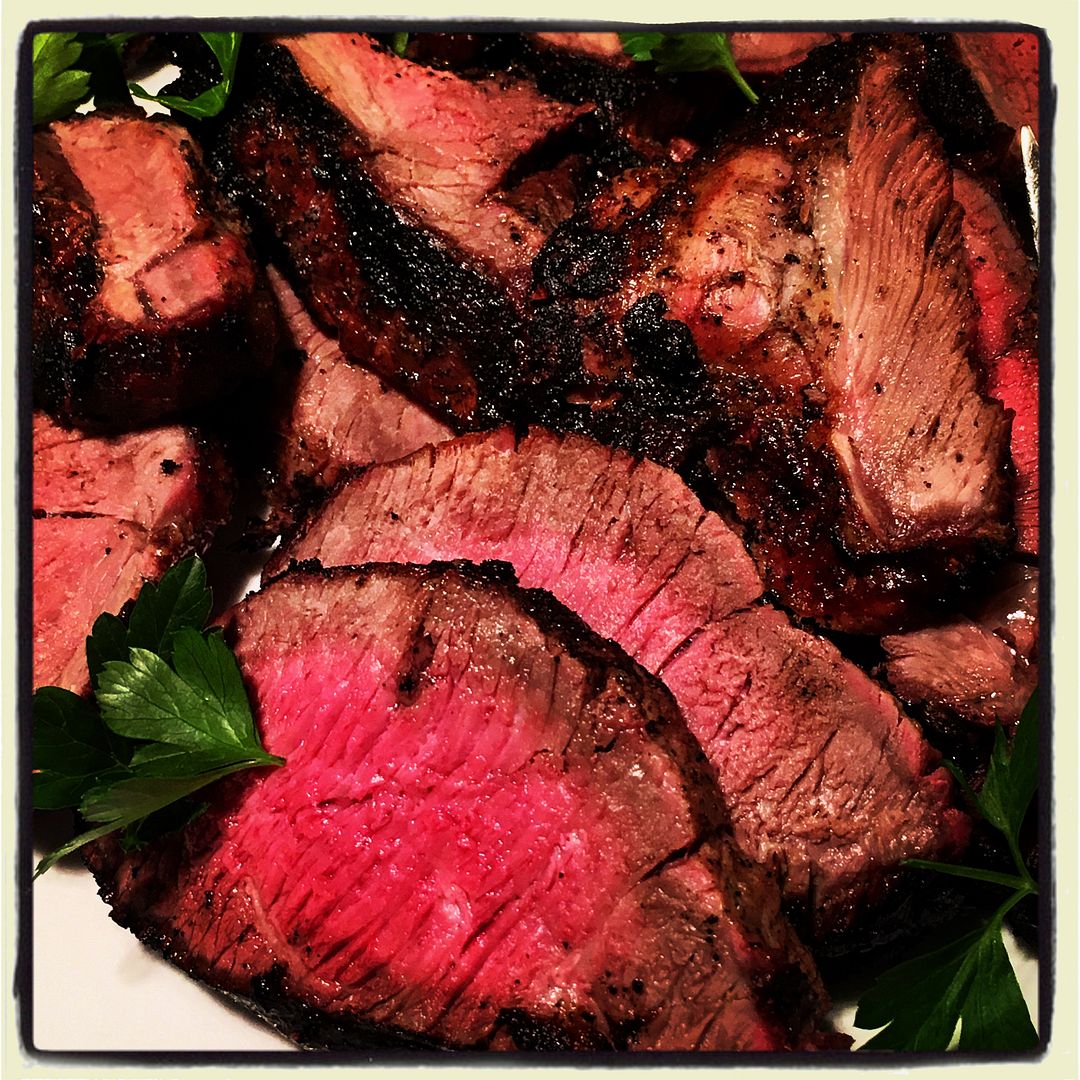
Grilled butterflied leg of tender spring lamb... an excellent menu choice.

March 15 - the Ides of March - is international EATAPETA Day, the day on which we eat animal protein morning, noon and night for the sole purpose of sticking a thumb in the eye of PETA. (Well, that, plus animal protein tastes good.)

EATAPETA (Eat a Tasty Animal for PETA) Day is the brainchild of Meryl Yourish, who explains its historic origins in this post.

I’ve been celebrating EATAPETA Day for eleven years now, and the only issue is how to cram as much animal protein as possible into a 24-hour day. That’s the kind of problem I enjoy sinking my teeth into. In fact, shortly after midnight, I sank my teeth into some grilled Coffee and Cardamom-Crusted Skirt Steak I had prepared earlier on our Big Green Egg, searing it at 700°F to build a fragrant layer of char on the outside.

Breakfast consisted of Steak and Eggs: some of that selfsame skirt steak, served alongside a couple of over-easy eggs sautéed in ghee. Gotta exploit them chickens and cows to the max.

For lunch, I took my inspiration from the sea by consuming a tuna salad. Tuna, of course, is what the PETA folks like to call sea-kittens. And I’ll admit, I love to pet those sea-kittens... with my stomach lining.

When suppertime came, I augmented the remaining supply of skirt steak with some chicken soup. (You didn’t think we’d stop at just chicken eggs, didja?) By way of dessert, a few bites off a Toblerone bar... a bar made with milk chocolate. Yet more cow exploitation.

A few years ago, our friend Houston Steve suggested oysters, foie gras, and veal as the ideal EATAPETA Day meal. “I understand the foie gras and the veal,” I replied at the time. “But what’s up with the oysters?” “They’re still alive when you eat ’em,” said he.]

Alex Bensky’s Rule should guide you in your menu selections on this sacred day: If it didn’t have a mother, it’s not on the menu.

Carp Mommy
Your mommy can’t help you now, Mr. Carp.

Monday, March 14, 2016

ROUND NUMBER

Summer Berry Pie
Summer berry pie... an appropriate way to celebrate Pi Day even if it isn’t even spring yet.

Today is Pi Day, March 14, often rendered as 3.14 in American English. Coincidentally, it’s also the day on which Albert Einstein’s birthday is celebrated in his adopted home of Princeton, New Jersey. It’s not quite a holiday, but it’s certainly a day that it worthy of note... at least, by the same nerds who celebrate Star Wars Day on May 4 (“May the Fourth Be With You”).

This year, Pi Day falls on 3.14.16, which is the result you get by rounding pi (3.14159) to four decimal places. Thus, some have taken to calling this year’s version Rounded Pi Day. Since pies are so often round - Pythagoras be damned! - it’s just one more reason to have a pie today.

By way of a reminder, tomorrow is EATAPETA (Eat A Tasty Animal for PETA) Day. Therefore, a meat pie would definitely be in order.

In order to celebrate this most auspicious occasion I shall trot out (what, again?) one of my favorite 100-word stories: Pie-Eyed Jeremy, originally posted in June 2006.  Enjoy.

PIE-EYED JEREMY: A 100-WORD STORY

Jeremy loved pie.

Jeremy loved pie with a white-hot passion.

No birthday cake for him. It had to be pie, only pie.

Dutch Apple. Mince. Blueberry. Rhubarb. Pumpkin. Coconut Custard. Steak and Kidney. Chicken Pot. If it was a pie, Jeremy would seek it out and devour it.

But pies were expensive. Fillings and crust cost money, which Jeremy had in short supply. Eventually, to support his pie habit, Jeremy turned to crime.

During a botched heist at Entenmann’s, two hostages died in a hail of bullets. Jeremy was arrested and convicted.

His last meal? Pie, of course. Cyanide pie.

Wednesday, March 9, 2016

AMERICA’S RENAISSANCE MAN


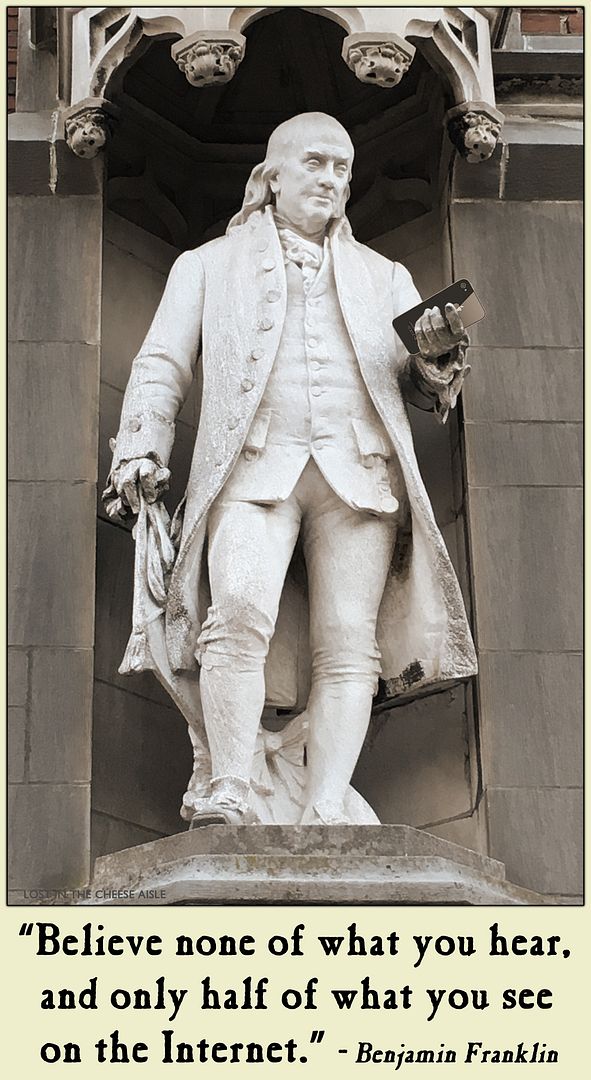
Ben attempts to take one of the earliest known selfies, circa 1792. [Photographed at Palmer Hall, Princeton University.]

Benjamin Franklin was not only one of this country’s Founding Fathers, he was also an accomplished scientist with numerous inventions to his credit - a true Renaissance Man.

Many of us know that Franklin invented bifocal spectacles, the lightning rod, and (obviously enough) the Franklin stove, yet few are aware that he was also a pioneer in social media and its attendant technologies. Poor Richard’s Almanack was originally conceived as an Application (popularly abbreviated Appn) for the STeam-powered Universal Portable Interpersonal Device that Franklin invented. It was, alas, an impractical technology at the time, owing to the fact that wireless communications had yet to be invented. The almost invisible copper threads that were used to connect Franklin’s STUPIDs created an impenetrable network that impeded people’s ability to move about in old Philadelphia, and so the invention never caught on. The Almanack, happily, survived, and the pearls of wisdom therein have become part of American popular culture.  

In Poor Richard’s, Franklin warned of the dangers of distracted ambulation: “He that texts and takes a Stroll, May find himself in a Graveyard-Hole.” How ironic that the sculpture pictured above portrays him in the act of ignoring his own advice.

Tuesday, March 1, 2016

JUST SUPER


No, it’s not about you, Supes.

Today is March 1, AKA Super Tuesday.

It’s “super” because this is the day that primary voters choose 595 out of the 1,237 delegates needed to win the Republican nomination, and 859 of the 2,383 delegates needed to lock up the Democratic nomination. That’s 48% and 36% respectively.

Georgia is one of the states holding primaries today. These days, the franchise seems to be less about selecting the best candidate for the job and more about choosing the least amongst a host of evils... but both Dee and I held our noses and voted.

We won’t know who will actually be running in the Presidential race until the respective party conventions take place, but we will have a pretty good idea after today’s results are tabulated.

It’s going to be a long, unpleasant election season... but at least it won’t be boring. Of course, natural disasters aren’t boring either, but nobody wants to be caught up in them or their aftermath.

Monday, February 29, 2016

SADIE HAWKINS

Higgledy piggledy,
Emperor Julius
Looked at the calendar,
Saying, “Oh, my!

“If we add one Dies
Intercalarius
,
We won’t have winter
Show up in July!”

Today is the civil calendar’s rara avis: Leap Day, the intercalary day inserted once every four years. There is an exception: Centennial years not evenly divisible by 400 do not include an extra day, thanks to Pope Gregory. That exceptional year next occurs in 2100, extremely unlikely to be in the lifetime of anyone reading this.)

By coincidence, this year in the Hebrew calendar (5776, which is also the square of 76) is also a leap year. Hebrew leap years take place seven out of every nineteen years, which makes their occurrence somewhat more frequent than Gregorian leap years (36.84% versus 24.25%), and they’re more dramatic: A whole month is added, not just a single day.

We’re about two-thirds of the way through that extra month now, which means that the Jewish holidays for the balance of the year will seem late according to their Gregorian dates. It’s why Passover will begin in late April - four weeks after Easter, rather than at roughly the same time.

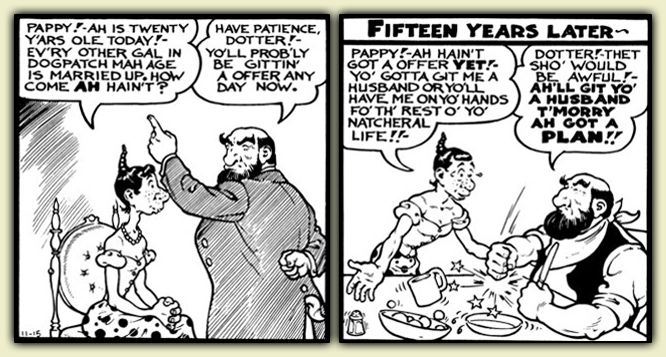
In American popular culture, Leap Day is sometimes conflated with Sadie Hawkins Day, the day on which unattached women in Dogpatch would try to outrun the town’s bachelors in a footrace, the (male) losers of which would have to marry the (female) winners. Sadie Hawkins Day was the creation of Al Capp, who drew the popular Li’l Abner comic strip in which the event first appeared in November 1937. In a testament to the pop culture influence of the funny pages, the fictional “holiday” actually caught on in many places across the country.


From Li’l Abner, the eponymous Sadie Hawkins wrestles with spinsterhood at the advanced age of thirty-five.

Laughably sexist notion that it is these days, there are still plenty of locales (high schools?) that still actually celebrate Sadie Hawkins Day, usually without the finality of the original(!) While some do so on November 15, many people consider February 29 to be Sadie Hawkins Day in view of an old British and Irish tradition that held that women were permitted to make marriage proposals only on Leap Day.

Al Capp, incidentally, was Jewish - which makes one wonder whether we Red Sea Pedestrians should observe a whole Sadie Hawkins month. Yeef.

Sunday, February 14, 2016

WOMAN OF VALOR

Antique Valentine
Valentine, circa 1938, from collection of Dee’s late Dad.

A woman of valor, who can find?
Well, I sure found one, never you mind.
- The Bard of Affliction

My Valentine is a Woman of Valor.

She has had to be brave this year, dealing with unexpected adversity - the kind that hits you in painful places both physical and spiritual. She who values independence and self-reliance so highly has had to allow others to care for her. But she is recovering - slowly, painfully, and yet inexorably - and my heart sings with every step she takes.

Saturday, February 6, 2016

SIA, WOULDN’T WANNA BIA, or
SEPARATED AT BIRTH?

Having recently remarked upon the astonishing resemblance between Ted Cruz and Hungry Chuck Biscuits, I couldn’t help but notice that there was another Face in the News that reminded me of a similar one from back in the day.

Sia, the pop star who famously likes to avoid showing her face while performing (perhaps she should redub herself “Nope, Can’t Sia”), has appeared on shows as diverse as SNL, the Tonight Show, and the Ellen Degeneres Show in the past few weeks. Up until her performance on SNL, I couldn’t have told you who Sia was even if she had bitten me on the ass, but now she seems to be everywhere. She is prodigiously talented, but I cannot bear to watch her perform, given that she is usually accompanied by some sort of performance artist cum dancer who writhes around on the stage while Sia sings. Even our own Elder Daughter, herself a performance artist, considers Sia’s stage act gagworthy. Just listen and don’t look, and she’s actually quite good.

The enormous black-and-white wig she has been sporting lately reminded me of an old Star Trek episode that featured Frank Gorshin, well known at the time for playing the Riddler on the Batman TV series. Lookee:


Sia (image ©2016 World Entertainment News Network) and Frank Gorshin (image ©1969 CBS Pictures/Photofest).

The ridiculous black-and-white makeup was for an episode entitled “Let This Be Your Last Battlefield,” which featured two aliens at each other’s throats in what could be considered a mash-up between the Javert-Valjean conflict from Les Miserables and a good old-fashioned race riot. Each alien, you see, was half black and half white... but one was black on the left, the other on the right.

If you think the writers of the episode were trying to convey a message of racial tolerance and opposition to bigotry in the most stupidly obvious and heavy-handed way possible, you’d be right. Not even Rod Serling at his most preachy was this bad. (Of course, it was the third and final season of the original Star Trek series, by which time any of the reasonable good SF ideas that made it to the screen in the first season were a distant memory.)

The difference between this “Separated at Birth” exercise and the one involving Ted Cruz and Hungry Chuck Biscuits? Here, it’s obvious that Sia and Frank Gorshin are not twins separated at birth. They just have the B&W theme going on. But I’m beginning to be convinced that Senator Cruz and Hungry Chuck Biscuits are not merely twins separated at birth - I think there’s a good chance they’re the same person.

Friday, February 5, 2016

AHA!

Ever since Ted Cruz achieved national prominence, there has been something gnawing at the back of my brain. He looked... all too familiar, as if I had seen him before. But where?

Could it have been at Princeton? After all, he is a fellow alumnus. Might we have run into him at Reunions? Highly unlikely: it’s doubtful we would show up at Reunions the same year, since our graduating classes (1974 and 1992) are eighteen years apart. (It would be a different story had he been in the ’89 or ’94 classes, since our major reunion years would coincide.)

So, not at Princeton. But where had I seen that face before?

Just a few minutes ago, I had that “Aha!” moment. The moment where the pieces of the puzzle all lock into place. When the tumblers of the safe go click, clickety click and the door swings open. When that little imaginary light bulb above your head - the one you see in all the cartoons - sets itself to shining with the glare of a thousand suns.

And that was the key: cartoons.

Years ago, there was a distinctive-looking character in the underground comix. A feckless idiot in a western shirt who sported an oily pompadour... and, coincidentally, who made his first appearance in 1970, the year Ted Cruz was born.

Coincidence? You decide...


Ted Cruz and Hungry Chuck Biscuits: Separated at birth? [Hungry Chuck Biscuits ©1971 Dan Clyne]

The real question is whether they were separated at birth or whether Ted Cruz is actually Hungry Chuck Biscuits. I really can’t decide.

Thursday, February 4, 2016

REMEMBERING THE HIGH PRIEST


Reading table cover made by Paula Coplon in memory of “Gravel-Voice” Larry Travis.

Today we observed Gravel-Voice Larry’s tenth Yahrzeit.

It’s hard to believe that it has been ten years. A whole decade.

A whole decade in which Larry has not presided over post-Minyan breakfast, selecting the smoked fish of the day with the care and expertise of a sommelier selecting a fine wine.

A whole decade of not hearing Larry’s throat-rattling voice knocking the morning liturgy around like so many tenpins.

A whole decade of not having Larry sit beside me in the front row of the chapel.

Things just haven’t been the same without our Kohen Gadol - our High Priest - walking the planet with us. And Larry, indeed, was descended from the High Priests of old. When it came to the Law, that gravelly voice of his conveyed authority and knowledge. It didn’t hurt that he had also served as a Miami cop in his younger days.

We remembered Larry this morning, reciting the Eil Malei Rachamim (“Father of Compassion”) prayer for the departed as well as the Mourner’s Kaddish. And I had a vision of our beloved Kohen Gadol sitting at breakfast in the World to Come, helping the Most High to pick out the tastiest sable and whitefish...

Tuesday, February 2, 2016

’TIS THE SEASON

Groundhog Day
©2006 King Features Syndicate.

Today is Groundhog Day. The excitement on people’s faces is almost palpable.

I don’t know about you, but I’m almost relieved when it’s finally over.

First of all, the relentless hype has really killed a lot of the joy for me. It used to be, you didn’t hear Groundhog Day music in every frickin’ retail establishment in the world - at least, not until right after New Year’s Day, when the holiday season “officially” begins. Not any more. Now, Groundhog Carols are the order of the day, 24/7, starting right after Thanksgiving. It’s relentless.

The malls are packed with people doing their last-minute shopping for Groundhog Day gifts, and post offices burn the midnight oil to keep up with the volume of packages and Groundhog Greeting cards. And it’s almost a given in the retail business that 60% of their business is done in the weeks leading up to Christmas; most of the remaining 40% comes from Groundhog Day. A successful ’Hog Season often means the difference between success and failure for small businesses.

That, of course, means hype. Advertising. A constant barrage of TV ads. Postal workers straining under mailbags laden with massive Groundhog Day catalogs.

And then there are the decorations. It seems that everybody is constantly trying to outdo the Joneses, putting up ever-more-elaborate displays. Lights by the megawatt, inflatable groundhog lairs... sometimes it makes me yearn for a simpler time, a time when every family dug a simple hole in the front yard, and Dad was content with a handmade cardboard top hat.

Now, don’t get the wrong idea. I’m hardly a Groundhog-Scrooge. I love this time of year as much as anybody. Holiday parties, the special seasonal foods, Hog Nog - it’s all good. But sometimes I worry that the real meaning of the day has gotten lost amidst all the hoopla.

After all, isn’t the holiday supposed to be about Phil?

Not Phil as we see him today, surrounded by handlers and media flacks. Just Phil, the simple woodland creature, on a mission from God to predict the weather. His message is one of peace and dignity, one that is immune from the cares of the everyday world. Politics? Global warming? Kyoto? Photo ops? News reporters? Pfaugh. Punxsutawney Phil cares not for these things.

They are merely temporal - and temporary. But the light of Phil’s love is eternal.

Put the Ground back in Groundhog Day! And may your Groundhog Day be sweet.

[Adapted from a post originally published at Blog d’Elisson on January 31, 2008.]

Thursday, January 21, 2016

BASKET CASE


“What the hell are you looking at?”

Monday, January 18, 2016

MACBETH AND ME

“Out, damned spot!” - Lady Macbeth (Macbeth, Act V, Scene 1)

“Will all great Neptune’s ocean wash this blood
Clean from my hand? No; this my hand will rather
The multitudinous seas incarnadine,
Making the green one red.” - Macbeth (Macbeth, Act II, Scene 2)

* * *

Every once in a while, I indulge my love of the Beet-Root.

Whole Paycheck Foods generally offers a fine selection of beets - red, golden, and, occasionally, the pink-and-white chioggia - and it is there that I will pick up a few softball-sized specimens when the Beet-Urge strikes. A softball-sized beet, we should note, is reasonably humongous.

Most often, I will rinse said beet to remove surface dirt, wrap it in aluminum foil, and then roast it at 350ºF for 75-90 minutes. Once it cools enough to be handled, I remove the skin by rubbing it off with paper towels - way easier than using a potato peeler on a raw beet. Then it is a simple matter of hacking the root into large dice and seasoning to taste. (I like to douse beets in sherry vinegar, give them a liberal sprinkle of orange zest and tarragon, a pinch or two of kosher salt and freshly ground black pepper, and then a drizzle of olive oil. Add some goat cheese and/or a few orange segments if you want to get fancy.)


Beets with suprêmes of blood orange, AKA “Murder in the Produce Section.”

As I was skinning one especially large root the other day, I could not help but notice the incredible amount of reddish-purple juice that was schpritzing all over the kitchen. Good Gawd, it resembled nothing so much as a vegan murder scene... and that made me think of The Scottish Play, for it takes a certain amount of obsessive hand-scrubbing à la Lady Macbeth to remove the persistent Beet-Root Stain.

Ahhh, the things I endure to enjoy my tasty treats.

Postscriptum: The following evening, I was reminded about yet another property of the Ruby Root, having been momentarily horrified at the reddish color appearing in the porcelain bowl. “Holy crap!” I thought. “Am I passing another kidney stone?” And then I remembered the beets.

Tuesday, January 12, 2016

DETAILS

You must pay attention
To your micturition
If a proper life you’d choose:
Everything will be great
If you keep your lines straight
Thus minding your pees and queues.

Monday, January 11, 2016

ZIGGY, NOW STARDUST


David Bowie, 1947-2016... a man of many talents. (Note the dilated left eye, a condition with which I have become very familiar in the last five years. Mine is intermittent; his was permanent.)

We were shocked and saddened to hear of David Bowie’s passing yesterday after a protracted struggle with liver cancer. He had just celebrated his sixty-ninth birthday.

Bowie first came to our attention in 1969 with “Space Oddity,” released just prior to the Apollo 11 launch... but it was in his glam-rock persona Ziggy Stardust that he catapulted himself to international pop stardom in the early 1970’s. Over and over again, he would, chameleonlike, reinvent and reinvigorate his music as the decades wore on, simultaneously expanding his career to include outlets for his prodigious acting talents.

Bowie’s output included that rara avis - dance music that I not only could tolerate, but actually liked. It was the soundtrack for the early 1980’s for Dee and me.
 
His first major hit serves as a fitting epitaph for a unique man.

Ground Control to Major Tom
Take your protein pills and put your helmet on
Ground Control to Major Tom (Ten, Nine, Eight, Seven, Six)
Commencing countdown, engines on (Five, Four, Three)
Check ignition and may God’s love be with you (Two, One, Liftoff)

This is Ground Control to Major Tom
You’ve really made the grade
And the papers want to know whose shirts you wear
Now it’s time to leave the capsule if you dare
This is Major Tom to Ground Control
I’m stepping through the door
And I’m floating in a most peculiar way
And the stars look very different today
For here
Am I sitting in a tin can
Far above the world
Planet Earth is blue
And there’s nothing I can do

Though I’m past one hundred thousand miles
I’m feeling very still
And I think my spaceship knows which way to go
Tell my wife I love her very much - She knows
Ground Control to Major Tom
Your circuit’s dead, there’s something wrong
Can you hear me, Major Tom?
Can you...
Here am I floating round my tin can
Far above the Moon
Planet Earth is blue
And there’s nothing I can do.


Ave atque vale, David. You will be sorely missed.

Friday, January 8, 2016

HAPPY BIRTHDAY, ROY


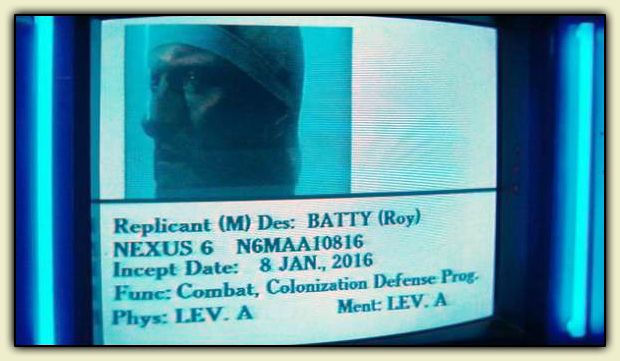
Screen grab from Blade Runner (1982).

“I’ve seen things you people wouldn't believe. Attack ships on fire off the shoulder of Orion. I watched C-beams glitter in the dark near the Tannhauser gate. All those moments will be lost in time... like tears in rain.” - Roy Batty

If you walk the planet long enough, temporal milestones that were once enshrined in various bits and pieces of pop culture ephemera start showing up in our rear-view mirror.

When I was a young Snot-Nose, a Looney Tunes cartoon short entitled The Old Grey Hare envisioned Bugs Bunny as a grizzled oldster in the year 2000. That seemed awfully far off back then - even 1950 was six years in the future when that film was made - but now it’s a sweet sixteen years in the past.

The Twilight Zone, in its brief fourth-season flirtation with an hour-long format, had an episode that starred Jack Klugman, who parenthetically shared with Burgess Meredith the record for most appearances on that classic anthology show (four). “Death Ship” took place in the far future year of 1997, by which time (the episode’s creators assumed) humans would be exploring distant stars in flying saucer-like spaceships. Oopsie.

2001: A Space Odyssey took place well in the future, at least when it was released in 1968. Now it looks just a bit quaint. No, we’re not building permanent bases on the Moon, and we’re not quite ready to send ships off to the orbits of Jupiter or Saturn, but we have better videophone technology. (Also, no more Pan American and precious little in the way of Howard Johnson’s).

You don’t have to go off trolling in the 1960’s and prior for these sorts of anachronisms. To me, it’s perfectly bizarre that the entire Back to the Future film trilogy now takes place entirely in our past.

Today, however, we’re starting to bump up against some really serious dystopian futurprediktnis. Blade Runner, Ridley Scott’s 1982 film based on Philip K. Dick’s classic novel Do Androids Dream of Electric Sheep? takes place in 2019... just around the temporal corner.

And today is Roy Batty’s birthday.

Roy Batty is the leader of a squad of artificial humans - replicants, in the film’s lingo - who have illegally infiltrated the earth. As such, they are marked for execution (so-called “retirement”), despite their having a built-in shortened lifespan. Batty is played by a young Rutger Hauer, in what is possibly the finest performance of his career.

Blade Runner takes place in a fictional world, but the idea that some of its characters might even now coexist with us is positively chilling. And fascinating.

Friday, January 1, 2016

CAESURA


Julius Caesar. [Image: “César (13667960455)” by Gautier Poupeau from Paris, France - César. Licensed under CC BY 2.0 via Commons.]

They prophesied to Caesar thus: “In March, beware the Ides,
When Senators you thought were Friends will perforate your Sides.”

And sure enough, that fateful Day, right in the Roman Senate,
They poked Holes in Caesar’s Body until not much Blood was in it.

He looked less like a Dictator and much more like a Sieve,
And Caesar came to realize he’d not much Time to live.

He saw that Brutus was among the Members of the Plot,
And whispered softly, “Et tu, Brute? I think you missed a Spot.”

Then as Brutus thrust his Dagger with a sharp and sudden Thwack,
He smiled and said, “No Worries, Mate - because I’ve got your Back.”