The trip that folks consider best
Is when they visit Budapest.
I find that I have often wished
One day to have been Budapished.
Sunday, May 22, 2016

Saturday, May 21, 2016
FOREVER YOUNG

Alan Young (1919-2016). Requiescat in pace.
I was saddened to hear that Alan Young, who will be remembered by many for his turn as straight man to a talking horse on Mr. Ed, the iconic early 1960’s sitcom, has passed away at the age of 96.
A prolific actor, Alan Young first came to my attention in The Time Machine, in which he played the inventor’s steadfast friend David Filby... as well as Filby’s son adult James in scenes taking place 17 and 66 years after the inventor embarks on his journey into the future. Young, whose role in George Pal’s 1960 film was expanded considerably from a brief appearance in H G. Wells’s novel, would play Filby again in 1993 in a mini-sequel entitled Time Machine: The Journey Back in which both he and Rod Taylor reprised their roles from thirty-three years prior. And Young even scored a cameo appearance as a flower shop owner in the 2002 remake of The Time Machine, a film mainly noteworthy for having been directed by Simon Wells, the great-grandson of the original novel’s author. (In a bizarre coincidence, when Young reported for costume fitting, he was given the same shirt collar he had worn in the 1960 film(!))
Despite having had a lengthy and productive career, the role that comes to mind when people mention Alan Young is (of course, or course) that of Wilbur Post, the owner of the uniquely verbose horse Mr. Ed. At least, it comes to mind for people of a certain age, the series having been aired from 1961-66. It is a testament to Young’s considerable self-confidence as an actor that he was willing to play second banana to the ’ponymously titular Mr. Ed. Whether Wilbur Post owned Ed or vice-versa is a bit of an unresolved matter, however, because the horse often seemed to have more intellectual wattage than his bemused owner - the only one who ever heard Ed speak. It is worth examining whether Wilbur was the victim of an unusually vivid type of hallucination, but that would consume far too much of my time.
And yet... although my time is so eminently valuable, it is nevertheless true that I had, at one point long ago, taken it upon myself to translate the Mr. Ed theme song into several foreign languages. I am here to report that it seems to work best in English... unless one takes the lyrical rather than the (semi) literal route.
Thus, by way of an elegy, I shall take the liberty of reprinting here (below the fold) my work of some twenty-five years past, the Ed Variations. May they serve to sing the late, lamented Mr. Young to his eternal rest, where he will be Forever Young. Ave atque vale!
Monday, May 16, 2016
A COMPLETELY USELESS FACT
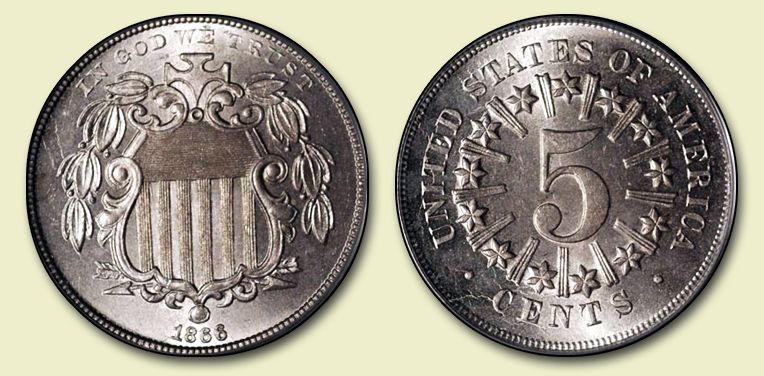
1866 Shield nickel... the first US five-cent coin struck from base metal. [Photo: PCGS.]
Here’s a completely useless fact that was brought to my attention today: The United States cupronickel five-cent piece - the coin we all know and love as the “nickel” - is 150 years old today, having first been produced May 16, 1866.
The five-cent nickel wasn’t the first coin that bore that sobriquet, however. That would have been the three-cent cupronickel coin, first issued in 1865 as an alternative to the silver three-cent pieces that had virtually disappeared thanks to hoarding during the Civil War (variously known here as “the War of Northern Aggression” or “The Late Unpleasantness.” Those silver 3¢ pieces were tiny-ass coins, popularly called “fishscales” for obvious reasons. The three-cent nickel was more manageable, although the denomination had more to do with postage rates and was not a good fit with the country’s decimal coinage system.
The five-cent nickel was also not our country’s first five-cent coin. The Mint had been producing silver half-dimes for circulation since 1794, but like their (even more) diminutive three-cent cousins, the little silver coins were thin on the ground during and after the war. The half-dime would stick around until 1873, by which time the nickel version of that denomination had caught on solidly.
The original design for the nickel five-cent coin was rather boring, featuring a shield on the obverse and a numeral 5 on the reverse. It also bore the legend “In God We Trust” - the second US issue to do so - a consequence of the national religious fervor that had accompanied the war.
In 1883, the Shield was replaced by Charles Barber’s Liberty Head design, which featured a dowdy Lady Liberty on the obverse and a large V on the reverse to indicate the denomination. Unfortunately, Barber had not included the word “cents” anywhere on the coin, and what with the nickel being about the size of a five-dollar gold coin, it was not long before enterprising criminals took to gold-plating the new nickels and passing them off on unsuspecting rubes as five-dollar coins. By mid-year, the Mint had had Barber redesign the coin to add the denomination.

Proof 1913 Type 1 Indian Head nickel... one of the most beautiful examples of US coinage. [Photo: PCGS.]
Fast forward thirty years to 1913, when the Indian Head nickel (AKA the “buffalo nickel” on account of the bison on the coin’s reverse) replaced the Liberty Head design. It, in turn, was replaced in 1938 by the Jefferson nickel.
Our five-cent nickel has been made of an alloy of 75% copper and 25% nickel since its inception, the sole exception being during World War II, when an alternative alloy of 56% copper, 35% silver and 9% manganese was substituted due to nickel having been a critical material. These “war nickels” circulated until 1965, when the elimination of silver coinage created an incentive for people to hoard any money that had actual precious metal in it.
If you want a real nickel nickel, though, you have to go to Canada, where for many years five-cent coins were produced with a composition of 99.9% nickel. American-style cupronickel was only used from 1982 until 2001: Since then, the Canadian nickel has been made of steel with a thin copper-nickel plating. And that brings us to another (almost) useless fact... most (but not all) Canadian nickels will stick to a magnet. Aren’t you glad you asked?
Wednesday, May 11, 2016
THIRTY
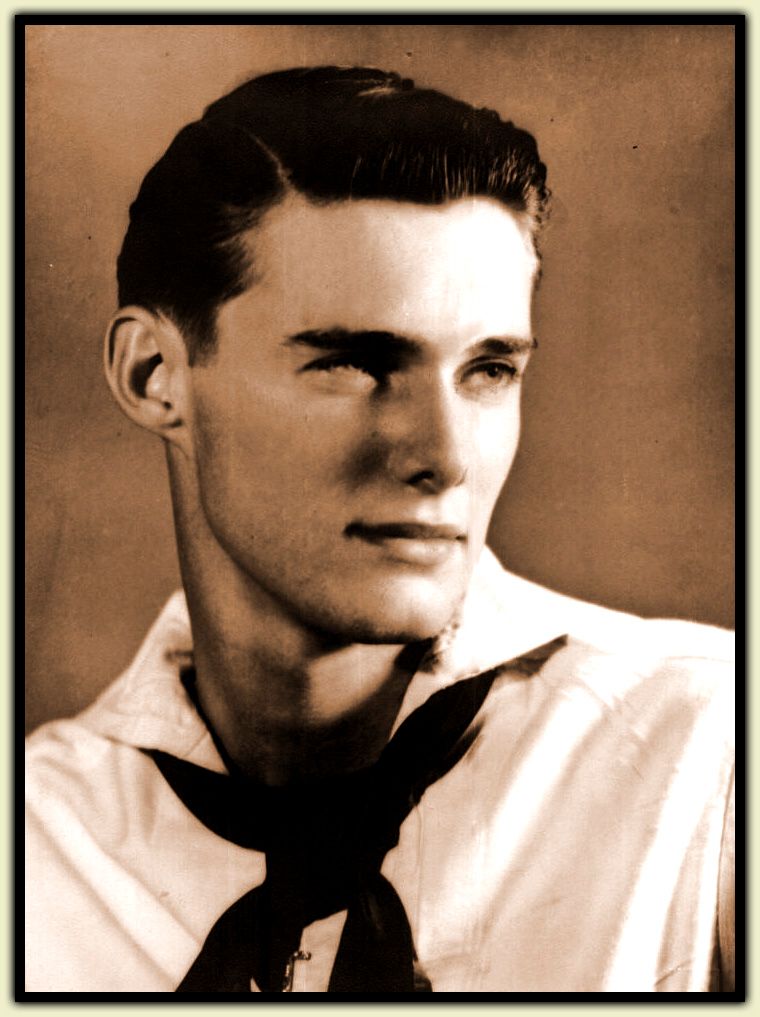
Bill, in his Navy days - ~1946.
“My daddy’s been gone 30 years. Not a day goes by that I don’t miss him.”
Today is Bill’s thirtieth Yahrzeit - the anniversary of his passing according to the Hebrew calendar. (On the Gregorian calendar, purely by coincidence, that anniversary is tomorrow.)
I cannot add or change a single word that would make Dee’s words any more eloquent.
We miss you, Bill. Every day.
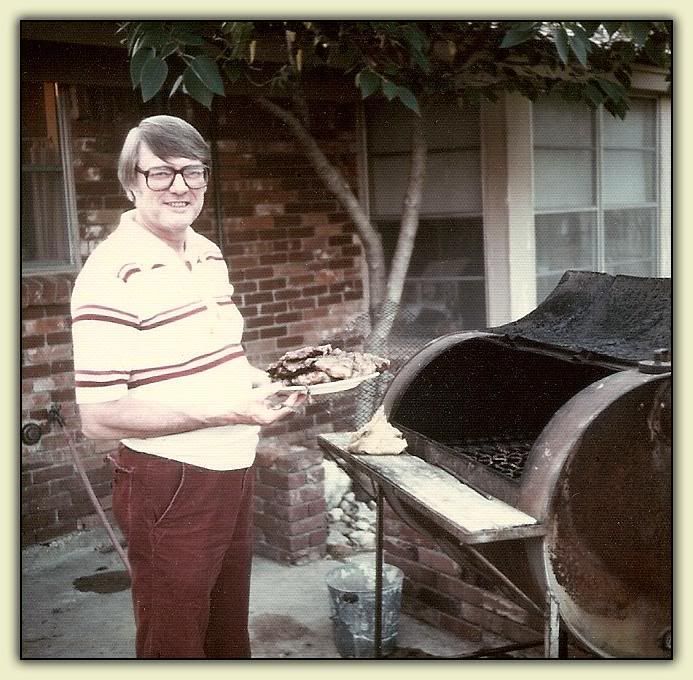
Bill, the barbecue maven, as photographed in the late 1970’s.
Sunday, May 8, 2016
ADRIAN’S LIVER HEAVEN

Chicken liver paté with pickled shallots.
Our friend Sue recently told me about a prank she and her kids would play upon the unsuspecting. It involved a fictional restaurant - Adrian’s Liver Heaven - where all the dishes would incorporate some form of liver.
The idea of a fictional restaurant is right up my alley. Well over a decade ago, I created the House of Meat, a no-nonsense restaurant offering titanic slabs of red meat, a monument to Wretched Excess. (Interested in investing? Feel free to leave a comment.)
But Adrian’s Liver Heaven takes it to another level, with a menu based on an organ meat that, while beloved by many, is the stuff of horror movies to others. It’s one of those proteins that you either love or hate: There is no middle ground on the liver lover’s scale.
Think of Bubba Gump’s Shrimp Company, only with liver...
Calf’s liver and onions.
Calf’s liver and bacon.
Calf’s liver with onions and bacon.
Rumaki (chicken livers and water chestnuts wrapped with bacon).
Chopped chicken liver.
Paté de foie gras.
Char-grilled foie gras skewers.
Chicken livers en brochette.
Southern fried chicken livers and gizzards.
Liver with fava beans (a good Chianti optional).
Strasburg Pie.
People would listen to Sue’s kids rattle off all of these bizarre dishes without batting an eye, but at some point they would get suspicious. “This isn’t a real place, is it?”
That would usually be right after the question, “Would you care to try the cream of liver soup?”
Hell, I’d eat at Adrian’s Liver Heaven if it were a real place. What liver-based dishes would you put on the menu?
Saturday, May 7, 2016
MOTHER’S DAY MEMORIES
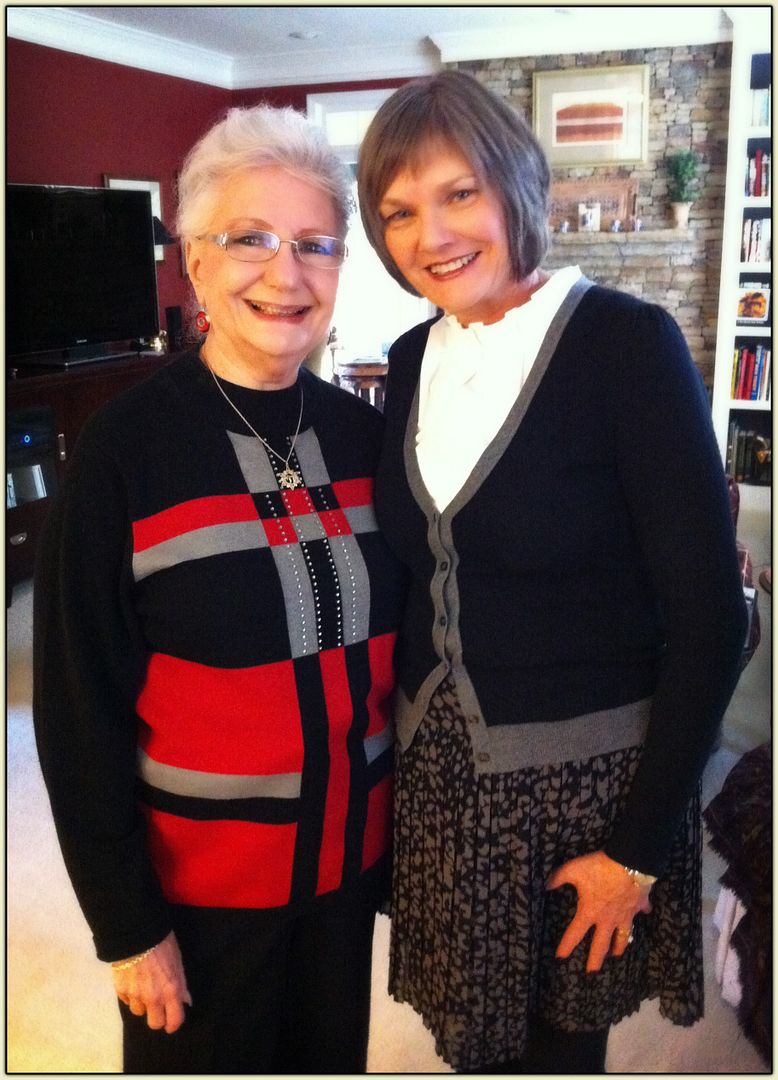
Dee and her mom, 2012.
Mother’s Day is one of those rare Greeting Card Holidays with a respectable pedigree. Its originator, one Anne Jarvis of Grafton, West Virginia, had initiated its observance 1908 as a way to memorialize her own mother... and in later years she was horrified at how commercialized the day had become, thanks to the incessant blandishments of the greeting card, florist, and restaurant industries.
But most of us walk this planet by the grace of being of mother born, and so it’s entirely appropriate to set aside one day of the year to glorify and honor All Things Maternal.
I’ve got three mothers that are the primary focus of my thoughts on this occasion: my own mother, now departed over twenty-eight years; Dee, the mother of our two daughterly children; and Dee’s mother.
Dee’s mom lives in Foat Wuth, where she still puts in a day a week working retail. She has had a lot on her plate this year, what with one son having undergone heart valve surgery and the other dealing with deep vein thrombosis... and her daughter still recovering from a broken hip and wrist. But she’s a tough bird, determined to do things her own way (even if it drives her children nuts).

Bernice, the Momma d’Elisson (z''l) in her 1949 college graduation photo.
My mom lives in Olam ha-Ba - the World to Come, where she has been resident for close to three decades, as well as in the memories of those who knew and loved her. I think of her whenever I eat duck, whenever I drink Scotch or Campari (she was not much of a cocktail hound, but she did love an occasional Rob Roy or Campari and soda), whenever I play golf or tennis, whenever I read a science fiction novel, and whenever I do the Sunday New York Times crossword puzzle. In the best of all possible worlds, she would have had a few more decades to enjoy her sons, her daughter-in-law, and her granddaughters... but, alas, it was not to be.
And then there’s Dee, who became a mother almost thirty-seven years ago when Elder Daughter (then Only Daughter) appeared on the scene. Dee was, and continues to be, a wonderful mom to our girls... certainly not her only skill-set, and by no means her defining role, but the one that is relevant to the occasion being celebrated. Navigating the waters of motherhood as your children grow into fully-fledged adults isn’t the easiest task, but we have been blessed with sweet, bright daughters who love their Mom without reservations, qualifications, or limits... and I know that it’s mutual.
I’ll raise a glass to these three Moms. Now: what should be in the glass?
ADVENTURES IN ASTRONOMY
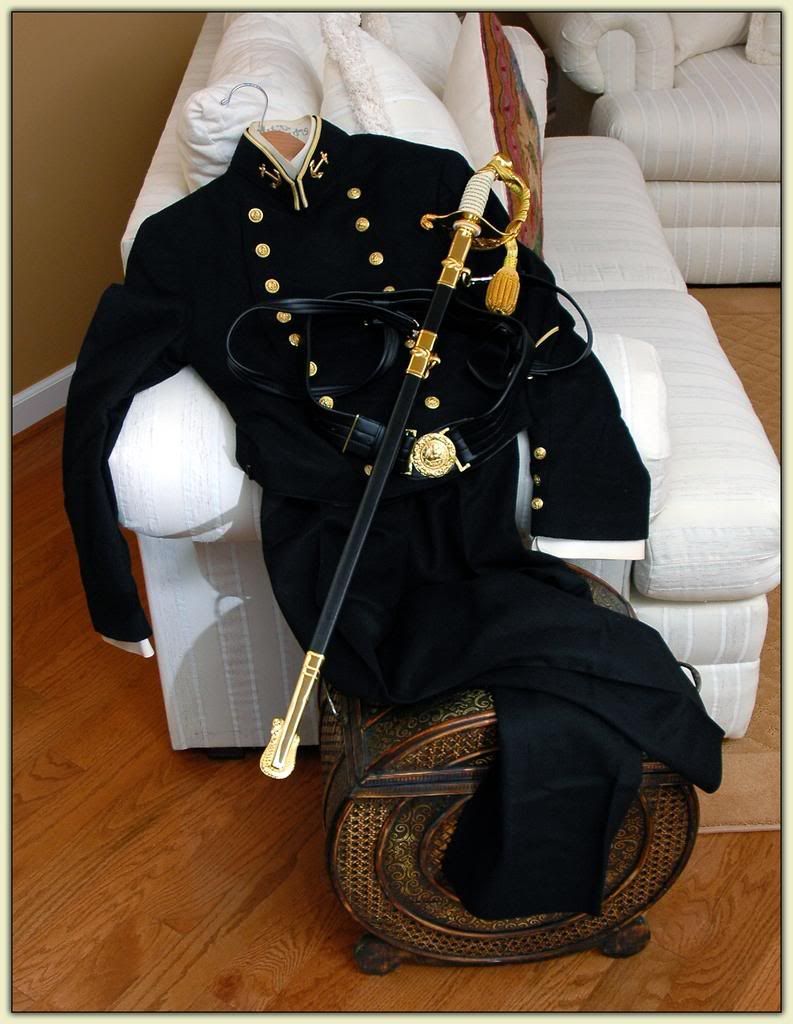
When he’s in a self-deprecating mood, Houston Steve likes to tell this story of his days in the United States Naval Academy, back when he was a naïve young middie.
It is a USNA tradition that upon returning from their summer cruise and sighting the Academy chapel dome, third-class midshipmen are elevated to the exalted status of “youngster,” with the various privileges pertaining thereto. Our story takes place during Houston Steve’s youngster cruise... on a dark, clear, moonless night somewhere in the Atlantic Ocean.
Picture, if you can, Midshipman 3c Houston Steve, who is standing on the signal bridge with a fellow whom we shall refer to here as Signalman 2c Smith. Smith is a grizzled veteran, someone who probably has been plugging away in the E-5 grade for at least ten and more likely twenty years. And yet Houston Steve, despite his being a mere snot-nosed middie, outranks Smith.
As noted above, it is a dark, clear, moonless night... and way out in the middle of the ocean, it is really dark. No cities are near enough to spoil the night sky with visual and atmospheric pollution, which means there is a spectacular view of the entire dome of the heavens from horizon to horizon.
This is when Houston Steve attempts to make conversation with his companion on the signal bridge.
Houston Steve: “You know, Smith - it’s pretty amazing. There’s no moon, but you can still see the clouds.”
Smith: “Jesus Christ, Sir - that’s the fucking Milky Way!”
Note that Smith’s riposte, despite conveying a heavy freight of amused contempt towards his youthful superior, is perfectly and appropriately polite.
It has been some forty-five years since this little adventure took place, and Houston Steve still takes pleasure in telling about it. He also acknowledges that Signalman Smith - assuming he is still walking the planet - probably enjoys telling the story as well. We both wonder how different it sounds from his vantage point.
Friday, May 6, 2016
THE YEAR THE MUSIC DIED

Ask not for whom the cowbell tolls
It tolls for music artists
Who shaped our culture and our lives
But now they must depart us
O, farewell Bowie, farewell Prince
Adieu, our sweet Merle Haggard
And yet, Keith Richards walks the Earth
That everlasting blackguard!
[2016 has been a rough year thus far for musical celebrities, with the Grim Reaper harvesting (among many others) David Bowie; Paul Kantner; Glenn Frey; Merle Haggard; Frank Sinatra, Jr.; and Prince.]
Wednesday, May 4, 2016
STAR WARS DAY

It’s Star Wars Day. May the Fourth be with you!
(An appropriately stupid occasion to immediately precede Drinko de Mayo.)
Monday, April 25, 2016
PESAHDIK POTABLES
One of the challenges even a moderately observant Jew must deal with during the eight-day Passover festival is that of What To Drink.
Soft drink fanciers will generally look for beverages that are sweetened with something other than the ubiquitous high-fructose corn syrup, corn being a product that most Ashkenazic Jews traditionally avoid during the holiday. But those of us who favor higher-octane tipples face a more difficult quandary.
Most spirituous liquors, you see, are made from grain - and most are produced from one or more of the five grains that are verboten during Passover: wheat, spelt, rye, oats, and barley.
Single malt Scotch? No can do. Irish? Uh-uh. Bourbon? That’d be disturbin’. Gin? A sin.
That leaves us with a limited palette of brandies (which must be produced under strictly controlled conditions); eaux-de-vie; rums, and vodkas (which are OK if made from potatoes).
My traditional Pesach Potable is the dastardly Central European plum brandy known as slivovitz. It is not a drink for the faint of heart: Strong men have been known to become violently ill after ingesting a single shot. Lower quality versions have a bouquet that reminds one of Ronsonol... and yet a good slivovitz, while powerfully alcoholic, has the unmistakable fragrance and subtle sweetness of sunny, ripe plums.
It’ll just have to do until sundown Saturday.
Tuesday, April 19, 2016
THOUGHTS ON THE TWELFTH OF NISAN

Our mom Bernice, z''l (1927-1988).
It’s been twenty-eight years since she has shared this world with us, and there isn’t a day that goes by that I don’t think of her.
The photograph above is one of my favorites, having captured just the smallest whiff of her vivaciousness. If you knew her, you’d know what I mean... and if you didn’t get to know her, alas for you.
Sometimes I wonder how much of my personality came from her and how much from Dad. My sense of humor is probably 99.8% Eli. The other day, Dee saw me react to something or other and immediately said, “What you just did? That’s Eli.”
But when I pick up a book? That’s Mom. I like to think that she’s there, invisible, looking over my shoulder whenever I read.
Tuesday, April 12, 2016
FIFTY WAYS
“The problem is all inside your head” she said one night
“The menu’s simple if just look at it right
I’d like to help you in your struggle for a bite
There must be fifty ways to love your liver”
She said “I really don’t want to get up into your grill
Furthermore, I hope you won’t think I’m an asshole or a pill
But I’ll repeat myself: If you wish to eat your fill
There must be fifty ways to love your liver
Fifty ways to love your liver”
You can have it sautéed, Sinéad
Throw it on the grill, Phil
Don’t drown it in soy, Roy
Just cook it gently
Serve it on toasted bread, Fred
Sear it ’til you don’t see red
Some fried onions are key, Lee
Please listen to me
Oooh, you can have it sautéed, Sinéad
Throw it on the grill, Phil
Don’t drown it in soy, Roy
Just cook it gently
Serve it on toasted bread, Fred
Sear it ’til you don’t see red
Some fried onions are key, Lee
Please listen to me
She said “It saddens me to see you in such grief
I wish there was something I could cook – perhaps roast beef”
I said “I appreciate that – now please tell me your belief
About the fifty ways”
She said “Why don’t we sleep on it tonight – I really care
And I believe a love like yours is more than very rare”
And then she smelled the pong of onions in my hair
There must be fifty ways to love your liver
Fifty ways to love your liver
You can have it sautéed, Sinéad
Throw it on the grill, Phil
Don’t drown it in soy, Roy
Just cook it gently
Serve it on toasted bread, Fred
Sear it ’til you don’t see red
Some fried onions are key, Lee
Please listen to me
You can have it sautéed, Sinéad
Throw it on the grill, Phil
Don’t drown it in soy, Roy
Just cook it gently
Serve it on toasted bread, Fred
Sear it ’til you don’t see red
Some fried onions are key, Lee
Please listen to me
[Apologies to Paul Simon]
Sunday, April 10, 2016
THE CHEESE AISLE DICTIONARY, Vol. 23
I could not help but be intrigued by my friend Eric’s recent Facebook post:
“...you know that you need your reading glasses when you click on a link to “Paleo Sandwich” on the internet and it turns out to be an article on a baseball player named Pablo Sandoval...”
Hmmm. Paleo Sandwich, Pablo Sandoval.
That post elicited a comment that went as follows:
“This made me laugh out loud. Beeecause... the other day, I saw an ad that I could’ve SWORE said something about a sphincter. I looked again and it said “specialized.”
I’ve experienced similar misreads... and as I get older, I find that this phenomenon occurs more frequently. One example: as we were stopped at a red light yesterday evening, I saw a license tag that said (I thought) “Okeechobeee” below the tag number. But when I realized that it was a Georgia plate, I also realized that Okeechobee - which may refer to either a lake or a county in Florida - made no sense. Closer examination showed the word to be “Oglethorpe.” Aha.
That, Esteemed Readers, is a mondeseen - the newest coinage in the Cheese-Aisle Dictionary.
mondeseen [mon-de-sin] (n): a word or phrase that is initially misread due to faulty eyesight, glitchy brain function, or a combination of both.
Mondeseen is a spin on the term “mondegreen,” meaning a mishearing of song lyrics or spoken words. The difference is that the focus is visual, not aural: misreading rather than mishearing.
Another example: While in the pet store a few days ago, Dee saw a sign that she initially read as “Cow List.” After the inevitable double-take, she realized that it said “Low Cost.”
I experience mondeseens frequently, and the number seems to be accelerating. I attribute this to my declining distance vision, coupled with changes in my mental acuity that I hope are the result of normal aging processes and not a rapid freefall into drooling senescence.
Time will tool, I suffuse.
[Other entries in the Cheese Aisle Dictionary may be found here.]
Monday, April 4, 2016
A CENTURY-OLD TURNING POINT
Calendar Year 2016 is already one-fourth over, and it took this long for me to realize how significant a year it is... at least for those of us who collect coins.
Yes, Esteemed Readers - Elisson is a coin collector. It’s hard to imagine a more nerdly hobby aside from stamp collecting, a pastime that makes the Dork-O-Meter go all the way to 11. My saving grace is that I’ve never gotten into it too seriously, owing to the fact that I usually spend my money on more mundane things like food, clothing, liquor, and The Interminable Mortgage. For that, I am thankful... though not as thankful as Dee, who cringes whenever I start talking about coinstuff.
Nothing, save music, can roll the years back like looking at the coins you used to see when you were young. And we had some real beauties when I was a young Snot-Nose.
This year is not such a big deal per se, but it’s important because it is the 100th anniversary of one of the great turning points in American numismatics: when American coinage finished crossing the great artistic divide into the twentieth century.
Up until then, the dime, the quarter, and the half-dollar all had sported similar Liberty Head designs by Chief Engraver Charles Barber (the quarter and half were almost identical in appearance). Barber’s coins were boring and stodgy, generating negative reviews almost from the first day they were produced in 1892. Without an act of Congress, however, his designs could not be replaced until 1916... by which time everything else coming out of the Mint had been modernized.
It was worth the wait.
The new designs were dramatically different from Barber’s simple Roman-style profiles of Lady Liberty. The dime, by Adolph Weinman, featured Liberty wearing a winged cap, symbolizing freedom of thought - and on the reverse, the fasces - the bundle of sticks that has represented strength in unity since Roman days.
Weinman’s half-dollar showed Liberty in full stride towards the sun, an American flag behind her and branches of laurel and oak in her arms. The reverse featured a mighty eagle, wings partially unfolded, perched atop a mountain crag.
For the quarter, Hermon MacNeil created an image of a standing Liberty in flowing robes, holding a shield in one hand and an olive branch in the other.
All of these coins were (you should excuse the pun) strikingly different from their predecessors. More than just utilitarian factory output, they were works of art in miniature, products of the sculptor’s imagination rather than the engraver’s. You would look at them and see America’s growing self-confidence and presence practically leaping from their shiny faces. They were not without their flaws - the quarter was difficult to strike properly and its date was notoriously prone to wear, for example - but they were beautiful.
In my Snot-Nose Days, all three of these coins were easily found in pocket change, despite the fact that they were all obsolete by then. The Standing Liberty quarter had only lasted until 1930 - an exceptionally short-lived series - yet well-worn specimens, often without readable dates, would show up daily. The so-called Mercury dimes and “Walker” halves were by no means uncommon. But when the Coinage Act of 1965 introduced dimes, quarters, and halves with a copper-nickel clad composition, silver coins vanished from circulation almost overnight.
Today, the beloved Walking Liberty design has been resurrected for use in silver bullion coins... but somehow, those lack the charm - the everyday beauty - of actual circulating coinage. As for today’s (faux) silver, the Roosevelt dime has been unchanged for seventy - count ’em! - years; the Washington quarter has essentially the same ugly obverse it has had since 1932, despite having five new (mostly forgettable) reverse designs every year since 1999; and the iconic Kennedy half, now fifty-two years old, no longer circulates at all. Où sont les dessins d’antan?
Once in a while, I’ll take some of those old coins out and look at them, rolling back the years. Damn, those were beautiful times. At least, that’s what the coins tell me.
Yes, Esteemed Readers - Elisson is a coin collector. It’s hard to imagine a more nerdly hobby aside from stamp collecting, a pastime that makes the Dork-O-Meter go all the way to 11. My saving grace is that I’ve never gotten into it too seriously, owing to the fact that I usually spend my money on more mundane things like food, clothing, liquor, and The Interminable Mortgage. For that, I am thankful... though not as thankful as Dee, who cringes whenever I start talking about coinstuff.
Nothing, save music, can roll the years back like looking at the coins you used to see when you were young. And we had some real beauties when I was a young Snot-Nose.
This year is not such a big deal per se, but it’s important because it is the 100th anniversary of one of the great turning points in American numismatics: when American coinage finished crossing the great artistic divide into the twentieth century.
Up until then, the dime, the quarter, and the half-dollar all had sported similar Liberty Head designs by Chief Engraver Charles Barber (the quarter and half were almost identical in appearance). Barber’s coins were boring and stodgy, generating negative reviews almost from the first day they were produced in 1892. Without an act of Congress, however, his designs could not be replaced until 1916... by which time everything else coming out of the Mint had been modernized.
It was worth the wait.
The new designs were dramatically different from Barber’s simple Roman-style profiles of Lady Liberty. The dime, by Adolph Weinman, featured Liberty wearing a winged cap, symbolizing freedom of thought - and on the reverse, the fasces - the bundle of sticks that has represented strength in unity since Roman days.
 |
| Adolph Weinman’s Liberty Head dime, popularly (but incorrectly) called the Mercury dime. [Image: Coin Community] |
 |
| Weinman’s Walking Liberty half-dollar. [Image: USA Coin Book] |
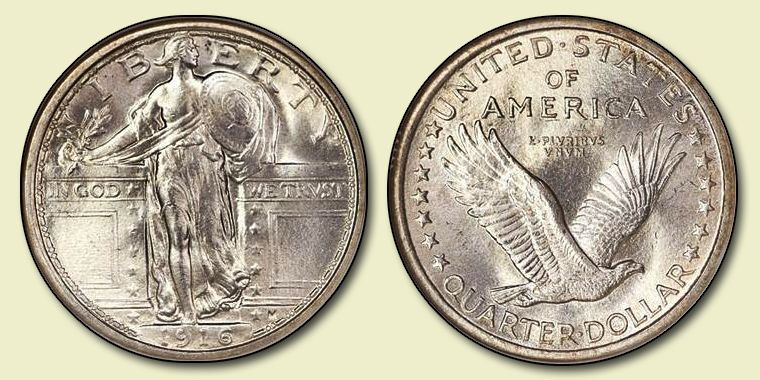 |
| Hermon MacNeil’s Standing Liberty Quarter. This version, produced in 1916, was subsequently modified to conform more closely to MacNeil’s original design. Only 52,000 of the 1916 specimens were struck, making it a rarity. [Image: CoinHELP!] |
In my Snot-Nose Days, all three of these coins were easily found in pocket change, despite the fact that they were all obsolete by then. The Standing Liberty quarter had only lasted until 1930 - an exceptionally short-lived series - yet well-worn specimens, often without readable dates, would show up daily. The so-called Mercury dimes and “Walker” halves were by no means uncommon. But when the Coinage Act of 1965 introduced dimes, quarters, and halves with a copper-nickel clad composition, silver coins vanished from circulation almost overnight.
Today, the beloved Walking Liberty design has been resurrected for use in silver bullion coins... but somehow, those lack the charm - the everyday beauty - of actual circulating coinage. As for today’s (faux) silver, the Roosevelt dime has been unchanged for seventy - count ’em! - years; the Washington quarter has essentially the same ugly obverse it has had since 1932, despite having five new (mostly forgettable) reverse designs every year since 1999; and the iconic Kennedy half, now fifty-two years old, no longer circulates at all. Où sont les dessins d’antan?
Once in a while, I’ll take some of those old coins out and look at them, rolling back the years. Damn, those were beautiful times. At least, that’s what the coins tell me.
Sunday, April 3, 2016
REMEMBERING ELI

The irrepressible Eli (1925-2014), photographed in 1990.
As the sun sets this evening, I will light a candle in my father’s memory to mark the second year since he passed on to the Undiscovered Country... that great and foreboding land to which we all must eventually journey.
Two years - at least, by the arcane reckonings of the Hebrew calendar.
They say Time heals all wounds. (They also say Time wounds all heels.) And it’s true. The ache of loss diminishes as the days and years pass - else how could we go on with the business of living, weighted down by accumulated grief? And yet there is an empty space that never goes away.
In the photograph above, Dad was sixty-five - only two years older than I am now. But my deepest memories were of Eli as a young man, spreading out newspaper on the floor to catch the drippings from his trumpet’s spit valve... sitting down to play the piano... taking me and my brother to Coney Island Steeplechase amusement park... navigating from Bensonhurst to our home in suburban Massapequa after a day with his parents, my sleepy head resting on his leg as he drove.
Those, ahh, those were sweet days.

Friday, April 1, 2016
VILLAGE OF FOOLS

Memorial marker at Beth David Cemetery, Elmont, NY. [Photograph by The Other Elisson.]
Chelm is a small city - with about 67,000 inhabitants, you could really call it a good-sized village - in eastern Poland. Back in the early 1920’s it really was more of a village, its population at the time not much more than 23,000... more than half of them Jews, the remainder Christians consisting of Roman Catholics, Eastern Orthodox, and a sprinkling of Lutherans.
Occupying a unique place in Jewish folklore, this small, otherwise unremarkable city is the legendary home of the Wise Men of Chelm, an ironic compliment typical of Yiddish. You could say that Chelm was celebrated for being an entire village of Village Idiots... the kind of people that, when asked why the sea was salty, attributed its salinity to the large number of herring living in it. You’d have to go to Washington, D.C. to find a more concentrated source of High Doltage.
Isaac Bashevis Singer, the noted Yiddish author, wrote about the well-meaning fools of Chelm (The Fools of Chelm and Their History), and it’s easy enough to find similar collections of tales by others. A quick search on Amazon.com will suffice.
Were the Jewish residents of Chelm really fools? It’s hard to say, because they’ve vanished. Most were exterminated by the Nazis in a single, brutal operation in early December, 1939, and the remaining stragglers were picked off as the war ground on.
But at least one escaped, back in 1922 when escape was possible. That would be my grandfather Jacob of blessèd memory, father of Eli (hizzownself)... a Chelmite who was smart enough to get out while the getting was good.
What better day to remember the Wise Men of Chelm - and the real-life victims of the Holocaust who lived there - than on April Fools’ Day?
Sunday, March 27, 2016
WAITING FOR PENTECOST: A 100-WORD BIBLE STORY
They carried his broken, bleeding body to the cave, weeping with every step.
They laid him down, bade their farewells, and sealed the cave entrance with a massive rock.
Three days later, he arose, clad in pure white raiment. He leaped to the mouth of the cave, rolled the rock away, and stepped into the blinding sunlight. Almost as quickly, he retreated into the depths of the cave, shaken and fearful.
That terrible dark shape on the ground! He shivered in horror. Could it have been the Devil himself?
No matter. After six more weeks, Punxsutawney Jesus would try again.
[Originally published April 24, 2006 at the old place... and resurrected just for you.]
Tuesday, March 15, 2016
EATAPETA: THE DAY TO EAT MEAT-A
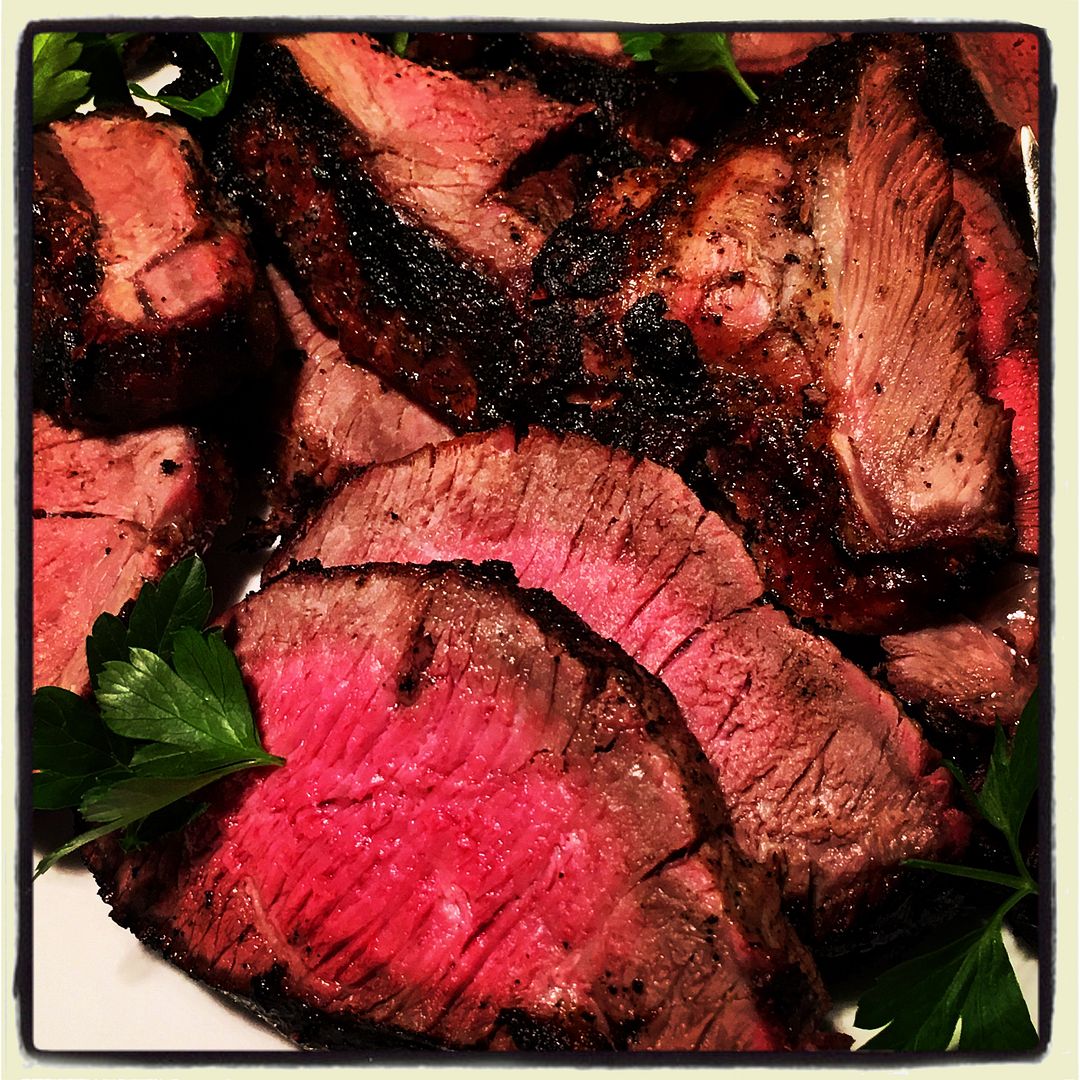
Grilled butterflied leg of tender spring lamb... an excellent menu choice.
March 15 - the Ides of March - is international EATAPETA Day, the day on which we eat animal protein morning, noon and night for the sole purpose of sticking a thumb in the eye of PETA. (Well, that, plus animal protein tastes good.)
EATAPETA (Eat a Tasty Animal for PETA) Day is the brainchild of Meryl Yourish, who explains its historic origins in this post.
I’ve been celebrating EATAPETA Day for eleven years now, and the only issue is how to cram as much animal protein as possible into a 24-hour day. That’s the kind of problem I enjoy sinking my teeth into. In fact, shortly after midnight, I sank my teeth into some grilled Coffee and Cardamom-Crusted Skirt Steak I had prepared earlier on our Big Green Egg, searing it at 700°F to build a fragrant layer of char on the outside.
Breakfast consisted of Steak and Eggs: some of that selfsame skirt steak, served alongside a couple of over-easy eggs sautéed in ghee. Gotta exploit them chickens and cows to the max.
For lunch, I took my inspiration from the sea by consuming a tuna salad. Tuna, of course, is what the PETA folks like to call sea-kittens. And I’ll admit, I love to pet those sea-kittens... with my stomach lining.
When suppertime came, I augmented the remaining supply of skirt steak with some chicken soup. (You didn’t think we’d stop at just chicken eggs, didja?) By way of dessert, a few bites off a Toblerone bar... a bar made with milk chocolate. Yet more cow exploitation.
A few years ago, our friend Houston Steve suggested oysters, foie gras, and veal as the ideal EATAPETA Day meal. “I understand the foie gras and the veal,” I replied at the time. “But what’s up with the oysters?” “They’re still alive when you eat ’em,” said he.]
Alex Bensky’s Rule should guide you in your menu selections on this sacred day: If it didn’t have a mother, it’s not on the menu.

Your mommy can’t help you now, Mr. Carp.
Monday, March 14, 2016
ROUND NUMBER

Summer berry pie... an appropriate way to celebrate Pi Day even if it isn’t even spring yet.
Today is Pi Day, March 14, often rendered as 3.14 in American English. Coincidentally, it’s also the day on which Albert Einstein’s birthday is celebrated in his adopted home of Princeton, New Jersey. It’s not quite a holiday, but it’s certainly a day that it worthy of note... at least, by the same nerds who celebrate Star Wars Day on May 4 (“May the Fourth Be With You”).
This year, Pi Day falls on 3.14.16, which is the result you get by rounding pi (3.14159) to four decimal places. Thus, some have taken to calling this year’s version Rounded Pi Day. Since pies are so often round - Pythagoras be damned! - it’s just one more reason to have a pie today.
By way of a reminder, tomorrow is EATAPETA (Eat A Tasty Animal for PETA) Day. Therefore, a meat pie would definitely be in order.
In order to celebrate this most auspicious occasion I shall trot out (what, again?) one of my favorite 100-word stories: Pie-Eyed Jeremy, originally posted in June 2006. Enjoy.
PIE-EYED JEREMY: A 100-WORD STORY
Jeremy loved pie.
Jeremy loved pie with a white-hot passion.
No birthday cake for him. It had to be pie, only pie.
Dutch Apple. Mince. Blueberry. Rhubarb. Pumpkin. Coconut Custard. Steak and Kidney. Chicken Pot. If it was a pie, Jeremy would seek it out and devour it.
But pies were expensive. Fillings and crust cost money, which Jeremy had in short supply. Eventually, to support his pie habit, Jeremy turned to crime.
During a botched heist at Entenmann’s, two hostages died in a hail of bullets. Jeremy was arrested and convicted.
His last meal? Pie, of course. Cyanide pie.
Wednesday, March 9, 2016
AMERICA’S RENAISSANCE MAN
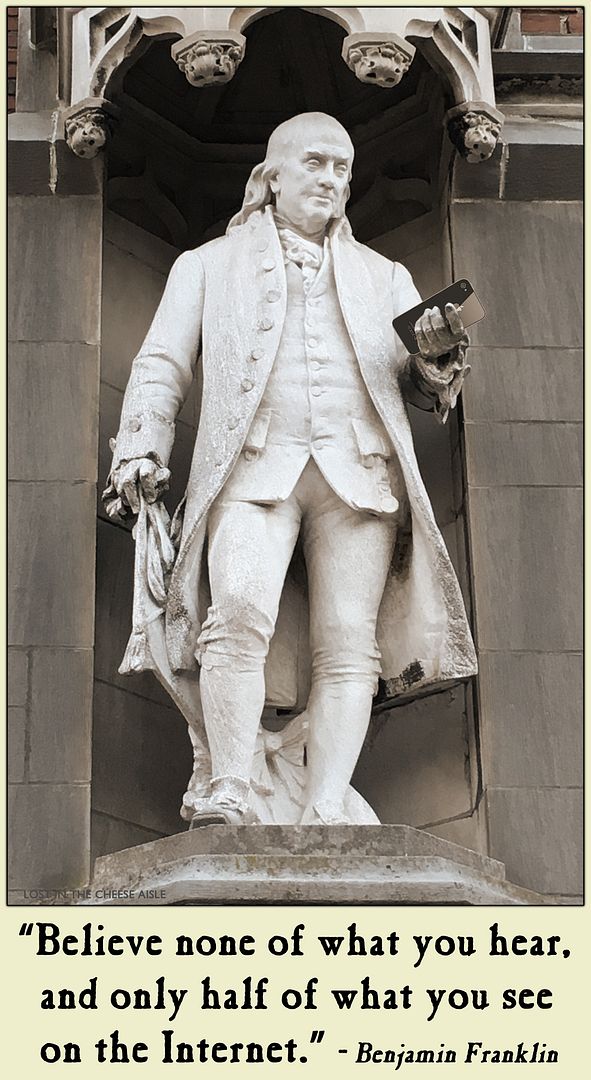
Ben attempts to take one of the earliest known selfies, circa 1792. [Photographed at Palmer Hall, Princeton University.]
Benjamin Franklin was not only one of this country’s Founding Fathers, he was also an accomplished scientist with numerous inventions to his credit - a true Renaissance Man.
Many of us know that Franklin invented bifocal spectacles, the lightning rod, and (obviously enough) the Franklin stove, yet few are aware that he was also a pioneer in social media and its attendant technologies. Poor Richard’s Almanack was originally conceived as an Application (popularly abbreviated Appn) for the STeam-powered Universal Portable Interpersonal Device that Franklin invented. It was, alas, an impractical technology at the time, owing to the fact that wireless communications had yet to be invented. The almost invisible copper threads that were used to connect Franklin’s STUPIDs created an impenetrable network that impeded people’s ability to move about in old Philadelphia, and so the invention never caught on. The Almanack, happily, survived, and the pearls of wisdom therein have become part of American popular culture.
In Poor Richard’s, Franklin warned of the dangers of distracted ambulation: “He that texts and takes a Stroll, May find himself in a Graveyard-Hole.” How ironic that the sculpture pictured above portrays him in the act of ignoring his own advice.
Subscribe to:
Posts (Atom)


 Posts