You’ve heard the song if you’ve seen that one television advertisement for Sleep Number beds.
While you were sleeping your babies grew
The stars shined and the shadows moved
It’s a song from Elvis Perkins’s Ash Wednesday album, titled (appropriately enough) “While You Were Sleeping” - a logical choice by the advertising folks who are trying to sell expensive high-tech bed gear to families with children.
It’s been a few years since I first heard that song. At the time I had been enroute from the wilds of the Northeast, headed towards Atlanta along with Elder Daughter, both of us passengers in the Mistress of Sarcasm’s car. It was coming on evening, grey and drizzly, as we cruised down Interstate 81 near Roanoke, Virginia, when “While You Were Sleeping” came on the radio. The lyrics grabbed me by the throat on the very first listen. Before we had gone ten miles down the road, I had already added the song to the growing library of tunes piled up in the electronic bowels of my smartphone.
While you were sleeping you tossed you turned
You rolled your eyes as the world burned
The heavens fell the earth quaked
I thought you must be but you weren’t awake, no
You were dreaming...
Those lyrics afflicted me with a powerful, sweet melancholy, magnified by my being in the presence of our own babies. They were no longer babies, of course. They had grown while we were sleeping, while the stars shined and the shadows moved.
While you were sleeping I tossed and I turned too
I closed my eyes but the future burned through
The planet turned a hair grey as I relived the day
Dee first heard the song when it appeared in that advertisement, and she had the same visceral, gut-punched reaction to it that I had... to the extent that she immediately grabbed the rest of the Ash Wednesday album.
Why does that song resonate so strongly for both of us? Why can’t I listen to it without getting a lump in my throat and a tear in my eye? Is it the image of fleeting time, big events, and life speeding past us in the seeming blink of an eye?
Monday, September 21, 2015

SUBWAY TOKEF
Some by local
Some by express
Those wheels will leave you in quite a mess
Some by diesel
Some by steam
In the tunnel nobody hears you scream
Some in the station
Some on the trestle
The rail’s the mortar; the train’s the pestle
Some by subway
Some by El
Neither will leave you feeling well
Some by turnstile
Some by gap
Choo-chooed up to the old Dirt Nap
The train’s the vehicle for me
But I hope to avert the Severe Decree
Saturday, September 19, 2015
THE PAINTERLY PRIVATEER: A 100-WORD STORY
He had spent a lengthy career on the high seas, accumulating a lifetime’s worth of plunder. Countless were the ships he had scuttled after having stripped them of their valuables; countless were the screaming sailors he had sent to Davy Jones.
But as Pete grew older, his taste for the violent life diminished. He came to treasure not gold and jewels, but the paintings of the Old Masters… and so he left Jolly Rogering for a more refined line of work.
Smiling, standing athwart the entrance to his new business, he greeted his customers. “Welcome to Pegleg Pete’s Arrrrht Gallery!”
[Today, September 19, is International Talk Like a Pirate Day.]
Friday, September 18, 2015
GETTING ON MY LAST NIRVANA: A 100-WORD STORY
He sat on the hard wooden floor in that posture Westerners called Indian-style and which he knew as padmāsana, the Lotus. With his feet pressed soundlessly into his thighs he emptied his mind, preparing for his ritual.
A few moments spent studying his chakra-board and he was ready. The elastic went above the left bicep just so; the tablespoon of diacetylmorphine burbled above the candle-flame.
Strange that the cow was considered sacred by his people, he thought, when it was the horse that could carry one to Nirvana.
The needle plunged home as Deepak Chopmeat practiced his daily Transcendental Medication.
Thursday, September 17, 2015
AUTUMNAL AMBROSIAL ALCHEMY
It’s not quite autumn yet, but summer has entered its final week and the morning air has taken on a most fall-like briskness. This being Georgia, the cool weather is a temporary condition - plenty of hot, sweaty days lie ahead in the next month or so - but nevertheless, it is a welcome reminder that the seasons are about to change.
I love this time of year. On the weekday mornings when I leave the house before seven o’clock to attend minyan, the rising sun is just beginning to paint the eastern sky with glorious shades of pink and orange. The trees are showing the beginnings - just the beginnings! - of their fall colors. And I have to decide between wearing short- or long-sleeved shirts, on account of that crisp air.
Along with cool mornings, fall colors, and the panoply of Jewish holidays, the impending onset of Fall also marks a change in our menus here at Chez Elisson. Salads give way to stewy dishes like chili, Hungarian goulash, and braised short ribs... and summery, chilled gazpacho yields to hot, restorative cabbage borscht.
Dee’s cabbage borscht, AKA cabbage soup, is amazing. Long years ago, she learned how to make it from her grandmother (with a substantial amount of kibitzing and back-burner driving from her great-aunt Dorothy)... a toothsome combination that includes diced tomatoes, a head of cabbage, beef shanks or flanken-style ribs (or both), and lashings of brown sugar, lemon juice, and sour salt. The exact composition is known to Dee, but not me: My input is limited to minor adjustments in the seasoning.
It never ceases to amaze me how a humble vegetable like cabbage can be transformed into a potage that, while certainly not the stuff of haute cuisine, nevertheless manages to be both earthy and ethereal. It is truly a sort of kitchen alchemy.
Cabbage borscht is the kind of concoction that gets better after a day or two, a homey, heady dish that warms both body and soul. It’s just right for those days of introspection and prayer that cluster so thickly on the calendars of us Red Sea Pedestrians this time of year... and for the occasional chilly evening.
Friday, September 11, 2015
MATCHA-RITION

Homemade matcha-coconut ice cream. Mmmmm, tasty. [Click to enhugify.]
I like ice cream
Made from green tea
Unlike asparagus
It does not perfume my pee
Thursday, September 10, 2015
THE MUSLIM BARTENDER (A TRUE STORY)
“You are not being persecuted for your beliefs when you are merely being denied the privilege of shoving them down someone else’s throat.” - The Bard of Affliction
There has been a lot of Sturm und Drang lately over one Kim Davis, a Kentucky county clerk who has garnered a certain amount of notoriety for having refused to issue wedding licenses to same-sex couples despite having been ordered by the courts to do so. Putting her name on said licenses would (she says) imply her approval of same-sex marriages, something she feels she cannot do based on her religious beliefs.
Ms. Davis’s staunch refusal to compromise her principles - or her ridiculous grandstanding, depending on where you stand on the matter - earned her a stay in the pokey for contempt of court. She was released after a brief sojourn, providing an opportunity for yet more grandstanding. (“Eye of the Tiger,” anyone?)
The people comparing Ms. Davis to the Reverend Martin Luther King, Jr. - after all, she went to jail for her beliefs, too! - should maybe take a step back. What if it were interracial marriages she objected to? That matter was settled in Loving vs. Virginia back in 1967, and I imagine that most of us would be justifiably outraged if a county clerk refused to issue papers for an interracial couple today. Perhaps a better comparison would be to Governors George Wallace and Orval Faubus, both of whom stood in the schoolhouse door (the University of Alabama and Little Rock Central High School, respectively) to demonstrate their opposition to SCOTUS-ordered desegregation.
My opinions are pretty straightforward on this matter. Ms. Davis was elected to a government post in which she is required to attend to certain matters in accordance with the law. Whether she finds the law disagreeable - for whatever reason - is of no consequence. If she is uncomfortable with performing certain job-related tasks, then she has the option of delegating them to someone else in her office with a more accommodating belief system. Or she can resign.
Plenty of folks have weighed in, with some proposing helpful analogies. How about a Muslim county clerk who refuses to issue driver’s licenses to women? Or a Quaker clerk who denies her constituents gun permits? My answer is the same in all of these cases: Do your job or slide over and let someone else do it. The First Amendment’s religious protections are intended to prevent the government from interfering in citizens’ free exercise of religion: They do not permit a citizen who is acting as an agent of said government to impose his or her own religious practices upon others.
Things are a bit different in the private sector, where there are legal formulae in place that require a certain amount of accommodation for employees’ religious restrictions. As long as the accommodations do not create undue hardship or expense for the employer, they must do what they can to deal with the flight attendant who refuses to serve alcohol or the pharmacist who refuses to dispense certain prescriptions. (The courts, of course, have the last word on what constitutes undue hardship or expense.)
As far as I’m concerned, I have no problem with accommodating people’s religious beliefs provided that they do not discommode others. You can’t work on Friday, Saturday, or Sunday? Fine, we can find someone to cover for you. You gotta wear that scarf, fedora, yarmulke, or turban? No problem. But as soon as you start getting up in my grill, there’s gonna be some kind of beef - with all due respect to my esteemed Hindu friends.
If you’re a Muslim working in a job that may involve your serving alcohol or transporting people who have alcohol in their baggage, and you have a problem with that, I have news for you: You are in the wrong job. You don’t have to drink the alcohol. Do not impose your beliefs on others.
If you are a religious Christian who works in a pharmacy, and you have problems dispensing certain birth control-related medications or devices, I have news for you: You are in the wrong job. You do not need to use those medications or devices. But deciding whether others who do not subscribe to your beliefs may do so is above your pay grade.
If you are an ultra-orthodox Jew who has booked a seat on a commercial airline flight and your seatmate happens to be of the opposite sex, and you wish to change seats, I have news for you: Sit the fuck down. Unless you want to buy the seats adjacent to you - or charter the entire flight - you are obligated to sit where you are assigned and not disrupt the flight while you search for alternative seating or neighbors. It is impolite and ridiculous, and you are imposing your beliefs on others who do not share them.
Most Westerners are familiar with the Golden Rule: Do unto others as you would have others do unto you. Jesus said it, paraphrasing Leviticus 19:18: “...Love your neighbor as yourself; I am the Lord.” But the great Rabbi Hillel formulated the Rule differently: “What is hateful to yourself, do not do to your fellow. That is the whole Torah; the rest is the explanation; go and learn it.” (Talmud, Tractate Shabbat 31a). My friend Houston Steve points out that Hillel’s version is better, as to have one “do unto others” requires a certain amount of presumption in assuming that someone else will like the same things you do. The things you do not like, however, are fairly obvious to you... and among them must be counted having someone else’s beliefs imposed upon you, however earnest those beliefs may be.
And all of this constitutes a long-winded introduction to the story of the Muslim bartender... a true story, not a joke.
Several months ago, Dee and I went to one of the local performing arts palaces to see a well known comedian. Having arrived sufficiently early, we had enough time to purchase a couple of Adult Beverages before the show started.
I joined the queue at the bar and, when it was my turn to be served, I was somewhat taken aback to see that the sever/bartender was wearing a hijab, a traditional scarf-like headcovering worn by observant Muslim women. But it was obvious that she had no problem whatsoever with doing her job, which is to say exchanging money for alcoholic beverages.
Dee ordered and received her drink: Scotch, served neat. But I, Mister Smart-Brains, had to get all fancy-pants Cocktail Nerdy. I ordered a Bombay Sapphire martini.
Leave it to me to violate the KISS (“Keep It Simple, Stupid!”) principle at a performing arts venue, where mixology is an art that is typically practiced at the finger-painting level. But my Muslim friend came through, despite the fact that she had absolutely no idea how to make a martini. She simply dumped about three drinks’ worth of gin in a plastic cup, added a big glug of dry vermouth, dropped in an olive, and handed it over. No ice, alas, but I was too gobsmacked to complain, having just been served by someone who - if the Kim Davis protocol were to be believed - should have been doing anything but tending bar. (Also, I had just gotten a triple for the price of a single drink. So what if it was a bit warm? That just allowed the flavors of the vermouth to come through.)
English author Samuel Johnson’s famous quip (“Sir, a woman’s preaching is like a dog’s walking on his hind legs. It is not done well; but you are surprised to find it done at all.”) immediately came to mind. But this young woman was doing her job - and, let’s face it, dealing mostly with much less complicated orders. She did not trot out her religion and wave it in her customers’ faces.
Is that level of civility too much to ask? Or would we all like to live in a Taliban-like society in which the hyper-religious turn our First Amendment freedom on its head in order to oppress us?
Wednesday, September 2, 2015
TOMMY

Tommy, can you eat me? Dry-aged tomahawk rib-eye steak, a perfect bachelor dinner. [Click to embiggenate.]
The Atlanta Braves may be notorious for their Tomahawk Chop, but I, for one, am a big fan.
No, I don’t particularly enjoy sitting in the nosebleeds watching America’s Team getting trashed - they are having a supremely rough season this year - while moving my right arm up and down, chanting, “Oy, oy, oy-oy-oy, oy, oy, oy-oy-oy.” But I do like a good, dry-aged rib-eye steak, and if there’s an enormous bone protruding off the end that makes the whole affair look like a weaponized dinner entrée, then I am, as they say, all-in.
The first time we saw one of these, it was when we were celebrating Eli (hizzownself)’s eighty-fifth birthday up on Long Island. It was a monster 40-ounce Meat-Club that even Fred Flintstone would have appreciated for its heft, balance, and beefy, beefy flavor. I’ve been harboring a jones for one ever since.
This one - it had caught my eye while I was rummaging around Food Whole the other day - got the Big Green Egg treatment, using the “Blast Furnace” heat setting. It was probably running somewhere between 750-800°F, enough to create a generous crusty layer of beefy, charred meat flavor on the outside with a perfect medium-rare interior. Glorious.
Seasoning a monster chop like this is pretty simple. I hit it with kosher salt and a generous twist of freshly ground black pepper about an hour or two before I was ready to throw it on the fire. A spoonful of hot garlic butter finished it off when it was done.
A little heirloom tomato salad, a wee dram of single-malt Scotch, and - by George! Dinner!
Tuesday, September 1, 2015
SUNSHINE ON A SPOON

Lemon sugar: the sunny, aromatic result of running Meyer lemon zest together with granulated sugar in the Cuisinart.
Some years back, when personal blogs were still a Thing, I discovered a certain site whose author wrote eloquently about food culture, cooking, and (especially) baking. Had I not already been thoroughly entranced by the way she expressed her love for the Kitchenly Arts, her piece about Patricia Neal would have snagged her a permanent spot on my blogroll. (Remember blogrolls?)
At that time, my baking “expertise” - such as it was - did not extend to breadmaking, so much of what she wrote on that subject was lost on me. But there were a few recipes that I essayed, and the results were good enough that they are still part of my repertoire unto this day.
Yesterday I was casting about for something sweet I could make for dessert. It was Dee’s birthday, and Houston Steve and his lovely daughter Monica were going to join us for dinner. Monica, alas, has issues with gluten - real ones, not the “I feel so much better since I went paleo” ones - and so cake was out of the question, moreso since Dee does not generally care for cake, birthday or no. And that’s when the Lemon Curd light went on in my brain.
It’s hard to beat a proper lemon curd, especially when you make it with Meyer lemons. It’s a tad on the rich side, but it has the perfect balance of custardy creaminess, sweetness, and bright citrus. Paired with a fresh blueberry compote, it is sunshine on a spoon - the kind of dessert that can be served any time of the year. And I’ve never seen a recipe that can outdo the one I copped from the Bakerina over ten years ago. I’m happy to post it here on the (hopefully unlikely) chance that Jen’s blog goes dark, but you really should go back to the source: There’s so much more there than just this one recipe.
Meyer Lemon Curd
½ cup sugar
3 large eggs, plus 4 yolks
¾ cup freshly squeezed Meyer lemon juice (about 4-5 lemons worth)
2 tsp lemon zest
4-8 tbsp chilled butter, cut into small chunks
Zest the lemons, being careful not to remove any of the white pith. (A Microplane grater is perfect for this purpose.) Put the sugar in the work bowl of a food processor with the zest; process for about one minute until the sugar is aromatic and lemony.
Once you zest the lemons, juice ’em. For the best yield, have them at room temperature (nuke them for about 15 seconds if they are cold from the fridge) and roll them around on the countertop while applying gentle pressure with the palm of your hand. By doing this, I only needed three good-sized Meyer lemons to get the requisite six ounces of juice.
In a metal bowl or the top of a double boiler, whisk the eggs, egg yolks, and lemon zest-sugar together until blended. Place over simmering water and cook, whisking frequently, just until the sugar is completely dissolved. Add the lemon juice. Continue whisking and stirring as you cook, bringing the mixture to 160˚F. As you approach the target temperature, the mixture will become foamy; the foam will then subside and the mixture will begin to thicken. You’re looking for a consistency like loose sour cream. Do not overcook or the mixture will curdle - you do not want a pile of lemon-flavored scrambled eggs.
Remove from the heat and press through a strainer into a clean bowl. Now, whisk the butter into the still-warm mixture, one chunk at a time. [Use the full 8 tbsp if you want a richer curd - I generally use 6 tbsp, which still gives rich and tasty results.]
Place the bowl in a larger bowl of ice water until chilled, then decant into a serving bowl or storage container. You can parcel it out into individual tartlet shells, ramekins, or wineglasses if you wish before serving it forth.
Damn, this stuff is good. There’s a bit left over from last night, and the knowledge that it is sitting there defenseless in the refrigerator is testing the limits of my self-control.
Friday, August 28, 2015
Wednesday, August 26, 2015
MUFF
This morning I took my morning meal with the Minyan Boyz at the local Panera, as dictated by our normal Breakfasty Rotation.
There’s no smoked fish at Panera, and the bagels are bagels in name only, their only resemblance to the Real McCoy being their toroidal configuration. Nevertheless, the coffee’s decent enough, and those who partake of the sweet stuff can choose from a plethora of pastries, cookies, and cakes.
I noticed that, in amongst the bakery treats, there was a selection of muffin tops. Yes, Panera actually sells muffin tops, using the vaguely sexual-sounding sobriquet “muffies.”
Muffies.

A Panera muffin top, AKA “muffie.” Photo credit: Cakespy.
If all this sounds like an episode of Seinfeld, it is. Elaine, who eats only the tops of muffins, theorizes that a shop that sold only muffin tops would be hugely successful. Her former boss, overhearing this, takes the idea and runs with it, opening a shop he calls “Top of the Muffin to You!” Unfortunately, to get the proper muffin top quality, he can’t simply bake muffin tops by themselves: he must bake whole muffins and remove the tops. That creates a serious problem: how does he dispose of the leftover muffin stumps?
I really have no idea how Panera has managed to wrestle this issue to the ground. I envision a murky underground business, one that is conducted in the dead of night behind the store, one in which grimy wads of cash exchange hands and sacks of muffin stumps are quietly heaved into the back of a panel truck with fake license plates.
There’s no smoked fish at Panera, and the bagels are bagels in name only, their only resemblance to the Real McCoy being their toroidal configuration. Nevertheless, the coffee’s decent enough, and those who partake of the sweet stuff can choose from a plethora of pastries, cookies, and cakes.
I noticed that, in amongst the bakery treats, there was a selection of muffin tops. Yes, Panera actually sells muffin tops, using the vaguely sexual-sounding sobriquet “muffies.”
Muffies.
A Panera muffin top, AKA “muffie.” Photo credit: Cakespy.
If all this sounds like an episode of Seinfeld, it is. Elaine, who eats only the tops of muffins, theorizes that a shop that sold only muffin tops would be hugely successful. Her former boss, overhearing this, takes the idea and runs with it, opening a shop he calls “Top of the Muffin to You!” Unfortunately, to get the proper muffin top quality, he can’t simply bake muffin tops by themselves: he must bake whole muffins and remove the tops. That creates a serious problem: how does he dispose of the leftover muffin stumps?
I really have no idea how Panera has managed to wrestle this issue to the ground. I envision a murky underground business, one that is conducted in the dead of night behind the store, one in which grimy wads of cash exchange hands and sacks of muffin stumps are quietly heaved into the back of a panel truck with fake license plates.
Sunday, August 23, 2015
VITREOUS SIMIAN

Submitted for your delectation, here is “Porcelain Monkey” - Warren Zevon’s left-handed tribute to Elvis Presley. Bitter and brilliant.
He was an accident waiting to happen
Most accidents happen at home
Maybe he should’ve gone out more often
Maybe he should’ve answered the phone
Hip-shakin’ shoutin’ in gold lamé
That’s how he earned his regal sobriquet
Then he threw it all away
For a porcelain monkey
He threw it away for a porcelain monkey
Gave it all up for a figurine
He traded it in for a night in Las Vegas
And his face on velveteen
From a shotgun shack singing Pentecostal hymns
Through the wrought iron gates to the TV room
He had a little world, it was smaller than your hand
It’s a rockabilly ride from the glitter to the gloom
Left behind by the latest trends
Eating fried chicken with his regicidal friends
That’s how the story ends
With a porcelain monkey
He threw it away for a porcelain monkey
Gave it all up for a figurine
He traded it in for a night in Las Vegas
And his face on velveteen
Porcelain monkey, har har har har
Hip-shakin’ shoutin’ in gold lamé
That’s how he earned his regal sobriquet
Then he threw it all away
For a porcelain monkey
He threw it away for a porcelain monkey
Gave it all up for a figurine
He traded it in for a night in Las Vegas
And his face on velveteen
Porcelain monkey, har har har har
Porcelain monkey, hey hey hey hey
Porcelain monkey
May you not spend your final moments riding the Porcelain Monkey... and let us say, “Amen.”
Tuesday, August 18, 2015
YES, YOUR EMINENCE
Is there anyone else who suppresses a chuckle every time one of those GMC truck ads comes on? I’m referring to the ones that are backed by The Who playing “Eminence Front.” It’s one of my favorite songs from the Who’s latter-day canon, but it seems to be misplaced as the anthem for a TV commercial selling motor vehicles.
Those ads remind me of when Ronald Reagan invoked Bruce Springsteen’s “Born in the USA” during a campaign speech in 1984:
“America’s future rests in a thousand dreams inside your hearts; it rests in the message of hope in songs so many young Americans admire: New Jersey’s own Bruce Springsteen.”
Obviously, Reagan and his clueless staffers had never bothered to look any deeper than the song’s kinda-sorta patriotic sounding title, because had they ever listened to the lyrics they would have found precious little to resonate with their “It’s Morning Again in America” campaign theme. Springsteen’s song is a working class lament, and its refrain - Born in the USA! - is a cynical counterpoint to the story of Vietnam veterans who suffered through the war only to become disaffected and marginalized upon their return home.
And so here we are, thirty-one years down the road, and it looks like, once again, somebody didn’t do his homework. “Eminence Front” is a bitter, cynical song despite its powerful, driving chords:
The sun shines
And people forget
They spray flies as the speedboat glides
And people forget
Forget they’re hiding
The girls smile
And people forget
The snow packs as the skier tracks
And people forget
Forget they’re hiding.
Behind an eminence front
Eminence front - it’s a put on.
It’s eminence front
It’s eminence front - it’s a put on.
An eminence front
Eminence front - it’s a put on.
Eminence front
It’s eminence front
It’s eminence front - it’s a put on.
It’s a put on
It’s a put on
It’s a put on
Come and join the party
Dress to kill
Won’t you come and join the party
Dress to kill.
Dress to kill.
The drinks flow
People forget
That big wheel spins, the hair thins
People forget
Forget they’re hiding
The news slows
People forget
The shares crash, hopes are dashed
People forget
Forget they’re hiding.
Behind an eminence front
An eminence front - it’s a put on
It’s just an eminence front
An eminence front - it’s a put on.
An eminence front
An eminence front- it’s a put on.
Eminence front
It’s eminence front - it’s a put on.
It’s a put on
It’s a put on
It’s a put on
It’s a put on
Come on join the party
Dress to
Come on join the party
Dress to
Come on join the party
Dress to
Come on join the party
Dress to kill
Dress yourself to kill.
It’s about wealthy hedonists with their drugs and expensive toys, poseurs who hide their problems behind a façade - an eminence front. Possibly they could use a GMC truck as one of those expensive toys, eh?
Does anyone else wonder about those ads, or is it just crazy old me?
Monday, August 17, 2015
ON THE FOODLY BUCKET LIST
Mimi Sheraton, celebrated food writer and former restaurant critic for the New York Times, has come out with a new book: 1000 Foods to Eat Before You Die: A Food Lover’s Life List.
Ms. Sheraton, at the age of eighty-nine, has had way more food experience than most of us. I figured I would see what I had been missing out on... or, put another way, whether I needed to reorder my Foodly Priorities in case (Gawd forbid) I should get hit by a bus or meteor tomorrow.
I’m still plowing through the first chapter, which focuses on British and Irish foods... and I have been pleasantly surprised to have enjoyed several items on her list, including roast goose (albeit not with sage-onion stuffing), roast beef with Yorkshire pudding, Gentleman’s Relish, shepherd’s pie, steak and kidney pie, fish and chips, codfish cakes, and Stilton cheese.
Cheddar cheese is also on Ms. Sheraton’s list, and here is what she has to say:
“By far the best and most complex of all, and the rarest in the U.S., is the Isle of Mull cheddar, from the Sgriob-ruadh farm (the Gaelic means ‘red furrow’ and is pronounced ‘SKEE-brooah’) on the Isle of Mull in the Inner Hebrides.”
Thanks to happy coincidence, I had only a few days prior procured a chunk of that very cheese at Star Provisions, the high-end food purveyor where I go when I need, say, a whole lobe of duck foie gras. It had gotten my attention because the Isle of Mull is the home of the Tobermory Distillery, some of whose fine products I have sampled thanks to my malt-loving buddy Eric. Apparently, the dairy lies hard by said distillery, and the cows’ diet is supplemented with spent barley mash. Lucky cows.

And, yes, that Cheddar is pretty damned good... although I also am a fan of Vermont-made Cabot Clothbound cheddar. Which one is better at any given moment depends on your mood, and what you’re having it with.
I can’t wait to see what other goodies Mimi and I agree upon. I’ll keep you posted...
Ms. Sheraton, at the age of eighty-nine, has had way more food experience than most of us. I figured I would see what I had been missing out on... or, put another way, whether I needed to reorder my Foodly Priorities in case (Gawd forbid) I should get hit by a bus or meteor tomorrow.
I’m still plowing through the first chapter, which focuses on British and Irish foods... and I have been pleasantly surprised to have enjoyed several items on her list, including roast goose (albeit not with sage-onion stuffing), roast beef with Yorkshire pudding, Gentleman’s Relish, shepherd’s pie, steak and kidney pie, fish and chips, codfish cakes, and Stilton cheese.
Cheddar cheese is also on Ms. Sheraton’s list, and here is what she has to say:
“By far the best and most complex of all, and the rarest in the U.S., is the Isle of Mull cheddar, from the Sgriob-ruadh farm (the Gaelic means ‘red furrow’ and is pronounced ‘SKEE-brooah’) on the Isle of Mull in the Inner Hebrides.”
Thanks to happy coincidence, I had only a few days prior procured a chunk of that very cheese at Star Provisions, the high-end food purveyor where I go when I need, say, a whole lobe of duck foie gras. It had gotten my attention because the Isle of Mull is the home of the Tobermory Distillery, some of whose fine products I have sampled thanks to my malt-loving buddy Eric. Apparently, the dairy lies hard by said distillery, and the cows’ diet is supplemented with spent barley mash. Lucky cows.
And, yes, that Cheddar is pretty damned good... although I also am a fan of Vermont-made Cabot Clothbound cheddar. Which one is better at any given moment depends on your mood, and what you’re having it with.
I can’t wait to see what other goodies Mimi and I agree upon. I’ll keep you posted...
BITTER CENTENNIAL
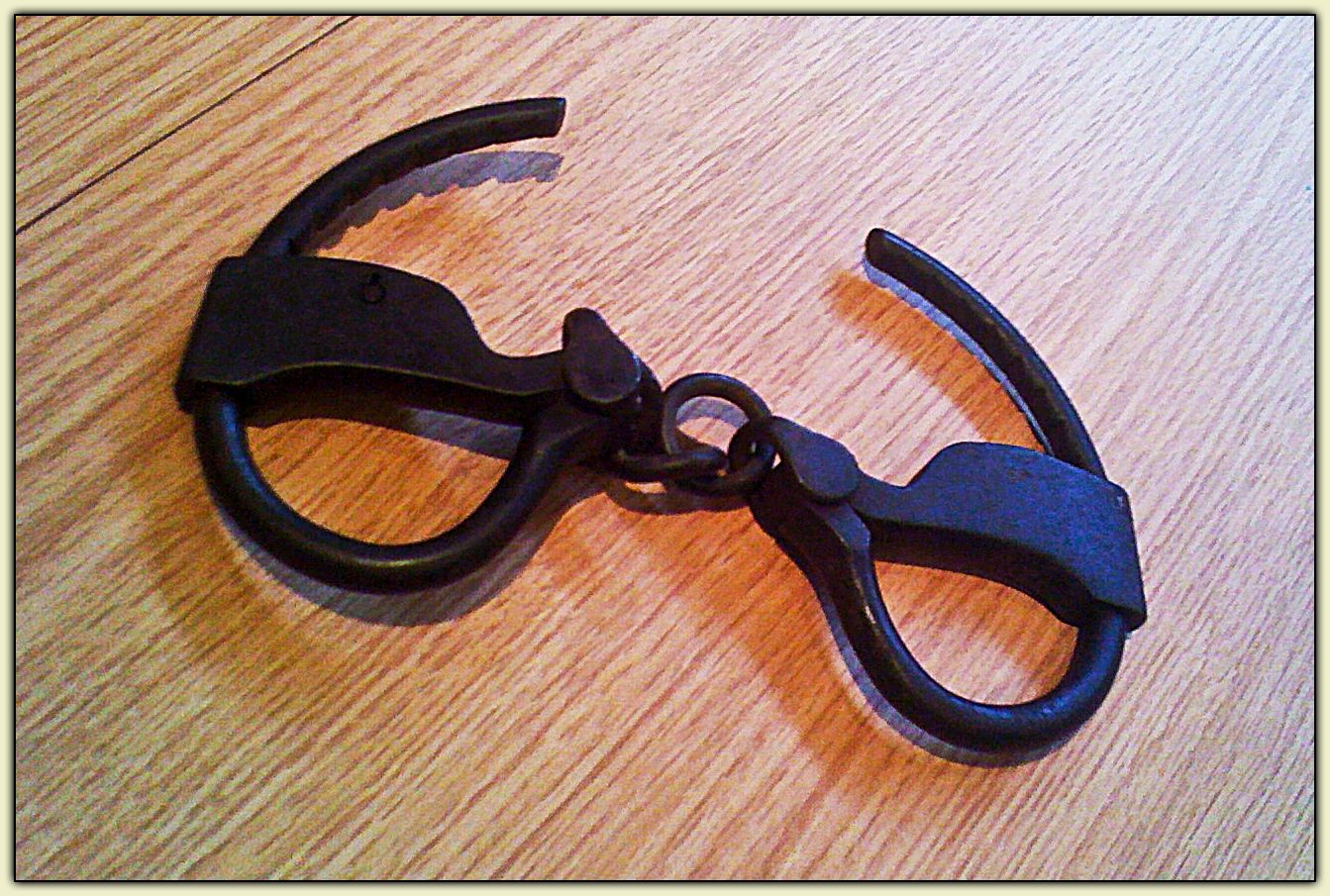
Manacles, believed to be the ones used on Leo Frank during his abduction. [Van Pearlberg; photo Elisson]
There’s a nondescript spot on Georgia Route 120 - Roswell Road, as it is known heareabouts - just over seven miles from my home in East Cobb County, just a few feet past the Interstate 75 underpass. It’s where the old Frey’s Gin Road used to be, and today it’s a stone’s throw from Marietta’s iconic landmark, the Big Chicken. I was just a few hundred feet away from that spot yesterday as I stopped in at Harry’s Farmer’s Market to pick up a few foodly odds and ends.
It’s a nondescript spot, but one with a tragic historical significance. One hundred years ago today, that is where Leo Frank was lynched.
Leo Frank’s story is a long and complicated one, one that still resonates powerfully today. But for years, it was spoken of in hushed tones if at all - by the perpetrators of the lynching and their descendants; and by the members of the local community, both Jewish and gentile. Discussion would not bring back the dead; discussion could only arouse old grievances, hates, and bitter feelings. But when an event is shrouded in silence, we learn nothing from it - including how to prevent similar tragedies in the future.
For those who are completely unfamiliar with the case, the bare-bones outline is as follows: On April 26, 1913, Mary Phagan of Marietta, Georgia - a thirteen-year-old employee of the National Pencil Factory in Atlanta - went to the factory to pick up her wages from Leo Frank, the factory superintendent. The following morning, her dead body was discovered in the basement. The investigation, rife with inconsistencies, eventually settled on Frank as the prime suspect, and an arrest followed. Frank was found guilty after a sensational trial. Appeals were denied; he was sentenced to hang. But two days before his term ended, then-Governor Slayton, who had become concerned that Frank’s trial could not possibly have been fair given the relentless media attention and the highly charged public opinion that prevailed, commuted Frank’s sentence to life in prison.
There was a group of state and Cobb county notables that were not having any part of what they perceived as a gross miscarriage of justice. They quietly laid plans to have Frank kidnapped from the state prison farm in Milledgeville where he had been lodged (and where an attempt on his life by a fellow prisoner had barely missed succeeding) - and on the night of August 16, 1915, an army of Mariettan stealth-ninjas extricated Frank from prison without a single shot being fired. After a seven-hour drive up country roads in the dead of night, the kidnappers arrived in Marietta. After alerting the locals - a lynching, after all, is no lynching without a crowd of excited locals to observe and cheer - Frank was hanged from an oak tree, his body left dangling for hours.
None of the kidnappers or members of the lynch party, and none of the conspirators who had made their dark arrangements, were ever charged with any crime... mainly because the people who would normally have been expected to enforce the law were all in on it.
There were profound implications. Jews who had been a part of the local community for decades understandably felt unwelcome; many deserted the South permanently. Members of a revitalized Ku Klux Klan burned a cross atop nearby Stone Mountain; on the other side of the cultural divide, the relatively new Anti-Defamation League found a sense of purpose. And the case receded into the shadows.
But in the mid-1980’s one Alonzo Mann, who had worked at the pencil factory as Leo Frank’s office boy, came forward to state that, on that fateful day in April 1913, he had seen Jim Conley, the janitor, carrying a girl’s body down to the basement. Conley had threatened to kill Mann if he spoke a word about what he had seen... and Mann, whose parents had sternly instructed him to keep his mouth shut, was never able to offer any exonerating testimony at Frank’s trial. Now Conley was dead, and an elderly, ailing Mann finally felt that it was time to speak out.
The authorities, of course, had been aware of Conley, and had briefly considered him a suspect. But Frank was a much better catch. Conley was just another black man, while Frank represented everything the average Southerner, only fifty years after the Late Unpleasantness, had come to resent. He was a wealthy, Ivy League-educated Northerner - and a Jew to boot. If he could be convicted, why, it would fit hand-in-glove with the narrative of continued Northern rapine and pillaging of the South. And one of those Christ-killers, too! We have us a real monster, boys!
Little Mary Phagan deserved justice. Instead, she got a circus.
Frank has since been pardoned by the State. His pardon did not address the matter of guilt or innocence in the Phagan murder, but was a recognition of the fact that the State had failed to try him fairly or to protect his person. Author Steve Oney, who researched the case for a full seventeen years before writing his book And The Dead Shall Rise: The Murder of Mary Phagan and the Lynching of Leo Frank, has said that he is 98% sure that Frank was innocent... but given the age of the case, there is always that nagging two-percent doubt. But - at least in my mind - Frank’s accusers failed to prove beyond a reasonable doubt that he was guilty. Spectacularly failed.
But that mattered not. So strong was their belief in his guilt - pumped up by firebrand populist demagogues such as Tom Watson, publisher of The Jeffersonian - that facts were mere inconveniences to be swept away or ignored. The mobs chanted “Hang the Jew - or we’ll hang you!” during the trial, and an ad-hoc committee of the finest Mariettans eventually gave them what they wanted.
It is an object lesson on what happens when we allow ourselves to be carried on the tide of public opinion without taking the time to critically examine facts. When the narrative becomes a substitute for reality, we are in Deep Trouble... a tale especially cautionary in our days of social media, where everyone with a Twitter or Facebook account is a potential Tom Watson shouting into an echo chamber of like-minded souls.
It’s a full century later, and Cobb County now is home to a thriving Jewish community. It is where I have lived for over a third of my life. Meanwhile, I hope the ghosts of Mary Phagan - the first innocent victim of this tragedy - and Leo Frank, who was a victim no less than little Mary, are in Heaven sitting together, bemoaning the cruelty and stupidity of the humans that put them there before it was their time... and yet hoping for a better future for all of us.

Update: Steve Oney, in an article in The New Republic, writes about how the Frank lynching foreshadowed today’s polarized political climate.
Saturday, August 15, 2015
ON REFLECTION
“Va-yivra Elohim et ha-adam b’tzalmo; b’tzelem Elohim bara oto...” (And God created man in His image; in the image of God [He] created him...) - Genesis 1:27
“For a human being stamps many coins with one stamp, and all of them are alike; but the King of the kings of kings, the Holy One, blessed be He, has stamped every man with the stamp of Adam the First, and nevertheless not one of them is like the other. Therefore every man may say: The world was created for my sake, hence I must be upright, just, etc....” - Babylonian Talmud (Tractate Sanhedrin, Chapter IV, Mishna III)
* * *
During our morning services today, the topic of discussion was how we humans were created b’tzelem Elohim - in the image of God, as it is phrased so eloquently in the Scriptures. But what can this mean? Our Deity is eternal and invisible, without form or body, unlike we mortal humans. How can we claim to be made in the image of God?
It occurred to me that God, though He cannot be seen directly, can nevertheless be seen by reflection. [In this manner we see that God is the exact opposite of the Transylvanian vampire.] And we - we mortal humans - are the reflected images of God.
The quality of that reflection, of course, is highly variable... because every individual is reflected in a different, unique mirror. Some of those mirrors are nearly flawless, but that is the exception. Most of us are reflected through mirrors that are cracked or distorted... in some cases, veritable funhouse mirrors, the shiny surfaces of which may be obscured by grime, bespattered (so to speak) with an encrustation of sins and misdeeds.
There’s good news: We all have the capability of doing good, of helping to repair the world in a myriad of small ways, of being better people... and when our actions take us in those directions, we scrape away some of the crud that diminishes our reflected images. Spiritual Windex, you could say. And if our personal mirrors are warped or cracked, what of it? We can still try to keep them as clean as possible, for even a distorted reflection carries the image of God within it. Humans don’t need to be perfect, after all - what is required of us is that we do the best we can.
“For a human being stamps many coins with one stamp, and all of them are alike; but the King of the kings of kings, the Holy One, blessed be He, has stamped every man with the stamp of Adam the First, and nevertheless not one of them is like the other. Therefore every man may say: The world was created for my sake, hence I must be upright, just, etc....” - Babylonian Talmud (Tractate Sanhedrin, Chapter IV, Mishna III)
During our morning services today, the topic of discussion was how we humans were created b’tzelem Elohim - in the image of God, as it is phrased so eloquently in the Scriptures. But what can this mean? Our Deity is eternal and invisible, without form or body, unlike we mortal humans. How can we claim to be made in the image of God?
It occurred to me that God, though He cannot be seen directly, can nevertheless be seen by reflection. [In this manner we see that God is the exact opposite of the Transylvanian vampire.] And we - we mortal humans - are the reflected images of God.
The quality of that reflection, of course, is highly variable... because every individual is reflected in a different, unique mirror. Some of those mirrors are nearly flawless, but that is the exception. Most of us are reflected through mirrors that are cracked or distorted... in some cases, veritable funhouse mirrors, the shiny surfaces of which may be obscured by grime, bespattered (so to speak) with an encrustation of sins and misdeeds.
There’s good news: We all have the capability of doing good, of helping to repair the world in a myriad of small ways, of being better people... and when our actions take us in those directions, we scrape away some of the crud that diminishes our reflected images. Spiritual Windex, you could say. And if our personal mirrors are warped or cracked, what of it? We can still try to keep them as clean as possible, for even a distorted reflection carries the image of God within it. Humans don’t need to be perfect, after all - what is required of us is that we do the best we can.
Thursday, August 13, 2015
WOBBLE

I sing you these words of great renown:
Weebles wobble but they don’t fall down.
Whether nude or wearing a dressing gown,
Weebles wobble but they don’t fall down.
Furrow your brow with a thoughtful frown:
Weebles wobble but they don’t fall down.
In an ocean of wisdom your soul will drown:
Weebles wobble but they don’t fall down.
As sure as Bozo’s a red-haired clown,
Weebles wobble but they don’t fall down.
Shout it from the tallest tower in town:
Weebles wobble but they don’t fall down.
Wear this knowledge like a golden crown:
Weebles wobble but they don’t fall down.
Weebles wobble but they don’t fall down.
Weebles wobble but they don’t fall down.
[Image credit: The Life of JWo]
TAKING THE CURE

When people used to speak of “taking the cure,” they’d be talking about visiting the spa in order to enjoy the hot mineral waters. But not me.
I take the cure and rub it all over my meat.
No, I’m not trying to go all Nasty Grandpa on you, dear Esteemed Reader. I’m talking about charcuterie: the fine art of curing meat.
Yesterday I finished making a nice batch of pastrami. You take whatever meat product you’re using - usually a beef brisket - and apply a rub composed of curing salt (salt and sodium nitrite), black pepper, ground coriander, brown sugar, and garlic. After the meat has cured for a week, you rinse it off, soak it in water to remove excess salt, and then cover it in a mixture of black pepper, ground coriander, garlic, and powdered smoke. Bake it at 250°F over a pan of hot water until cooked through, then steam. Presto: hot pastrami!
The amazing peppery, garlicky fragrance that wafts through the house? That’s just a bonus. (The Glade and Air Wick folks can eat their hearts out.)

Pastrami... fresh out of the oven.
You wanna kick it up a notch? Simple: make it out of duck breast instead of beef brisket.
Ohhhh, yeah.
Update: Duck pastrami and scrambled eggs. Need I say more?
Tuesday, August 11, 2015
IN WHICH I DESPOIL A SCIENCE FICTION CLASSIC
Science fiction fans will remember Frank Herbert’s 1965 novel Dune, a landmark work that eventually gave rise to a whole series of books. Herbert ended up writing six Dune novels in total, ranging in quality from “meh” to “excellent,” with none of the sequels quite measuring up to the original. (After his death, his son Brian, along with collaborator Kevin J. Anderson, would milk the property relentlessly with additional sequels and prequels.)
Dune was a rarity: a science fiction novel set in a fully realized imaginary universe, one that had a complex society, technology that was simultaneously highly advanced and yet limited in comparison with our own, and memorable characters. It cried out to be filmed, yet was so intricate as to be practically unfilmable. That did not stop people like Arthur P. Jacobs and Alejandro Jodorowsky from trying, although they never succeeded in getting a project off the ground... too damn bad, because that film would have been amazing. (Imagine Dune as envisioned by H. R. Giger. Yeah, that H. R. Giger.)
Instead, after a decade or so of Development Hell, executive producer Dino De Laurentiis hired David Lynch to write and direct his own version of Dune. At first blush, one would think that the creative mind behind films such as Eraserhead and The Elephant Man - not to mention the enigmatic television series Twin Peaks - would be just the person to bring Dune to the big screen with the appropriate creative vision. One would, alas, be wrong.
The 1984 De Laurentiis production of Dune was, to put it mildly, disappointing. The art and set design were the sole bright spots in a movie that featured weird voiceovers, huge narrative and motivational gaps, and plenty of scenery chewing. That’s too bad: the property deserved so much better.
It had its moments. Kyle MacLachlan and Sting in a knife fight! Sting wearing a glorified diaper! Mentat Piter de Vries (played by Brad Dourif with majorly bushy eyebrows, a complete 180° turn from his later, eyebrowless portrayal of Grima Wormtongue in the LOTR films) mumbling the Mentat Mantra, a glorious piece of nonsense Lynch created for the film:
Nevertheless, some people see something salvageable in this glorious mess of a film. At least, film editor Michael Warren did. He decided to patch together the original theatrical film along with numerous deleted scenes, storyboards, and extended television footage to create what he thinks is a New and Improved Dune, which he was kind enough to upload to Vimeo.
Is it any good? Well, I just started watching it, so it’s too early to say. But one thing caught my eye, and that was some of the early footage that featured illustrations of José Ferrer in his role as the Padishah Emperor Shaddam IV. Why, that face and uniform looked sorta... familiar!

General Elisson and the Padishah Emperor. Separated at birth?
Update: It appears that the video has been taken down, no doubt because of the spike in attention it received as a result of the Digg link. Perhaps the nice folks at Universal had some intellectual property concerns.
Oh, well. That’ll save me the three hours I would have pissed away watching the thing.
Dune was a rarity: a science fiction novel set in a fully realized imaginary universe, one that had a complex society, technology that was simultaneously highly advanced and yet limited in comparison with our own, and memorable characters. It cried out to be filmed, yet was so intricate as to be practically unfilmable. That did not stop people like Arthur P. Jacobs and Alejandro Jodorowsky from trying, although they never succeeded in getting a project off the ground... too damn bad, because that film would have been amazing. (Imagine Dune as envisioned by H. R. Giger. Yeah, that H. R. Giger.)
Instead, after a decade or so of Development Hell, executive producer Dino De Laurentiis hired David Lynch to write and direct his own version of Dune. At first blush, one would think that the creative mind behind films such as Eraserhead and The Elephant Man - not to mention the enigmatic television series Twin Peaks - would be just the person to bring Dune to the big screen with the appropriate creative vision. One would, alas, be wrong.
The 1984 De Laurentiis production of Dune was, to put it mildly, disappointing. The art and set design were the sole bright spots in a movie that featured weird voiceovers, huge narrative and motivational gaps, and plenty of scenery chewing. That’s too bad: the property deserved so much better.
It had its moments. Kyle MacLachlan and Sting in a knife fight! Sting wearing a glorified diaper! Mentat Piter de Vries (played by Brad Dourif with majorly bushy eyebrows, a complete 180° turn from his later, eyebrowless portrayal of Grima Wormtongue in the LOTR films) mumbling the Mentat Mantra, a glorious piece of nonsense Lynch created for the film:
“It is by will alone I set my mind in motion. It is by the juice of sapho that thoughts acquire speed, the lips acquire stains, the stains become a warning. It is by will alone I set my mind in motion.”Baron Harkonnen in his antigravity belt, soaring around the room and laughing like a maniac! And, of course, the bizarre Guild steersmen, so mutated by constant exposure to the melange spice that they resemble giant versions of Donovan’s Brain.
Nevertheless, some people see something salvageable in this glorious mess of a film. At least, film editor Michael Warren did. He decided to patch together the original theatrical film along with numerous deleted scenes, storyboards, and extended television footage to create what he thinks is a New and Improved Dune, which he was kind enough to upload to Vimeo.
Is it any good? Well, I just started watching it, so it’s too early to say. But one thing caught my eye, and that was some of the early footage that featured illustrations of José Ferrer in his role as the Padishah Emperor Shaddam IV. Why, that face and uniform looked sorta... familiar!

General Elisson and the Padishah Emperor. Separated at birth?
Update: It appears that the video has been taken down, no doubt because of the spike in attention it received as a result of the Digg link. Perhaps the nice folks at Universal had some intellectual property concerns.
Oh, well. That’ll save me the three hours I would have pissed away watching the thing.
Tuesday, August 4, 2015
NIHON-NO KAKUTERU

Japanese Cocktail.
This semi-opaque little gem is the Japanese Cocktail (Nihon-no Kakuteru, 日本のカクテル), which is a peculiar name for a drink that complements a French base liquor with tiki ingredients. But I didn’t make the name up.
From what I can glean from my various sources, the cocktail was created by “Professor” Jerry Thomas back in the early 1860’s, the formula having been published in his landmark 1862 anthology How to Mix Drinks, or The Bon-Vivant’s Companion. The name came not from the ingredients - there’s absolutely nothing Japanese about ’em - but (probably) from the fact that the first Japanese mission to the United States was staying in New York at that time.
In its simplest and most original form, a cocktail is simply a base liquor, a sweetener, and bitters. The Old Fashioned, for example uses rye whiskey or bourbon as a base, with sugar or simple syrup as a sweetener and, most commonly, Angostura bitters. Substitute Cognac for the whiskey and orgeat for the sugar, and you have a Japanese Cocktail. Think of it as a tikified Old Fashioned, or perhaps the bastard child resulting from a hookup between Cognac and marzipan. Mmmmm, marzipan.
Japanese Cocktail
2 ounces Cognac
½ ounce orgeat*
3 dashes Angostura bitters
Combine ingredients in a cocktail shaker with ice. Stir well and strain into a chilled cocktail glass. Garnish with a lemon twist.
*You can use ready-made orgeat, which is expensive and often made with crappy ingredients like high-fructose corn syrup. Or you can make your own.
If you like tiki-style drinks - Mai-Tais and the like - give this fellow a try. It’s a delightful little nip.
Subscribe to:
Posts (Atom)


 Posts